

Running a company in Hong Kong means dealing with the Inland Revenue Department (IRD) every year. The territory’s profits tax system is straightforward compared to many jurisdictions, but missing a deadline or filing incorrectly can trigger penalties that hurt your bottom line. Whether you’re a startup founder, an accountant managing multiple clients, or a foreign entrepreneur setting up shop, understanding what you need to file, when, and how makes all the difference.
Hong Kong companies must file annual profits tax returns within one month of receiving them from the IRD. Incorporated businesses pay 16.5% on assessable profits above HKD 2 million, while the first HKD 2 million is taxed at 8.25%. Unincorporated businesses face 15% and 7.5% respectively. Filing late or inaccurately triggers penalties, interest, and potential prosecution. Keeping proper records and understanding exemptions protects your business.
Who needs to file profits tax in Hong Kong
Every person, partnership, trustee, or body of persons carrying on any trade, profession, or business in Hong Kong must file a profits tax return. This includes companies incorporated locally and foreign companies with a Hong Kong branch or office.
The key test is whether you’re conducting business in Hong Kong, not whether you’re incorporated here. A Singapore company that operates a warehouse and sales team in Hong Kong needs to file. A British company that only invoices Hong Kong customers from London typically does not, assuming no permanent establishment exists in the territory.
Even if your company made a loss or had no income during the year, you still need to file. The IRD wants to see your financial position regardless of profitability.
Dormant companies can apply for exemption, but you must formally notify the IRD and meet specific criteria. Simply not trading isn’t enough to skip filing.
Understanding the two-tier tax rate system
Hong Kong introduced a two-tier profits tax regime in 2018 to help smaller businesses. The system works like this:
For corporations, the first HKD 2 million of assessable profits is taxed at 8.25%. Anything above that is taxed at 16.5%.
For unincorporated businesses like sole proprietorships and partnerships, the first HKD 2 million is taxed at 7.5%, with the remainder at 15%.
Only one entity within a connected group of companies can claim the lower rate. If you own three companies, you must choose which one benefits. The other two pay the standard rate on all profits.
This prevents large corporate groups from splitting operations across multiple entities just to multiply the tax benefit.
What counts as assessable profits
Assessable profits are your company’s net profit arising in or derived from Hong Kong, adjusted for tax purposes. Start with your accounting profit, then make adjustments based on tax rules.
You can deduct expenses that are revenue in nature, wholly and exclusively incurred in producing assessable profits. Salaries, rent, utilities, and office supplies usually qualify.
Capital expenditures don’t qualify for immediate deduction. Buying a delivery van is capital. Repairing that van is revenue.
Depreciation shown in your accounts isn’t tax deductible, but you can claim capital allowances on qualifying assets instead. These allowances follow specific rates set by the IRD.
Entertainment expenses face restrictions. General entertainment is typically not deductible, but staff entertainment often is.
Donations to approved charities are deductible up to 35% of your assessable profits.
The territorial source principle
Hong Kong only taxes profits that arise in or are derived from the territory. This territorial principle is what makes Hong Kong attractive for international business.
Determining source can get complex. The IRD looks at where the operations that produce the profit take place, not where contracts are signed or where customers are located.
If you manufacture goods in Shenzhen, store them in Hong Kong, and sell them to customers in Europe, part of your profit might be offshore. The manufacturing happens outside Hong Kong, but the storage and logistics happen inside.
If you buy goods from overseas suppliers and sell them to overseas customers, with all contracts negotiated from your Hong Kong office, those profits are typically onshore because the profit-generating activities occur here.
The IRD publishes Departmental Interpretation and Practice Notes (DIPNs) that explain how they apply the source rules to different business models. DIPN 21 covers profits from trading activities.
Forms you’ll need to complete
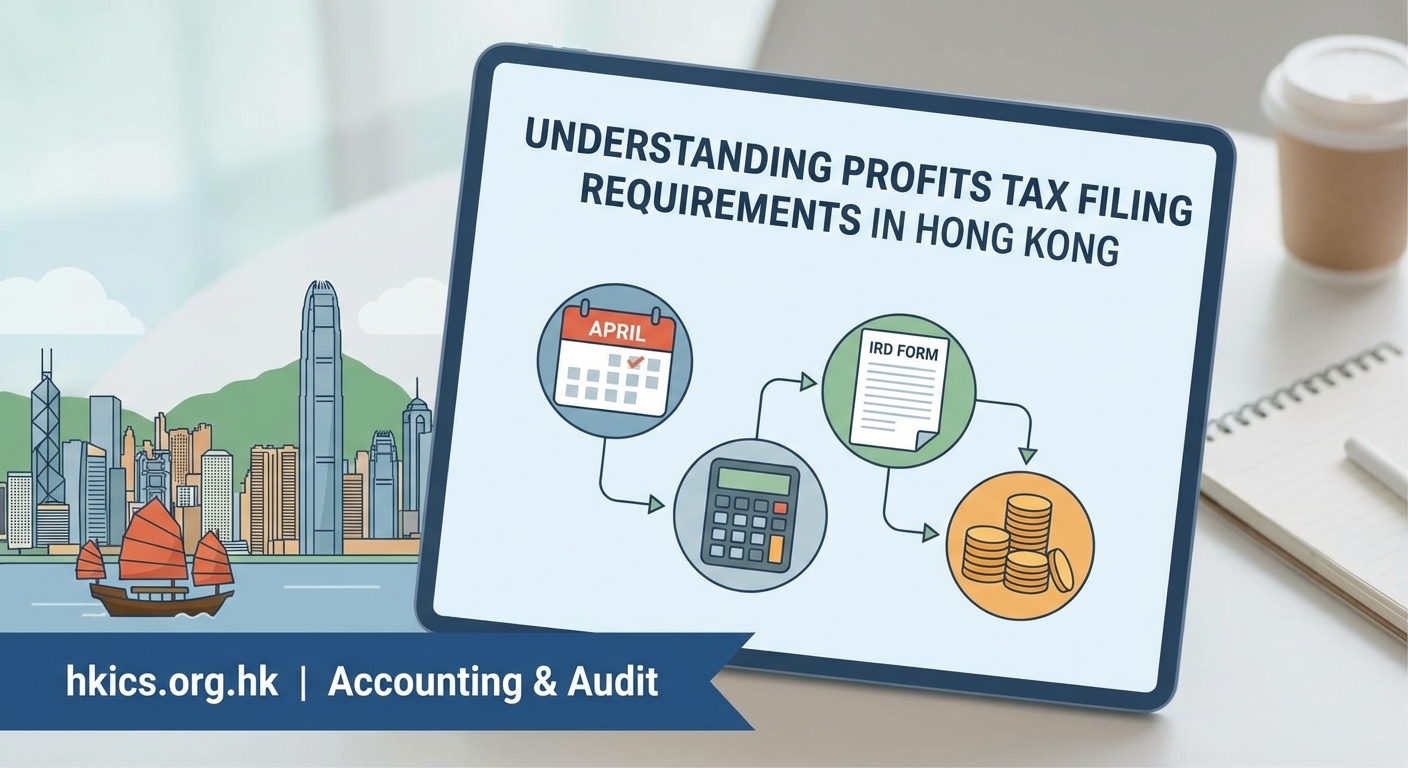
The IRD issues profits tax returns annually, usually in April. You’ll receive either a BIR51 (for corporations) or BIR52 (for unincorporated businesses).
The return asks for basic information about your business, your accounting period, and your profits or losses. You must attach audited financial statements if you’re a limited company.
Even if you’re not required by the Companies Ordinance to audit your accounts, the IRD typically expects audited statements from corporations. Unincorporated businesses can submit unaudited accounts.
You’ll also need to complete tax computation schedules showing how you arrived at your assessable profits from your accounting profits. This includes adding back non-deductible expenses and claiming capital allowances.
If you’re claiming the two-tier rate, you need to complete the relevant section and confirm that no other connected entity is claiming it.
Filing deadlines you can’t miss
The standard deadline is one month from the date of issue printed on your tax return. Most returns are issued in early April, making the deadline early May.
If your accounts are handled by a tax representative who’s a member of an approved professional body, you can benefit from extended deadlines. These typically fall in mid-August for April year-ends, with later dates for other year-ends.
The extended deadlines only apply if your tax representative notifies the IRD that they’re handling your return and agrees to the block extension arrangement.
Missing the deadline triggers automatic penalties. The first penalty is HKD 1,200. If you continue to ignore the return, the IRD can issue estimated assessments and impose additional penalties up to three times the tax underpaid.
Interest accrues on late payments at rates that change periodically but hover around 4% to 6% per year.
Common filing mistakes and how to avoid them
| Mistake | Why it happens | How to prevent it |
|---|---|---|
| Missing the deadline | Relying on old calendar dates instead of checking the actual return | Set alerts when returns arrive, not based on last year’s dates |
| Not adjusting for non-deductible expenses | Using accounting profit without tax adjustments | Review each expense category against IRD rules |
| Claiming two-tier rates in multiple companies | Forgetting about connected entity restrictions | Document which entity claims the benefit each year |
| Overstating offshore profits | Wishful thinking about source rules | Apply the operations test honestly, get professional advice |
| Poor record keeping | Treating tax filing as a once-a-year event | Maintain organized records throughout the year |
| Not disclosing all income sources | Overlooking small revenue streams | Review all bank accounts and revenue channels |
Step-by-step filing process
- Receive your profits tax return from the IRD, usually in April.
- Gather your financial statements, accounting records, and supporting documents for the relevant year of assessment.
- Prepare your tax computation, adjusting accounting profits for tax purposes by adding back non-deductible items and claiming allowable deductions and capital allowances.
- Complete the tax return form, ensuring all sections are filled accurately and all required attachments are included.
- Have your tax representative review everything if you’re using one, or double-check your work if filing independently.
- Submit the return and payment before the deadline, keeping copies of everything for your records.
- Wait for the IRD to issue a notice of assessment, which confirms the tax payable or refundable.
- Pay any additional tax due or claim any refund owed based on the final assessment.
What happens if you disagree with an assessment
The IRD sometimes issues assessments that differ from what you filed. This might happen because they questioned certain deductions or challenged your source claims.
You have the right to object. The objection must be in writing and filed within one month of the date of the assessment notice.
Your objection should clearly state the grounds for disagreement and provide supporting evidence. Simply saying you disagree isn’t enough. Explain why the IRD’s position is wrong and what the correct treatment should be.
The IRD will review your objection and either revise the assessment, maintain it, or request more information. This process can take months.
If you can’t reach agreement, you can appeal to the Board of Review, an independent tribunal. Cases can go further to the courts if needed, but most disputes settle before that point.
Pay the tax shown on the assessment even while objecting. You can claim a refund if you win, but not paying triggers penalties and interest. The IRD can hold payment over if you demonstrate financial hardship, but this requires a formal application.
Exemptions and special situations
Certain types of income are exempt from profits tax. Dividends received from other Hong Kong companies are exempt because the underlying profits were already taxed. Capital gains aren’t taxed in Hong Kong, so selling your office building at a profit typically doesn’t create a tax liability.
Offshore funds and qualifying corporate treasury centers can claim exemptions under specific conditions. These require advance applications and strict compliance with detailed rules.
Shipping companies can elect for tonnage tax instead of profits tax. This substitutes a calculation based on vessel tonnage for the normal profit-based approach.
Newly incorporated companies sometimes qualify for loss relief provisions that let them carry back losses to earlier years or carry them forward indefinitely.
Record keeping requirements
The IRD requires you to keep sufficient records to enable your assessable profits to be readily ascertained. This means more than just bank statements.
You need invoices, receipts, contracts, correspondence, and accounting records. Digital records are acceptable if properly maintained and accessible.
The retention period is seven years from the end of the year of assessment. For the 2023/24 year of assessment, you need to keep records until at least 2031.
The IRD can request to inspect your records. Failing to produce them can result in prosecution and fines up to HKD 100,000.
Good record keeping also protects you during audits. Being able to quickly produce supporting documents for claimed expenses or offshore profit calculations makes the process smoother and builds credibility with the assessor.
Working with tax representatives
Most Hong Kong companies use tax representatives to handle their profits tax filings. These are typically accountants or tax specialists registered with professional bodies.
A good tax representative does more than fill out forms. They advise on legitimate tax planning, ensure you claim all available deductions, and help you avoid common pitfalls.
They also provide peace of mind. Tax rules change, and keeping up with amendments, new DIPNs, and case law takes time you might not have.
The cost varies based on your company’s complexity. A simple trading company with straightforward accounts might pay HKD 5,000 to HKD 10,000. Complex structures with offshore claims or multiple revenue streams cost more.
Choose someone with relevant experience in your industry. A tax advisor who specializes in property development might not be the best fit for a tech startup.
Penalties for non-compliance
The IRD takes compliance seriously. Penalties escalate based on the severity and repetition of violations.
Late filing without reasonable excuse triggers a fixed penalty of HKD 1,200. Continued failure can lead to prosecution and fines up to HKD 10,000, plus a further HKD 1,000 for each day the offense continues.
Filing an incorrect return without reasonable excuse can result in penalties up to three times the amount of tax undercharged.
Deliberately filing false returns or evading tax is a criminal offense. Convicted individuals face fines up to HKD 50,000 plus three times the tax evaded, and imprisonment up to three years.
The IRD distinguishes between honest mistakes and deliberate evasion. If you discover an error after filing, voluntarily disclosing it typically results in lighter treatment than waiting for the IRD to find it during an audit.
Planning ahead for next year
Don’t wait until you receive next year’s return to start preparing. Good tax planning happens throughout the year.
Keep your accounting records current. Monthly bookkeeping is easier than scrambling to reconstruct a year’s worth of transactions in April.
Review your expense policies to ensure business spending is properly documented. A dinner receipt without notation of who attended and the business purpose might not be accepted.
Consider timing of major expenditures. Buying qualifying equipment before year end might generate capital allowances that reduce this year’s tax bill.
If you’re expanding internationally, think about how new operations affect your Hong Kong tax position. Setting up structures properly from the start is easier than untangling them later.
Meet with your tax advisor mid-year to review your position and identify planning opportunities. Waiting until year end limits your options.
Making compliance work for your business
Understanding Hong Kong profits tax filing requirements isn’t just about avoiding penalties. It’s about running your business efficiently and making informed decisions.
The territorial tax system rewards businesses that genuinely operate across borders. Properly documenting where your profit-generating activities occur can significantly reduce your tax burden.
The two-tier rate system gives smaller businesses real savings. Making sure you claim it correctly protects those savings.
Accurate filing and good record keeping also build credibility with banks, investors, and business partners. A company that handles its tax obligations professionally signals that it handles everything else professionally too.
Start with the basics: know your deadlines, keep good records, and don’t guess about complex issues. When something feels uncertain, get professional advice. The cost of that advice is almost always less than the cost of getting it wrong.
Your profits tax return is due one month after you receive it. Mark that date now, set up your systems, and make compliance a routine part of running your Hong Kong business.