

The world of business is changing faster than most organizations can adapt. What worked five years ago feels outdated today, and the pace of transformation is only accelerating. Understanding the business trends next 10 years means looking beyond quarterly reports to see the fundamental shifts reshaping how companies operate, compete, and create value.
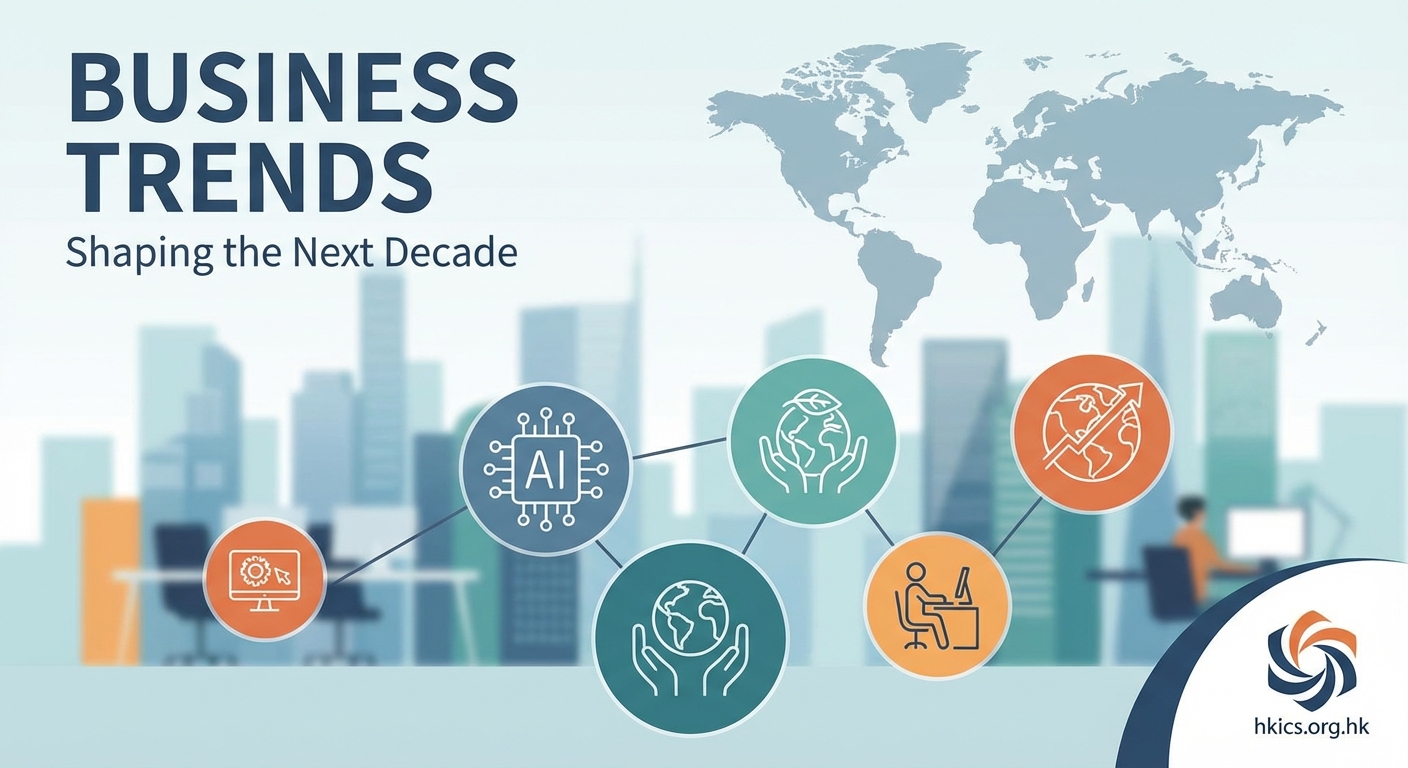
The next decade will be defined by artificial intelligence integration, climate-driven business models, workforce transformation, regulatory complexity, and technology convergence. Organizations that proactively adapt to these forces will gain competitive advantages, while those that wait risk obsolescence. Success requires balancing innovation with governance, sustainability with profitability, and automation with human capability. Strategic planning must account for interconnected global systems and rapid technological change.
Artificial intelligence becomes infrastructure
AI is moving from experimental technology to essential infrastructure. By 2035, businesses without AI integration will face the same disadvantages as companies without internet access did in 2005.
The shift is already visible. Companies are embedding machine learning into core operations, from customer service to supply chain management. What makes this trend different from previous technology waves is the breadth of application.
AI will reshape decision making at every organizational level. Junior employees will have AI assistants handling routine analysis. Middle managers will use predictive models for resource allocation. Executives will rely on AI for scenario planning and risk assessment.
The challenge is not whether to adopt AI, but how to do it responsibly. Organizations need governance frameworks that address bias, transparency, and accountability. Companies that build ethical AI practices now will avoid regulatory problems and reputation damage later.
The organizations that thrive will treat AI as a capability to enhance human judgment, not replace it. The goal is augmentation, not automation for its own sake.
Climate considerations drive business models
Environmental sustainability is transitioning from corporate social responsibility to core business strategy. Regulatory pressure, investor demands, and consumer preferences are making climate considerations unavoidable.
Carbon accounting will become as routine as financial accounting. Companies will need to measure, report, and reduce emissions across their entire value chain. This creates both challenges and opportunities.
New business models are emerging around circular economy principles:
- Product-as-a-service models that incentivize durability over planned obsolescence
- Reverse logistics systems that recapture materials for reuse
- Regenerative practices that restore natural systems while generating profit
- Carbon markets that create financial value from emission reductions
- Green financing structures that reward sustainable operations
The transition will be messy. Some industries face existential pressure to transform. Others will find competitive advantages in early adaptation. Smart organizations are already repositioning for a carbon-constrained economy.
Workforce structures undergo fundamental change
The traditional employment model is fragmenting. By 2035, the line between employee, contractor, and partner will be increasingly blurred.
Several forces are driving this transformation. Remote work technology enables global talent access. Younger workers prioritize flexibility and purpose over job security. Automation is eliminating routine tasks while creating demand for uniquely human skills.
Companies will need new approaches to talent:
- Build ecosystems of contributors rather than hierarchical employee structures
- Develop skills-based assignment systems that match capabilities to projects dynamically
- Create compelling value propositions beyond salary and benefits
- Invest in continuous learning infrastructure that keeps capabilities current
- Design hybrid work environments that balance flexibility with collaboration
The human element becomes more valuable as routine work disappears. Creativity, judgment, empathy, and complex problem solving cannot be easily automated. Organizations that cultivate these capabilities will outperform competitors focused purely on efficiency.
Leadership requirements are changing too. Managing distributed teams across time zones and employment models demands different skills than traditional office management. The ability to build culture and alignment without physical proximity becomes critical.
Regulatory complexity multiplies across borders
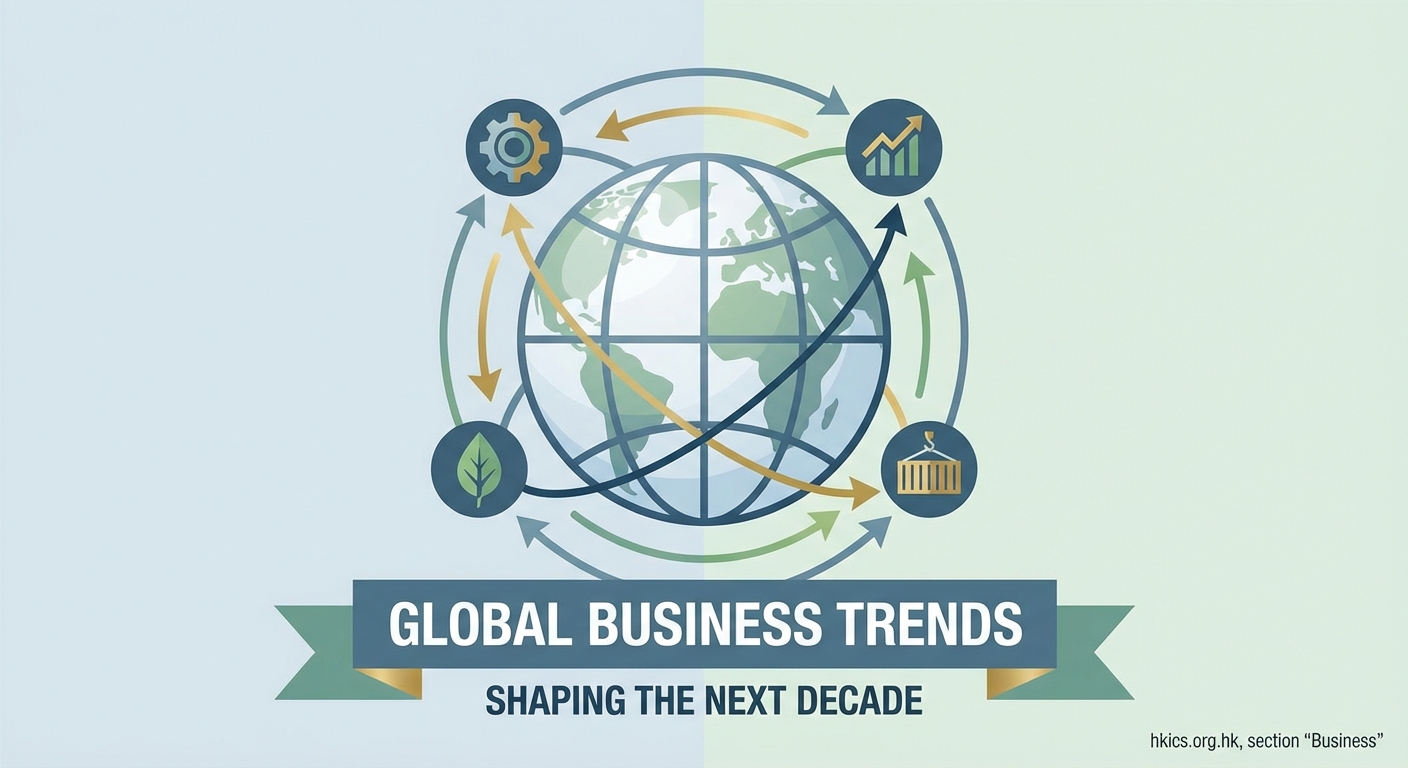
As business becomes more global and digital, regulatory frameworks are struggling to keep pace. The next decade will see ongoing tension between innovation speed and governance development.
Companies operating internationally face a patchwork of conflicting requirements. Data privacy rules vary by jurisdiction. Tax authorities are developing new approaches to digital commerce. Environmental regulations are tightening in some markets while remaining lax in others.
This creates several challenges:
| Challenge | Impact | Response Strategy |
|---|---|---|
| Compliance costs | Rising expense burden | Invest in automated compliance systems |
| Regulatory uncertainty | Difficulty planning investments | Build flexible operational models |
| Jurisdictional conflicts | Legal exposure in multiple markets | Develop robust governance frameworks |
| Rapid rule changes | Constant adaptation required | Create dedicated regulatory intelligence functions |
| Enforcement variation | Inconsistent risk across regions | Implement highest common standard approach |
The smartest organizations will treat regulatory complexity as a competitive advantage. Strong governance and compliance capabilities become barriers to entry that protect market position.
Proactive engagement with regulators also matters. Companies that help shape emerging rules often get frameworks that work better for their business models. Waiting for regulations to be imposed means accepting whatever constraints result.
Technology convergence creates new possibilities
Individual technologies are powerful. Combined technologies are transformative. The next decade will see accelerating convergence between previously separate domains.
Artificial intelligence plus biotechnology enables personalized medicine and synthetic biology applications. Internet of things plus blockchain creates transparent supply chains and automated contracts. Quantum computing plus materials science could revolutionize battery technology and energy storage.
These combinations create opportunities that did not exist before. They also create risks. The same technologies that enable beneficial applications can be misused. Organizations need to think carefully about second and third order effects of technology deployment.
The pace of change means that technology strategy cannot be static. Companies need processes for continuous scanning, evaluation, and adaptation. What seems like science fiction today may be standard practice in five years.
Geopolitical shifts reshape global commerce
The post-World War II global trading system is under pressure. Rising nationalism, strategic competition between major powers, and concerns about supply chain resilience are fragmenting global markets.
Businesses face difficult choices about where to operate and how to structure international activities. Some trends to watch:
- Regionalization of supply chains to reduce vulnerability
- Friend-shoring that prioritizes political alignment over pure cost efficiency
- Technology decoupling between competing spheres of influence
- Increased scrutiny of cross-border investment and data flows
- Growing importance of trade corridor infrastructure
These shifts require scenario planning that accounts for multiple possible futures. Companies that optimize for a single global market may find themselves exposed if fragmentation accelerates.
At the same time, opportunities exist in emerging markets that are growing faster than developed economies. The challenge is balancing growth potential against political and operational risks.
Data becomes the most valuable asset
Organizations have always collected information, but the volume, variety, and velocity of data available today is unprecedented. The ability to capture, analyze, and act on data is becoming the primary source of competitive advantage.
This goes beyond traditional business intelligence. Real-time data from sensors, transactions, and interactions enables new capabilities:
- Predictive maintenance that prevents equipment failures before they occur
- Dynamic pricing that optimizes revenue based on demand signals
- Personalized experiences that adapt to individual customer preferences
- Risk detection systems that identify threats as they emerge
- Automated decision making for routine operational choices
The challenge is turning data into insight and insight into action. Many organizations are drowning in data while starving for wisdom. Building the analytical capabilities and organizational processes to extract value from information requires sustained investment.
Privacy and security considerations are also critical. Data breaches damage reputation and trigger regulatory penalties. Organizations need robust data governance that balances utilization with protection.
Customer expectations continue rising
Digital natives are becoming the dominant consumer demographic. Their expectations, shaped by experiences with leading technology platforms, are spreading across all industries.
Customers now expect:
- Instant access to information and services
- Seamless experiences across channels and devices
- Personalization based on their preferences and history
- Transparent pricing and business practices
- Alignment with their values on social and environmental issues
Meeting these expectations requires rethinking customer experience from the ground up. Traditional approaches based on transactions and touchpoints are giving way to journey-based design and relationship building.
The bar keeps rising. What delights customers today becomes table stakes tomorrow. Organizations need continuous innovation in customer experience to maintain competitive position.
Health and wellness integrate into business
The pandemic accelerated awareness of health’s importance to organizational performance. This trend will continue expanding over the next decade.
Forward-thinking companies are moving beyond basic health insurance to comprehensive wellness programs. Mental health support, ergonomic work environments, fitness incentives, and nutrition programs are becoming standard benefits.
The business case is clear. Healthier employees are more productive, take less sick time, and stay with organizations longer. The costs of wellness programs are offset by reduced healthcare expenses and improved performance.
This trend extends to products and services too. Consumers increasingly favor offerings that support health and wellbeing. Companies that integrate wellness into their value propositions tap into growing market demand.
Financial systems evolve with digital currencies
Central banks are developing digital currencies. Cryptocurrencies are maturing beyond speculation. Blockchain technology is enabling new forms of value transfer and contract execution.
The financial infrastructure that underpins business is changing. These shifts will affect how companies manage treasury operations, conduct international transactions, and access capital.
Digital currencies could reduce transaction costs and settlement times. They could also increase transparency and traceability in financial flows. The transition will create winners and losers among financial intermediaries.
Smart contracts that execute automatically when conditions are met could transform procurement, insurance, and many other business processes. The technology is still maturing, but the potential is significant.
Organizations need to monitor these developments and prepare for a financial system that looks different from today’s. Early adopters of new payment rails and financial technologies may gain efficiency advantages.
Preparing your organization for what comes next
The business trends next 10 years will not unfold in isolation. They will interact, amplify, and occasionally contradict each other. Organizations that thrive will be those that develop capabilities for continuous adaptation.
Start by building awareness systems that track changes in your industry and adjacent domains. Create space for strategic thinking that goes beyond immediate operational demands. Invest in capabilities that provide flexibility to respond as conditions change.
The future will not be a straight-line projection of the present. Surprises are inevitable. But organizations that understand the major forces reshaping business can position themselves to capitalize on opportunities and manage risks as they emerge.
The next decade will reward those who act with informed confidence, balancing the courage to change with the wisdom to preserve what works. Your strategic choices today will determine your competitive position tomorrow.