

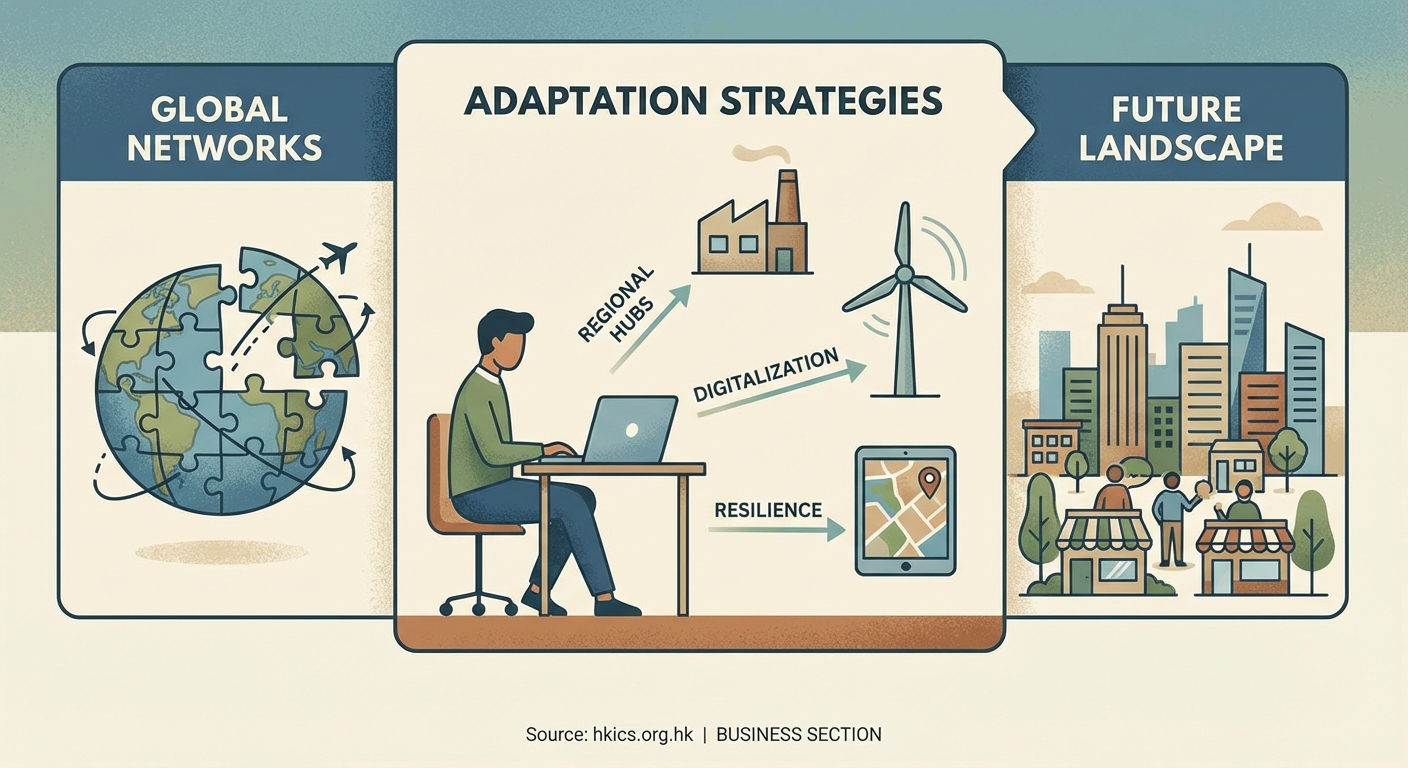
The world economy is shifting. For decades, businesses built strategies around open borders, seamless trade, and global supply chains. Now, geopolitical tensions, pandemic disruptions, and rising nationalism are forcing a rethink. Companies that thrived on globalization must now adapt to a post-globalization reality where regionalization, resilience, and flexibility matter more than scale alone.
Businesses adapt to post-globalization by restructuring supply chains closer to home, building regional strategies, diversifying suppliers, investing in digital infrastructure, and prioritizing operational resilience. Success requires balancing efficiency with flexibility, understanding local regulations, and preparing for continued geopolitical uncertainty. Companies that move early gain competitive advantages in this shifting landscape.
Understanding the shift from globalization to regionalization
Globalization promised efficiency through specialization. Companies could manufacture in one country, assemble in another, and sell worldwide. That model worked when trade was predictable and borders stayed open.
Things changed. Trade wars created tariff uncertainty. Pandemic lockdowns exposed supply chain fragility. Geopolitical tensions made single-source dependencies risky. Energy costs and shipping disruptions added volatility.
The result is deglobalization, where companies prioritize security and resilience over pure cost optimization. This does not mean the end of international trade. It means businesses are rethinking how, where, and with whom they operate.
Regional trade blocs are growing stronger. Companies are shortening supply chains. Manufacturing is moving closer to end markets. These shifts create both challenges and opportunities for strategic leaders.
Core strategies businesses use to adapt

Nearshoring and reshoring production
Moving production closer to home markets reduces transit time, lowers geopolitical risk, and improves supply chain visibility. Nearshoring places manufacturing in nearby countries. Reshoring brings it back domestically.
A U.S. electronics company might shift assembly from Asia to Mexico. A European automaker might move component production from China to Poland. Both reduce exposure to distant disruptions.
Benefits include:
- Faster response to demand changes
- Lower shipping costs and carbon footprint
- Better quality control and intellectual property protection
- Reduced tariff exposure in trade disputes
Challenges include higher labor costs and the need to rebuild supplier networks. Companies must weigh these against the value of stability and speed.
Building supplier diversity
Relying on a single supplier or country creates vulnerability. Smart businesses now cultivate multiple sources across different regions.
This strategy requires more complex management but provides insurance against disruptions. If one supplier faces problems, others can compensate.
“The companies that survive deglobalization are those that treat supplier relationships as strategic assets, not just cost centers. Redundancy is no longer waste. It’s resilience.”
Supplier diversity works best when companies maintain active relationships with backup vendors, not just lists of potential alternatives. This means regular communication, smaller trial orders, and shared forecasting.
Regionalizing business models
Instead of one global strategy, leading companies now develop distinct regional approaches. This means adapting products, marketing, and operations to specific geographic markets.
A consumer goods company might maintain separate supply chains for North America, Europe, and Asia. Each region gets tailored inventory, pricing, and distribution strategies.
Regional autonomy allows faster decision making and better local market fit. It also insulates other regions when one faces disruptions.
Operational changes driving adaptation
Digital infrastructure investment
Technology enables flexibility. Cloud platforms, data analytics, and automation help companies manage complex, distributed operations.
Digital twins simulate supply chain scenarios. AI predicts disruptions before they cascade. Blockchain improves transparency across multi-tier supplier networks.
These tools matter more in a fragmented world. When you cannot rely on stable, predictable trade flows, you need better information and faster decision making.
Inventory strategy shifts
Just-in-time inventory minimized costs during stable times. Now, many businesses are adding strategic buffers for critical components.
This does not mean returning to bloated warehouses. It means smarter inventory placement, better demand forecasting, and clear priorities about which items need safety stock.
Companies are also regionalizing inventory, storing products closer to customers rather than centralizing in a few global hubs.
Compliance and regulatory adaptation
Deglobalization brings more complex regulatory environments. Different regions impose unique requirements for data privacy, labor standards, environmental rules, and trade documentation.
Businesses must build compliance capabilities for multiple jurisdictions simultaneously. This requires legal expertise, documentation systems, and ongoing monitoring of regulatory changes.
Companies that master multi-jurisdictional compliance gain competitive advantages. They can operate where others struggle.
Practical implementation framework
Here is how businesses systematically adapt their operations:
-
Assess current vulnerabilities. Map your supply chain from raw materials to customer delivery. Identify single points of failure, geopolitical risks, and long lead times. Quantify the potential impact of disruptions.
-
Prioritize critical components. Not everything needs immediate restructuring. Focus on items that are business-critical, have long lead times, or come from high-risk sources. Create a phased implementation plan.
-
Build regional supplier networks. Research alternative suppliers in different geographic regions. Start with small test orders to evaluate quality, reliability, and communication. Gradually shift volume as confidence grows.
-
Invest in enabling technology. Implement systems that provide supply chain visibility, scenario planning, and rapid communication. Train teams on new tools and processes.
-
Develop regional strategies. Assign clear ownership for each geographic market. Give regional leaders authority to make local decisions within overall strategic guidelines. Create feedback loops to share learning across regions.
-
Establish resilience metrics. Track not just cost and efficiency, but also supply chain flexibility, time to recovery, and supplier diversity. Make resilience part of performance evaluations.
Common mistakes and better approaches
| Mistake | Better Approach |
|---|---|
| Pursuing lowest cost without considering risk | Calculate total cost of ownership including disruption probability and impact |
| Maintaining only paper relationships with backup suppliers | Regularly place small orders with alternative sources to keep relationships active |
| Centralizing all decision making at headquarters | Empower regional teams with authority and resources to respond to local conditions |
| Treating adaptation as a one-time project | Build continuous monitoring and adjustment into standard operations |
| Ignoring mid-tier suppliers in risk assessment | Map the full supply chain including sub-suppliers who may create hidden vulnerabilities |
| Assuming globalization trends will reverse completely | Plan for a hybrid future with both global and regional elements |
Financial and strategic considerations
Adapting to post-globalization requires investment. Nearshoring typically increases direct costs. Supplier diversity adds complexity. Regional strategies need local expertise.
These costs are real but must be weighed against the price of disruption. A single supply chain failure can cost more than years of resilience investment.
Smart companies treat adaptation as strategic positioning, not just risk management. Being able to serve customers reliably when competitors cannot creates market share gains that offset higher operating costs.
Financial planning should account for:
- Higher initial setup costs for new supplier relationships
- Ongoing complexity costs from managing multiple sources
- Technology investments in visibility and planning tools
- Working capital increases from strategic inventory
- Potential efficiency losses from smaller scale in each region
These investments pay off through reduced disruption risk, faster market response, and competitive differentiation.
Industry-specific adaptation patterns
Different sectors face unique post-globalization challenges.
Manufacturing focuses on nearshoring production and securing critical component supplies. Companies are building regional production networks that can serve nearby markets independently.
Technology balances global talent access with data sovereignty requirements. Many are creating regional cloud infrastructures and development centers.
Retail shortens fashion and consumer goods supply chains to improve responsiveness. Fast fashion companies are moving production closer to major markets.
Pharmaceuticals must navigate complex regulatory requirements while ensuring medicine availability. Many are diversifying active ingredient sources and building regional production capacity.
Financial services adapt to fragmented regulatory environments and data localization requirements. Regional hubs are replacing some centralized global operations.
Understanding your industry’s specific pressures helps prioritize adaptation efforts.
Building organizational capabilities
Successful adaptation requires new skills and mindsets throughout the organization.
Procurement teams need risk assessment capabilities beyond cost negotiation. Supply chain managers must balance efficiency with resilience. Regional leaders need autonomy and strategic thinking.
Training programs should cover:
- Geopolitical risk analysis
- Multi-criteria decision making that includes resilience factors
- Scenario planning and contingency development
- Cross-cultural communication for diverse supplier relationships
- Regulatory compliance across jurisdictions
Leadership must model the new priorities. When executives consistently choose resilient options even at higher cost, the organization learns that stability matters.
Measuring success in a post-globalization world
Traditional metrics like unit cost and inventory turns remain important but incomplete. Add measures that capture resilience and flexibility:
- Supply chain recovery time after disruptions
- Percentage of critical components with qualified backup suppliers
- Geographic distribution of supply base
- Time from order to customer delivery by region
- Regulatory compliance incident rate
- Supplier relationship health scores
Track these alongside financial metrics to get a complete picture of organizational health.
Making adaptation work for your organization
Start small. Pick one product line or geographic region as a pilot. Test new approaches, learn from results, and scale what works.
Build cross-functional teams that include procurement, operations, finance, and regional leaders. Adaptation requires coordination across traditional silos.
Communicate clearly about why changes matter. Help teams understand the strategic context so they support rather than resist new approaches.
Stay flexible. The post-globalization landscape continues evolving. What works today may need adjustment tomorrow. Build learning and adaptation into your standard processes.
Positioning for long-term success
Post-globalization is not a temporary disruption. It represents a fundamental shift in how the world economy operates. Companies that adapt thoughtfully will gain advantages that compound over time.
The businesses thriving in this environment share common traits. They balance global reach with regional strength. They invest in relationships, not just transactions. They treat resilience as a competitive advantage, not a cost center.
Your adaptation journey starts with honest assessment of current vulnerabilities and clear priorities about what matters most. Build incrementally, learn continuously, and stay committed to the long-term vision.
The companies that move decisively now will define the next era of international business. Those that cling to old globalization models will find themselves increasingly vulnerable. The choice is clear, and the time to act is today.