How to File Form NSC2 for a Share Buy-Back or Redemption in Hong Kong
File Form NSC2 with the Hong Kong Companies Registry to report a share buy-back or redemption.
NSC2 at a glance
- Official title
- Return of Share Redemption or Buy-back
- Issued by
- Companies Registry
- e-Filing
- Available
We link the issuing authority's own index rather than hosting a copy, because the form is revised there and an out-of-date copy is worse than none.
What Is Form NSC2 Hong Kong?
Form NSC2 is the specified form a Hong Kong company files with the Companies Registry to report the buy-back or redemption of its own shares. The form is prescribed under the Companies Ordinance (Cap. 622). It is the mechanism through which the registry records a reduction in issued share capital by way of a share repurchase or a redemption of redeemable shares. Filing Form NSC2 is a statutory obligation, not an optional disclosure. Failure to file within the prescribed period is an offence that can result in a fine and, for a continuing default, a daily penalty.
One-Month Filing Requirement for the Share Buy-Back Return
Deliver the form to the Companies Registry within one month of the date the shares were bought back or redeemed. The one-month period runs from the transaction date, not from the date the board resolved to approve it. If the last day of the month falls on a public holiday, the due date is the next business day.
File through the Companies Registry e-Services portal or by paper. Electronic filing permits same-day registration if received before the cut-off time. Paper filing takes longer because the document must be manually processed. The registration fee is HK$20 online or HK$25 on paper. Late filing attracts a higher registration fee, and the company and every responsible officer may be prosecuted.
Information Required on the NSC2 Filing Hong Kong
The NSC2 filing requires the company to provide:
- The number and class of shares bought back or redeemed
- The amount of consideration paid
- The date the shares were bought back or redeemed
- The company's share capital before and after the transaction
- The aggregate amount of any premium paid (if any)
- The manner in which the buy-back or redemption was effected, for example, a purchase on a recognised stock exchange, an off-market purchase approved by resolution, or a redemption in accordance with the company's articles
Report each class of shares separately. If the buy-back involved more than one class, the form should contain a separate line item for each class. The specified form prompts for the currency of the consideration, but the entry must be in Hong Kong dollars unless the company's share capital is maintained in another currency.
How the Hong Kong Share Redemption Return Works
A Hong Kong share redemption return is filed when a company redeems shares issued as redeemable shares. The company's articles must authorise the issue and redemption of redeemable shares. The redemption must be made out of distributable profits or the proceeds of a fresh issue of shares made for the purpose. The return records that the shares have been cancelled on redemption and that the company's issued share capital has been reduced accordingly.
The form is identical to the buy-back return. The Companies Ordinance treats both buy-backs and redemptions as events requiring the same return. The Registrar does not distinguish between a redemption of redeemable shares and a purchase by the company of its own shares on the market. Both are reported on NSC2.
Capital Maintenance Rules Under Cap. 622
The Companies Ordinance (Cap. 622) contains strict capital maintenance rules governing share buy-backs and redemptions. A company may only buy back its own shares out of:
- Distributable profits
- The proceeds of a fresh issue of shares made for the purpose
- The company's share premium account, if the articles permit
The company must remain solvent after the buy-back or redemption. The directors must make a solvency statement in the prescribed form before the transaction takes place, confirming that the company will be able to pay its debts as they fall due for the 12 months following the transaction. Directors who make a solvency statement without reasonable grounds are personally liable.
The capital maintenance rules protect creditors by preventing a company from reducing its share capital without adequate justification. A buy-back or redemption that violates these rules is voidable. The directors who authorised it may be required to restore the company to its former position.
Contrast with NSC1 and NSC11
Distinguish Form NSC2 from two other share capital forms:
- NSC1 (Return of Allotment): Filed when a company issues new shares. The deadline is one month from the date of allotment. NSC1 reports an increase in issued share capital; NSC2 reports a decrease.
- NSC11 (Notice of Alteration of Share Capital): Filed when a company alters its share capital in a way that does not involve an allotment or a buy-back, such as a consolidation, sub-division, or conversion of shares. NSC11 is due within one month of the resolution authorising the alteration.
Each form serves a distinct purpose and is filed under a different section of Cap. 622. Using the wrong form will result in rejection by the Companies Registry. Ensure the correct specified form is used for the transaction that has occurred.
Filing the Company's Share Capital Return
A director or company secretary completes the company's share capital return (Form NSC2). The form must be signed by a director or the company secretary. If the company has appointed a shareholder or a professional firm as agent, the agent may also sign. The Companies Registry will refuse a form that is not properly completed or that contains inconsistent information.
For paper filing, send the completed form to the Companies Registry's Companies Facilitation and Licensing Section at 14/F, Queensway Government Offices, 66 Queensway, Hong Kong. Pay the registration fee by cheque payable to "Companies Registry" or by cash at the counter. Electronic filing through the e-Services portal requires a registered user account and payment by credit card or online bank transfer.
What Happens If You Miss the Deadline
Late delivery of Form NSC2 triggers a higher registration fee:
- More than one month but within three months: HK$600
- More than three months but within six months: HK$1,200
- More than six months: HK$2,400
These penalty fees are in addition to the standard registration fee. The company and every responsible officer may also be prosecuted and liable to a fine of HK$5,000 and, for a continuing default, a daily penalty of HK$200.
Practical Steps for the NSC2 Filing
- Determine the exact date of the buy-back or redemption, the closing date of the transaction, not the resolution date.
- Calculate the one-month deadline from that date.
- Complete the form with the number, class, and consideration for each class of shares bought back or redeemed.
- Ensure the solvency statement has been made and is dated no earlier than the date of the buy-back or redemption.
- File through the Companies Registry e-Services portal (recommended) or by paper.
- Retain a certified true copy of the filed form for the company's records. Order a certified true copy from the Companies Registry through its electronic search service for HK$20 per copy.
Where to Obtain Form NSC2
Download the current version of Form NSC2 from the Companies Registry's specified forms index. Always obtain the form directly from the Registry rather than using a copy saved elsewhere. The Registry revises forms periodically and a stale version will be rejected. The same page contains the form's explanatory notes and the relevant sections of Cap. 622.
How to fill out Form NSC2
Page one of the official form. Every field named below appears on it in the same order.
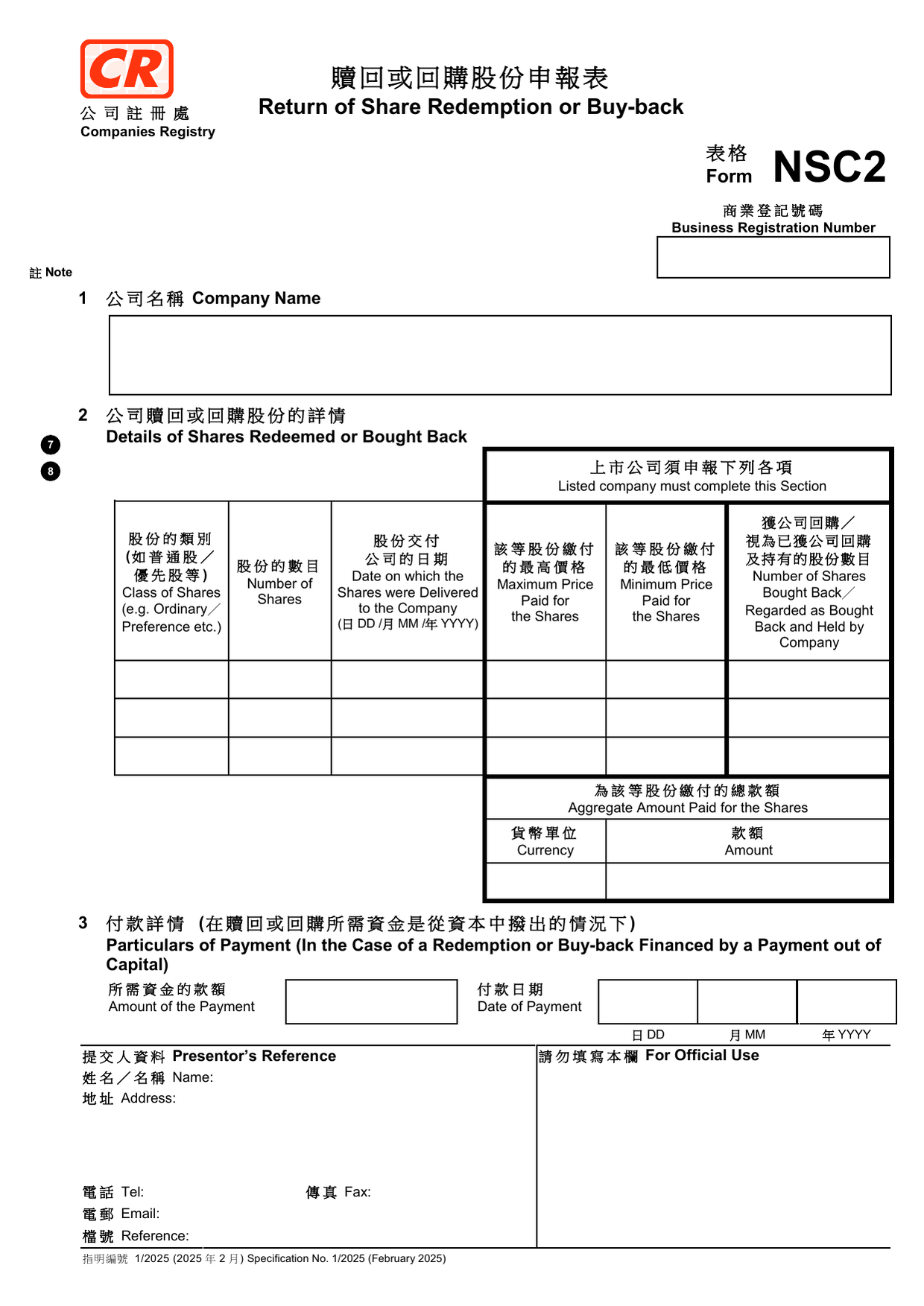
Business Registration Number
Enter the company’s Business Registration number exactly as shown on the Business Registration certificate.
1 Company Name
Enter the full company name as it appears on the Certificate of Incorporation.
2 Details of Shares Redeemed or Bought Back
This section is for listed companies only. For each class of shares (e.g., Ordinary, Preference), complete the following columns: - Class of Shares - specify the class. - Number of Shares - the number redeemed or bought back. - Date on which the Shares were Delivered to the Company - use DD/MM/YYYY format. - Number of Shares Bought Back/Regarded as Bought Back and Held by Company - shares that are cancelled are not included here; only those held in treasury. - Maximum Price Paid and Minimum Price Paid for the shares. - Aggregate Amount Paid for the Shares - enter the currency unit and total amount.
Do not complete Section 2 for private companies.
3 Particulars of Payment (In the Case of a Redemption or Buy-back Financed by a Payment out of Capital)
Complete only if the redemption or buy-back was funded wholly or partly from capital (not profits or a fresh issue). - Amount of the Payment - the capital amount. - Date of Payment - use DD/MM/YYYY format.
Presentor’s Reference
Optional: name, address, telephone, fax, email, and your own file reference.
4 Statement of Capital (As at the Time Immediately After the Redemption or Buy-back)
4A Share Capital
For each class of shares outstanding immediately after the transaction: - Class of Shares - e.g., Ordinary, Preference. - Currency - e.g., HKD, USD. - Total Number of issued shares. - Total Amount - the nominal value (column b). - Total Amount Paid up or Regarded as Paid up - (column a). - Total Amount Unpaid - column a minus column b. If space is insufficient, use Continuation Sheet A.
4B Particulars of Rights Attached to Shares
Complete only if the company has more than one class of shares. For each class, describe the rights: voting, participation in dividend distributions, participation in capital distributions, and whether the shares are redeemable. If space is insufficient, use Continuation Sheet B.
5 Signatures
The form must be signed by a director or a company secretary (delete the inapplicable). Enter the signatory’s name in full, and the date of signing in DD/MM/YYYY format. The signature must be original (not a photocopy or scanned copy for paper filing).
Continuation Sheets
If you use Continuation Sheet A or B, tick the corresponding box under “This Return includes the following Continuation Sheet(s)” and state the total number of pages.
Download the current form - always file the version on the issuing authority's site, not a copy.
Sources
More on the forms library.