

Starting a business in Hong Kong opens doors to one of Asia’s most dynamic markets. The city offers low tax rates, minimal bureaucracy, and a strategic location that connects you to mainland China and Southeast Asia. But before you can start operations, you need to understand what the government actually requires from foreign entrepreneurs who want to incorporate.
Foreign entrepreneurs can incorporate a Hong Kong company without residency requirements. You need at least one director, one shareholder, a registered local address, and a company secretary who resides in Hong Kong. The process takes approximately one week and requires specific documentation including passport copies, proof of address, and business details. No minimum capital requirement exists, making Hong Kong accessible for startups and established businesses alike.
Basic eligibility for foreign business owners
Hong Kong welcomes international entrepreneurs with open arms. You don’t need to be a resident to own or operate a company here. You don’t need a work visa to be a shareholder. You don’t even need to visit Hong Kong to complete the incorporation process.
The government sets only a few baseline requirements. Any individual over 18 years old can serve as a company director. Corporate directors are allowed, but at least one natural person must be on the board. Shareholders face no nationality restrictions whatsoever.
This openness makes Hong Kong one of the most foreigner-friendly jurisdictions in Asia. You can own 100% of your company as a non-resident. You can manage operations remotely. You can hire local staff or work with contractors across borders.
Mandatory company structure elements
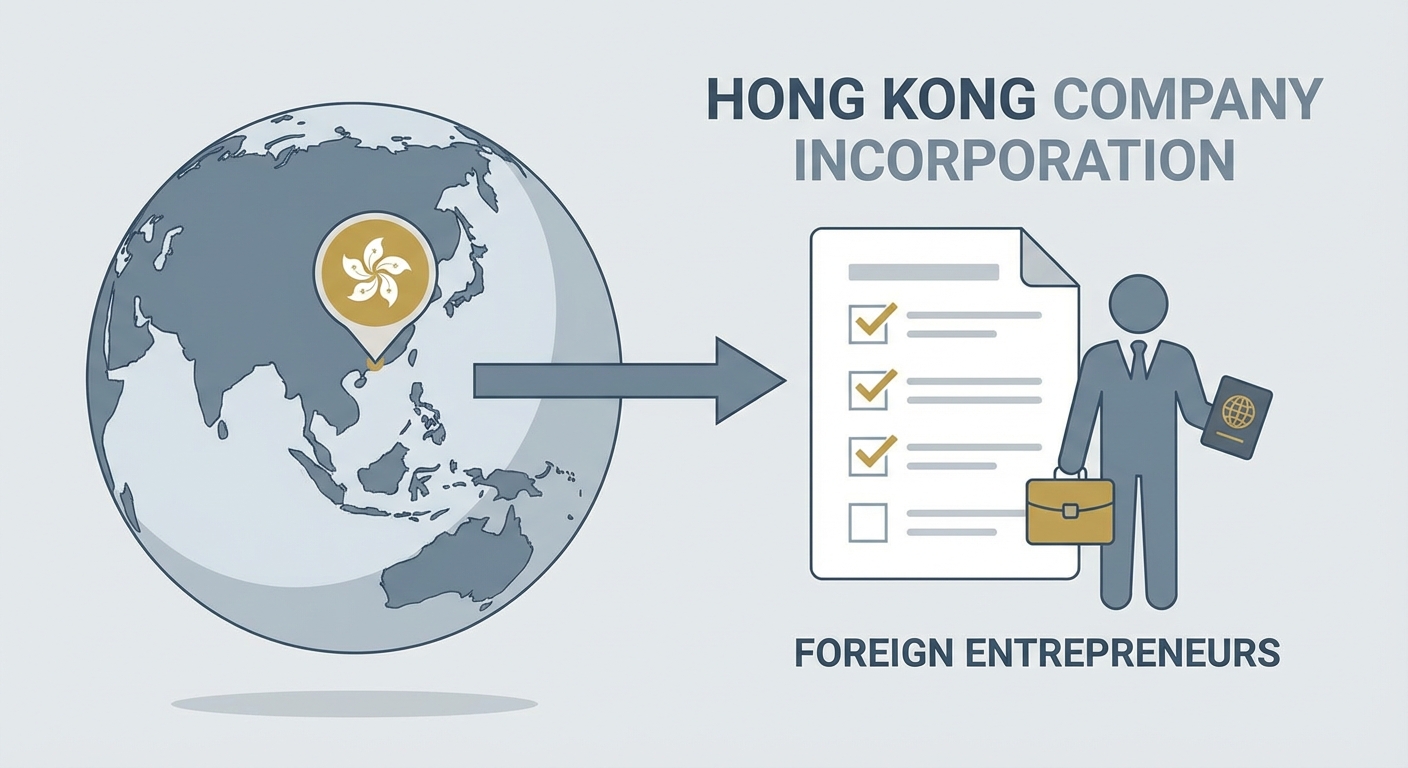
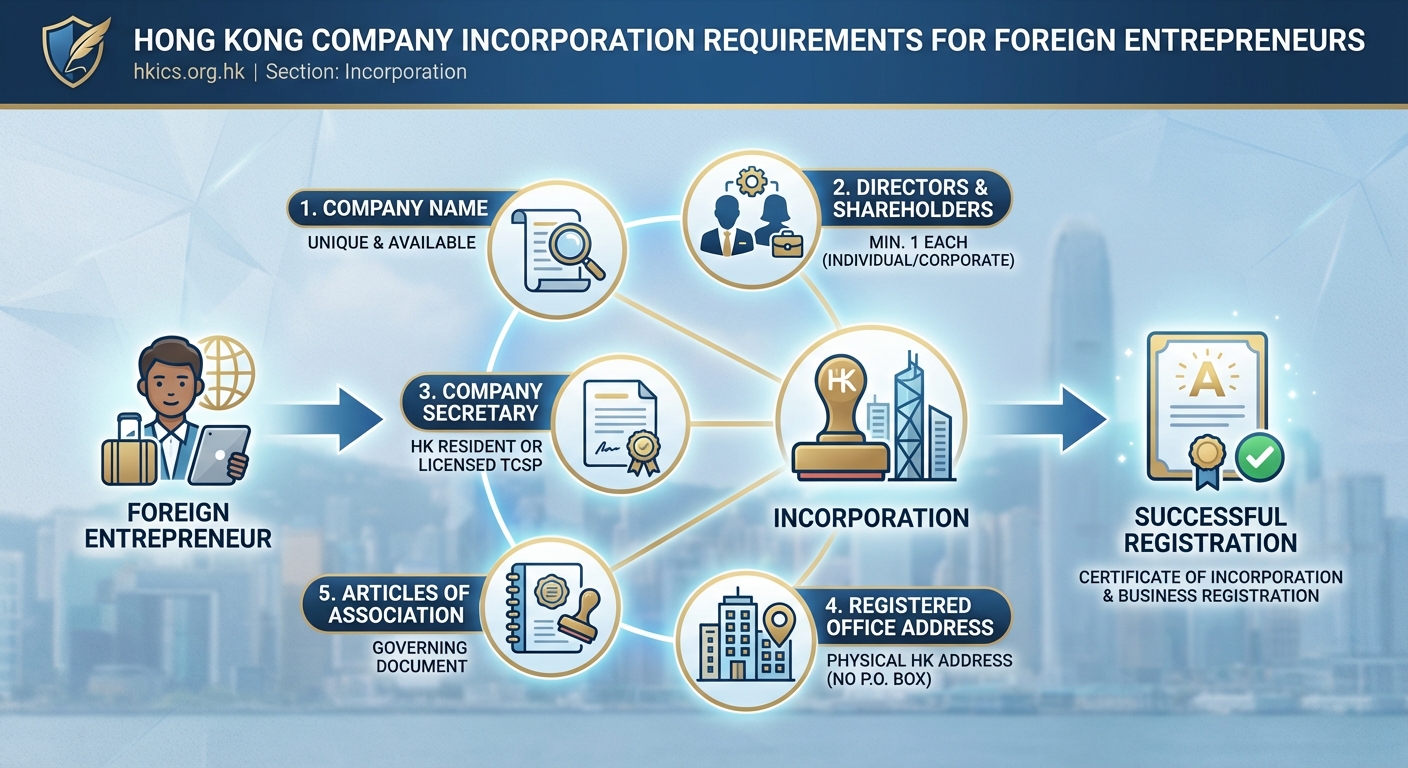
Every Hong Kong private limited company needs four core components. Miss any of these and your application gets rejected.
Company director
At least one director must be appointed. This person can be of any nationality and doesn’t need to live in Hong Kong. Directors hold legal responsibility for company compliance and filing obligations. They sign official documents and represent the company in legal matters.
Shareholder
You need at least one shareholder. The same person can serve as both director and shareholder. Shareholders can be individuals or corporate entities. There’s no upper limit on the number of shareholders you can have.
Company secretary
This role must be filled by either a Hong Kong resident or a Hong Kong registered company. The secretary handles statutory filings, maintains company records, and ensures compliance with the Companies Ordinance. Most foreign entrepreneurs hire a professional corporate services firm for this role.
Registered office address
Your company needs a physical address in Hong Kong. Post office boxes don’t qualify. Virtual offices are acceptable as long as they can receive official correspondence. This address appears on public records and receives government notices.
Documentation you need to provide
Gathering the right paperwork prevents delays. Here’s what you’ll submit during incorporation.
For each director and shareholder:
- Valid passport copy (certified if submitting remotely)
- Proof of residential address dated within the last three months
- Personal information form with contact details
For the company itself:
- Proposed company name (Chinese name optional)
- Business nature description
- Share capital structure details
- Registered office address confirmation
- Articles of Association
The proof of address can be a utility bill, bank statement, or government-issued document. It must show your current residential address clearly. Scanned copies work fine for most service providers.
Share capital considerations
Hong Kong abolished minimum capital requirements years ago. You can incorporate with just HKD 1 if you want. Most companies issue between HKD 10,000 and HKD 100,000 in share capital.
The standard structure uses ordinary shares at HKD 1 par value. You decide how many shares to authorize and how many to issue initially. Unissued shares can be allocated later as needed.
“Setting your initial share capital too low can create administrative hassle later when you need to increase it. Choose a number that gives you flexibility for future fundraising or partner additions without requiring immediate capital calls.” – Corporate governance advisor
Different share classes are allowed. You can create voting and non-voting shares, preference shares, or custom structures. Most startups stick with simple ordinary shares until they need complexity.
Step-by-step incorporation process
The actual filing follows a clear sequence. Professional service providers handle most of these steps, but understanding the flow helps you plan.
-
Name approval: Submit your proposed company name to the Companies Registry. They check for duplicates and restricted words. Approval typically takes one business day.
-
Document preparation: Your service provider prepares the Incorporation Form (NNC1), Articles of Association, and supporting documents. You review and sign where required.
-
Registry submission: The complete package goes to the Companies Registry electronically or in person. Filing fees are paid at this stage.
-
Certificate issuance: Once approved, you receive the Certificate of Incorporation and Business Registration Certificate. This usually happens within four to six business days.
-
Post-incorporation setup: Open a corporate bank account, order company chops (seals), and establish accounting systems.
The entire process from name approval to receiving certificates takes about one week under normal circumstances. Rushed applications can be processed in one business day for an additional fee.
Common mistakes that delay approval
| Mistake | Why it causes problems | How to avoid it |
|---|---|---|
| Choosing a restricted name | Names containing “Bank,” “Insurance,” or “Trust” require special licensing | Check the Companies Registry guidelines before submitting |
| Incomplete address proof | Documents older than three months get rejected | Use recent utility bills or bank statements |
| Missing signatures | Unsigned forms bounce back for correction | Review all signature fields before submission |
| Incorrect share structure | Math errors in share allocation cause rejections | Double-check that issued shares don’t exceed authorized shares |
| Non-compliant secretary | Appointing someone who doesn’t meet residency requirements | Verify your secretary’s Hong Kong residency status |
Ongoing compliance obligations
Incorporation is just the beginning. Hong Kong companies must maintain certain standards after formation.
Annual returns must be filed within 42 days of your company’s anniversary. The Business Registration Certificate renews yearly with an associated fee. You need to maintain proper accounting records and prepare financial statements.
Companies must keep a Significant Controllers Register that identifies anyone owning more than 25% of shares. This register stays at your registered office and must be available for inspection.
Tax returns go to the Inland Revenue Department separately from Companies Registry filings. Even if your company has no assessable profits, you still need to file a tax return when requested.
Bank account opening realities
Getting a corporate bank account deserves special attention. Banks have tightened requirements significantly in recent years.
Most banks want to meet directors in person. Some accept video conferences for initial meetings. You’ll need to explain your business model, expected transaction volumes, and source of funds.
Prepare these documents for your bank meeting:
- Certificate of Incorporation
- Business Registration Certificate
- Articles of Association
- Director and shareholder identification
- Proof of business address
- Business plan or overview
- Expected account activity description
The approval process takes anywhere from two weeks to three months. Banks conduct due diligence on your business activities and background. Having an established business track record helps tremendously.
Cost breakdown for foreign entrepreneurs
Understanding the financial commitment helps with budgeting. Here are typical costs for a standard incorporation.
Government fees run around HKD 1,720 for the Companies Registry filing plus HKD 250 for the Business Registration Certificate. These are mandatory and paid directly to authorities.
Professional service fees vary widely. Budget between HKD 3,000 and HKD 8,000 for a basic incorporation package from a corporate services provider. This typically includes name search, document preparation, filing, and first-year company secretary service.
Additional costs include:
- Registered office address rental: HKD 2,000 to HKD 6,000 annually
- Company seal (chop) production: HKD 300 to HKD 800
- Certified document copies: HKD 100 to HKD 300 per document
- Bank account opening assistance: HKD 2,000 to HKD 5,000
Total first-year costs usually fall between HKD 10,000 and HKD 25,000 depending on service levels and provider choices.
Special considerations for specific industries
Certain business activities require additional licenses or approvals. Financial services, education, food and beverage, import/export, and employment agencies all have sector-specific requirements.
If you plan to hire employees, you’ll need to register for Mandatory Provident Fund (MPF) contributions. This retirement scheme applies to most employees working more than 60 days.
Businesses handling personal data must comply with the Personal Data (Privacy) Ordinance. This affects everything from customer databases to employee records.
Import/export businesses need separate registration with Customs and Excise. Some product categories require specific licenses regardless of company structure.
Why the requirements stay manageable
Hong Kong maintains its reputation as a business-friendly hub by keeping incorporation requirements straightforward. The government wants foreign investment and makes the process as friction-free as possible.
You can incorporate without traveling to Hong Kong. You can own your company entirely as a foreigner. You can operate with minimal ongoing compliance compared to many other jurisdictions.
The key is understanding what’s actually required versus what’s optional. Focus on the four mandatory elements: director, shareholder, secretary, and registered address. Get those right and everything else falls into place.
Most foreign entrepreneurs work with a corporate services provider for their first Hong Kong company. The cost is modest and the time savings substantial. Once you understand the system, subsequent incorporations become routine.
Your Hong Kong company can be operational within two weeks from deciding to incorporate. That speed, combined with low barriers to entry, explains why over 1.4 million companies are registered in this small territory. The requirements exist to maintain order without creating obstacles.