

Choosing between Hong Kong and Singapore for your business incorporation can feel like picking between two star students. Both cities rank as top financial hubs in Asia. Both offer business-friendly environments. Both attract entrepreneurs from around the world.
But they’re not identical twins.
Each location brings distinct advantages, different regulatory frameworks, and unique challenges. Your choice will shape your tax obligations, compliance workload, banking relationships, and market access for years to come.
Hong Kong and Singapore both excel as incorporation destinations, yet differ significantly in taxation, regulatory complexity, and strategic positioning. Hong Kong offers zero capital gains tax and simpler compliance, while Singapore provides extensive tax treaties and government incentives. Your decision should align with your target markets, business model, and operational preferences rather than reputation alone.
Tax systems that actually matter to your bottom line
Tax structure often tops the priority list for international businesses. Both jurisdictions use territorial tax systems, but the details tell different stories.
Hong Kong taxes only profits sourced within its territory. If you earn income from clients in Europe, North America, or other Asian markets, those profits typically remain untaxed. The corporate tax rate sits at 16.5% for profits above HKD 2 million, with a reduced 8.25% rate for the first HKD 2 million.
Capital gains? Zero tax. Dividends received from overseas? Usually exempt. Sales tax or VAT? Doesn’t exist.
Singapore operates differently. While also territorial in principle, the Inland Revenue Authority of Singapore scrutinizes offshore claims more rigorously. The headline corporate tax rate reaches 17%, though effective rates often drop lower through various schemes.
Singapore compensates with an extensive network of tax treaties. The city state maintains over 90 double taxation agreements, compared to Hong Kong’s roughly 45. If you’re doing business across multiple countries, these treaties prevent paying tax twice on the same income.
| Feature | Hong Kong | Singapore |
|---|---|---|
| Corporate tax rate | 8.25% / 16.5% (tiered) | 17% (with incentives available) |
| Capital gains tax | 0% | 0% |
| Tax treaties | ~45 agreements | ~90 agreements |
| Territorial scope | Strictly territorial | Territorial with stricter tests |
| Dividend withholding | 0% | 0% |
Singapore also offers targeted incentives. The Productivity and Innovation Credit scheme, startup tax exemptions, and industry-specific grants can reduce your effective tax burden significantly. Hong Kong takes a simpler approach with fewer schemes but less paperwork.
Setup costs and timeline realities
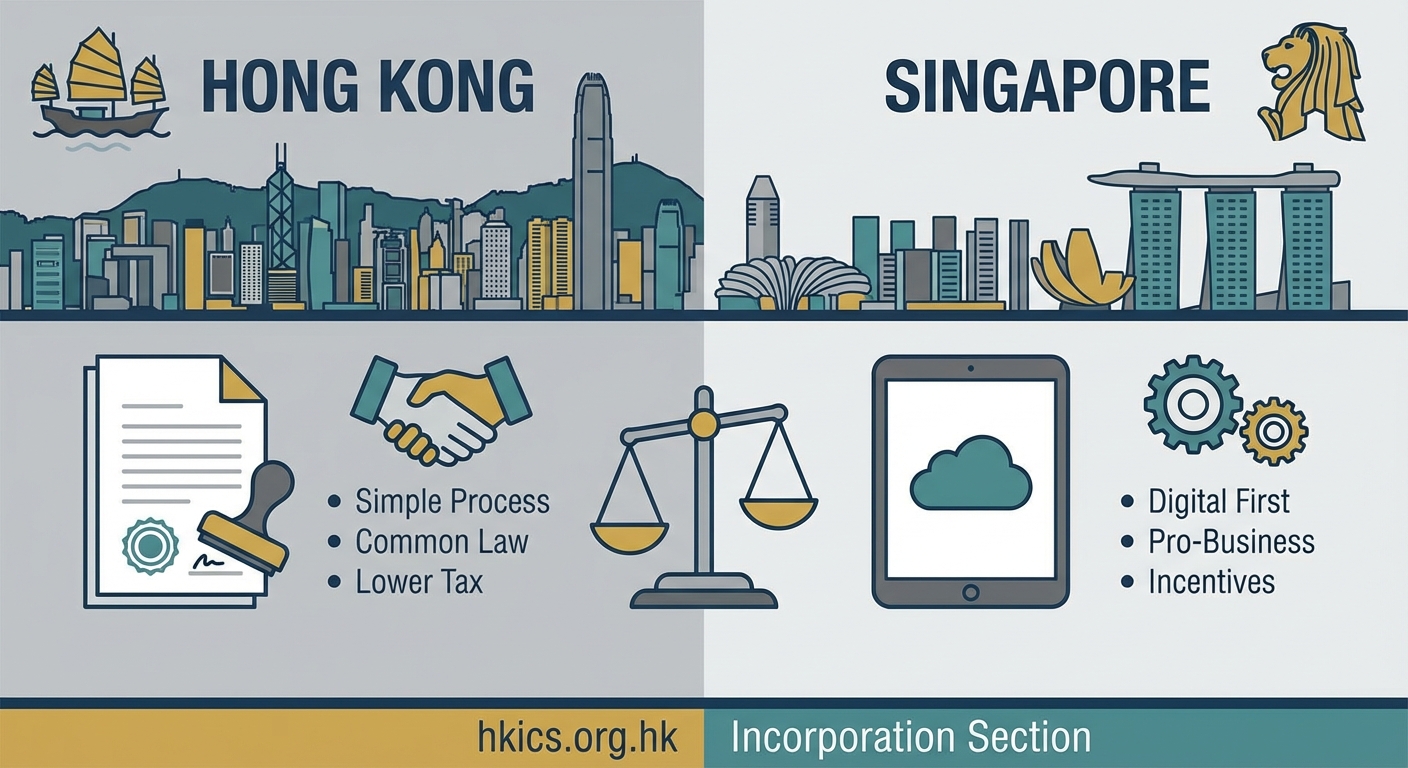
Incorporating in Hong Kong costs less upfront. Government fees run around HKD 1,720 (roughly USD 220). Add professional service fees from a corporate secretary, and you’re looking at USD 500 to 1,000 total for basic incorporation.
The process moves fast. You can receive your Certificate of Incorporation within one to two business days if documents are in order. No minimum capital requirement exists. One director and one shareholder suffice, and they can be the same person.
Singapore charges higher government fees, starting around SGD 315 (approximately USD 235), but professional fees tend to run higher overall. Total setup costs typically range from USD 800 to 1,500.
Timeline? Similar speed. Singapore’s ACRA (Accounting and Corporate Regulatory Authority) processes applications within one to two days for straightforward cases. You’ll need at least one resident director, which adds complexity if you’re not based locally. Many entrepreneurs hire a nominee director to meet this requirement.
Here’s what you need for each location:
Hong Kong requirements:
- Company name approval
- At least one director (any nationality, any residence)
- At least one shareholder (individual or corporate)
- Registered office address in Hong Kong
- Company secretary (individual or corporate, with residency requirements)
Singapore requirements:
- Company name approval
- At least one director who is ordinarily resident in Singapore
- At least one shareholder (individual or corporate)
- Registered office address in Singapore
- Company secretary appointed within six months of incorporation
The resident director requirement in Singapore creates an immediate hurdle. You’ll either need to relocate someone, partner with a local, or engage a professional nominee service. Hong Kong imposes no such restriction.
Compliance workloads that eat your time
Annual compliance in Hong Kong remains relatively light. You’ll file an Annual Return, maintain statutory registers, and submit audited accounts. Most small businesses handle this with a few days of work per year, plus accountant fees.
Hong Kong requires an audit for nearly all companies, regardless of size. This adds cost but also provides clean financials that banks and investors appreciate. Audit fees for small companies start around USD 800 annually.
Singapore demands more ongoing attention. Annual General Meetings must occur within specific timeframes. Financial statements require filing within strict deadlines. The company secretary role carries more active responsibilities.
Singapore does offer audit exemptions for small companies meeting certain criteria. If your annual revenue stays below SGD 10 million, you may skip the audit, saving time and money.
The compliance calendar matters more than people realize. Missing a filing deadline in Singapore triggers automatic penalties. Hong Kong’s system is less automated but still enforces consequences. Build these dates into your operations from day one, not as afterthoughts.
Both cities require maintaining proper accounting records. Both expect timely tax filings. The difference lies in frequency and complexity of interactions with authorities.
Banking access and practical operations
Opening a corporate bank account has grown challenging in both locations. Banks scrutinize new applications heavily due to anti-money laundering regulations.
Hong Kong banks often request extensive documentation. Expect to provide business plans, proof of business activities, client contracts, and source of funds declarations. The process can take weeks or months. Some banks decline applications without clear explanation.
Physical presence helps enormously. Banks prefer meeting directors face to face. If you’re incorporating remotely, account opening becomes significantly harder.
Singapore banks impose similar requirements but generally maintain slightly more openness to international businesses. The Monetary Authority of Singapore pushes banks to support legitimate businesses while maintaining compliance standards.
Alternative solutions exist in both cities. Virtual banks and fintech providers offer faster onboarding with lower balance requirements. Traditional banks typically want minimum deposits of USD 10,000 to 50,000 or more.
Market access and strategic positioning
Geography influences your business differently depending on target markets.
Hong Kong sits on China’s doorstep. The city serves as the primary gateway for businesses entering mainland markets or Chinese companies going global. If your strategy involves China, Hong Kong’s proximity, cultural connections, and special administrative status provide clear advantages.
The Greater Bay Area initiative connects Hong Kong with Macau and nine mainland cities, creating a massive economic zone. Businesses incorporated in Hong Kong can leverage this integration.
Singapore positions itself as the Southeast Asian hub. ASEAN markets, with over 650 million consumers, sit within easy reach. Singapore’s membership in regional trade agreements facilitates access to Indonesia, Malaysia, Thailand, Vietnam, and other growing economies.
Consider these factors:
- Language: English dominates in Singapore. Hong Kong operates bilingually with Cantonese and English, plus growing Mandarin use.
- Legal system: Both use common law, but Hong Kong’s system aligns more closely with UK traditions.
- Talent pool: Singapore invests heavily in attracting international talent. Hong Kong faces housing costs that can deter relocation.
- Political stability: Both cities maintain strong rule of law, though Hong Kong’s relationship with mainland China adds a layer of consideration.
Real costs beyond incorporation fees
Budget for expenses that extend beyond government fees and professional services.
Office space in both cities ranks among the world’s most expensive. Hong Kong’s prime districts command premium rents. Singapore offers slightly more variety, but central locations still cost substantially.
Many businesses use virtual office services initially. These provide a registered address and mail handling for a few hundred dollars monthly. Coworking spaces offer another option, blending flexibility with professional presentation.
Hiring employees brings different cost structures. Hong Kong’s mandatory provident fund requires employer contributions of 5% of salary. Singapore’s Central Provident Fund demands higher contributions, up to 17% of employee wages.
Salary expectations differ by role and industry, but both cities require competitive compensation to attract quality talent. Budget at least USD 3,000 to 5,000 monthly for entry-level professional staff.
Professional services add up. You’ll need:
- Accounting and bookkeeping services
- Annual audit (in most cases)
- Corporate secretarial services
- Legal advice for contracts and compliance
- Tax filing assistance
Annual professional fees for a small business typically range from USD 3,000 to 8,000 across both locations.
Immigration and residency pathways
Neither city automatically grants residency through business incorporation. You’ll need separate visa applications.
Hong Kong offers several routes. The General Employment Policy allows companies to sponsor foreign employees, including directors. The Investment as Entrepreneurs scheme targets business founders, though it requires demonstrating significant contribution to Hong Kong’s economy.
Processing times vary. Employment visas typically take four to six weeks. Bring your patience and complete documentation.
Singapore provides the EntrePass for entrepreneurs. You’ll need to meet criteria around innovation, funding, or business network connections. The pass initially grants one year, renewable based on business performance.
Singapore also offers the Employment Pass for professionals earning above minimum salary thresholds. Companies can sponsor foreign directors through this route.
Both cities eventually offer paths to permanent residency after several years of continuous residence and contribution. Citizenship remains possible but highly selective.
Sector-specific considerations
Certain industries face different regulatory landscapes in each location.
Financial services firms often prefer Singapore due to its extensive licensing frameworks and regulatory clarity. The Monetary Authority of Singapore actively supports fintech innovation through regulatory sandboxes and grant programs.
Hong Kong excels for trading companies, logistics operations, and businesses focused on Greater China markets. The city’s free port status and lack of tariffs on most goods create advantages for import-export operations.
Technology startups find support in both cities. Singapore’s government runs numerous programs through Enterprise Singapore and other agencies. Hong Kong’s Cyberport and Science Park provide incubation facilities and funding opportunities.
Professional services, consulting, and creative industries operate smoothly in both locations. Licensing requirements vary by profession, so research your specific field.
Making your decision with confidence
The hong kong vs singapore business incorporation choice ultimately depends on your specific circumstances rather than abstract rankings.
Choose Hong Kong if:
- Your business targets Greater China markets
- You prefer simpler tax structures with territorial clarity
- Lower setup and compliance costs matter
- You want maximum flexibility in director residency
- Capital gains tax elimination is crucial
Choose Singapore if:
- Southeast Asian markets form your primary focus
- You need extensive tax treaty coverage
- Government grants and incentives align with your sector
- You value slightly more structured regulatory frameworks
- Resident director requirements pose no obstacle
Many successful businesses operate entities in both locations. This dual structure captures advantages from each hub while adding complexity and cost.
Start by clarifying your business model, target markets, and operational preferences. Run the numbers on tax implications for your specific revenue sources. Consider where you’ll realistically spend time and where your team will be based.
Your next steps toward incorporation
Neither Hong Kong nor Singapore represents a wrong choice for most international businesses. Both cities offer world-class infrastructure, business-friendly environments, and access to Asian markets.
The details matter more than the headlines. Your tax situation, compliance capacity, market focus, and personal preferences should drive the decision.
Take time to model your specific scenario. Calculate actual tax obligations under each system. Factor in all costs, not just incorporation fees. Consider where you want to build relationships and establish your operational base.
Your business deserves a foundation that supports growth rather than creating obstacles. Choose the location that aligns with your vision, then commit fully to making it work.