

Every Hong Kong company must keep a set of official records. These aren’t optional documents tucked away in a filing cabinet. They’re legal requirements under the Companies Ordinance, and failing to maintain them properly can result in fines and prosecution.
Hong Kong companies must maintain several statutory registers including members, directors, company secretaries, and significant controllers. Each register has specific content requirements and inspection rights. Companies must keep these records at their registered office or another notified location, update them promptly after changes, and make certain registers available for public inspection. Non-compliance can result in fines up to HKD 50,000 and imprisonment for company officers.
Understanding statutory registers in Hong Kong
Statutory registers are the official books of record for your company. They document who owns shares, who runs the business, and who ultimately controls it.
The Companies Ordinance (Cap. 622) sets out exactly which registers you need to keep. Most companies require at least four core registers, though some businesses need additional ones depending on their structure.
These aren’t just bureaucratic paperwork. They serve real purposes. Investors can verify ownership. Creditors can identify decision makers. Law enforcement can trace beneficial ownership. The government can ensure transparency in the corporate sector.
Think of statutory registers as your company’s permanent memory. They create an auditable trail of every significant change in your corporate structure.
The four essential registers every company needs

Register of members
This register lists everyone who holds shares in your company. It’s the definitive record of ownership.
For each member, you must record:
- Full name and address
- Date of becoming a member
- Date of ceasing to be a member (if applicable)
- Number and class of shares held
- Amount paid or agreed to be paid on each share
- Share certificate number (if issued)
You need to update this register within 15 days of any share transfer or allotment. That deadline matters. Miss it, and both the company and every responsible officer can face fines.
Private companies must keep this register open for inspection by members at no charge. Members of the public can also inspect it, though you can charge a fee.
Register of directors
This register identifies who sits on your board. It includes both executive and non-executive directors.
For each director, record:
- Full name (including any former names used in the past 20 years)
- Residential address
- Correspondence address
- Hong Kong Identity Card number or passport number and issuing country
- Date of birth
- Date of appointment
- Date of cessation (if applicable)
You must update this register within 15 days of any change. That includes new appointments, resignations, and even address changes.
This register is open to public inspection at your registered office. Anyone can view it during business hours, though you can charge a reasonable fee.
Register of company secretaries
Every Hong Kong company must have at least one company secretary. This register tracks who holds that role.
Record the same information you would for a director:
- Full name
- Residential and correspondence addresses
- Identity document details
- Appointment and cessation dates
If your company secretary is a corporate entity rather than an individual, record the corporate name, registered office, and company number instead.
The same 15-day update rule applies. The same public inspection rights exist.
Register of significant controllers
This is the newest mandatory register, introduced in 2018. It identifies who really controls your company, looking beyond just shareholding.
A significant controller is any individual or entity that meets one or more of these conditions:
- Holds more than 25% of shares
- Holds more than 25% of voting rights
- Holds the right to appoint or remove a majority of directors
- Has the right to exercise or actually exercises significant influence or control
For each significant controller, you must record:
- Full name and address
- Identity document details
- Date of becoming a significant controller
- Nature of control over the company
This register has stricter rules. You must identify your significant controllers and obtain the required information from them. If someone fails to provide information after a formal notice, you can apply restrictions to their shares.
Law enforcement officers can inspect this register. Members can inspect it. But unlike other registers, the general public cannot access it without a court order.
Additional registers some companies need
Not every company needs these, but check if yours does.
Register of charges: If your company has granted any mortgages or charges over its assets, you need this register. It records details of each charge, including the property charged, the amount secured, and the charge holder’s name.
Register of debenture holders: Companies that issue debentures must maintain this register with details similar to the register of members.
Register of directors’ interests in shares: If your directors hold shares or debentures in the company or related companies, some situations require tracking these separately.
Where to keep your registers
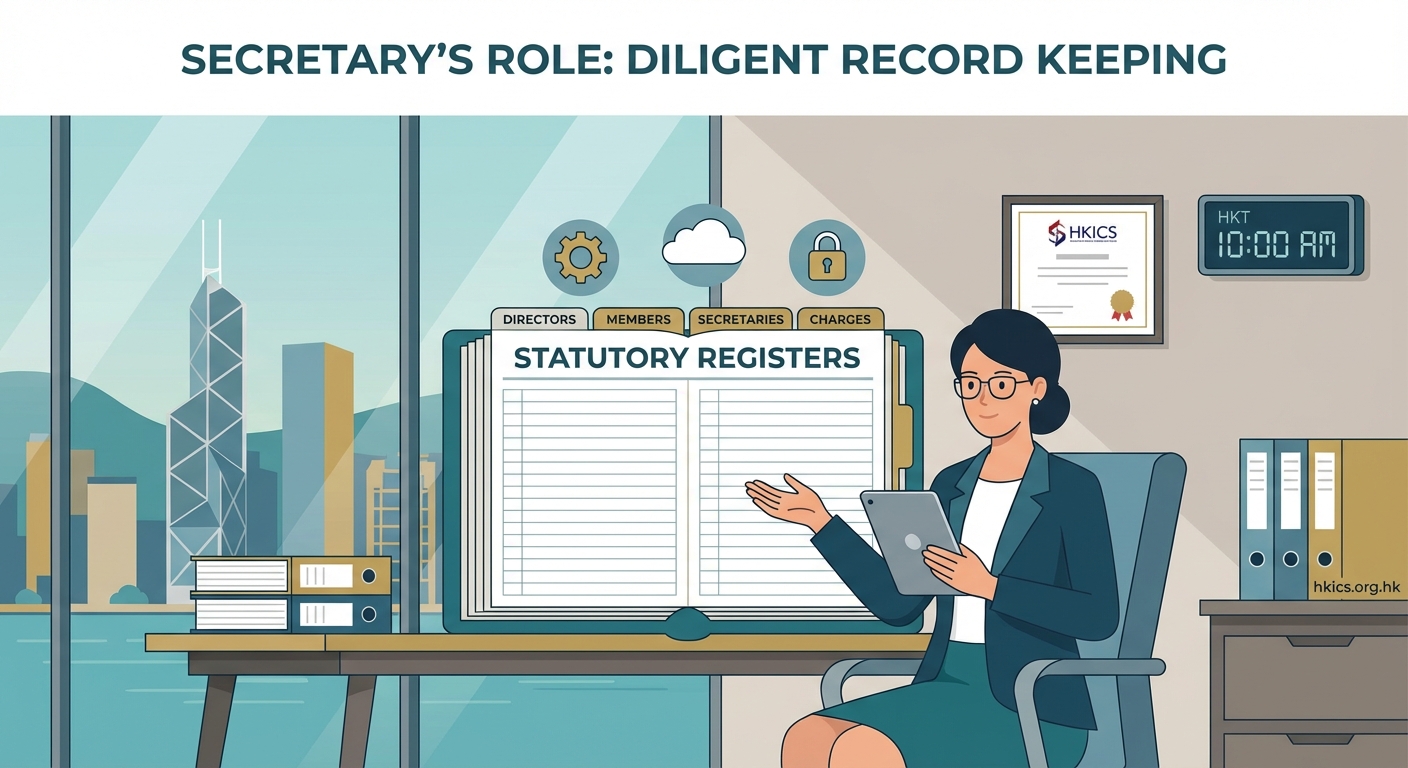
You have two options for storing statutory registers.
The default location is your registered office address. This is where the Companies Registry expects to find them unless you notify otherwise.
Alternatively, you can keep them at another location in Hong Kong. But you must file a notice with the Companies Registry within 15 days of establishing that location. You must also notify the Registry within 15 days if you move them.
You cannot store statutory registers outside Hong Kong. They must remain physically accessible in the territory.
Many companies use their company secretary’s office as the storage location. This makes sense because the secretary typically maintains these records anyway.
What information goes in each register
Different registers have different requirements. Getting the details right matters because incomplete registers can trigger compliance issues.
| Register | Key Information Required | Update Deadline |
|---|---|---|
| Members | Name, address, shares held, amounts paid, certificate numbers | 15 days after change |
| Directors | Name, addresses, ID details, birth date, appointment date | 15 days after change |
| Company Secretaries | Name, addresses, ID details, appointment date | 15 days after change |
| Significant Controllers | Name, address, ID details, nature of control | 15 days after identification or change |
| Charges | Charge details, property charged, amount, charge holder | 15 days after creation |
The 15-day rule appears repeatedly. This isn’t coincidental. The Companies Ordinance uses this timeframe as the standard update window for most corporate records.
Common mistakes that create compliance problems
Many companies make the same errors when maintaining statutory registers.
Outdated addresses: Directors move house but forget to update their registered address. This seems minor until the Companies Registry sends important notices to the wrong location.
Missing identity numbers: Some companies record names and addresses but skip ID card or passport numbers. These are mandatory fields, not optional ones.
Incomplete share transfer records: Recording that shares changed hands isn’t enough. You need the transfer date, consideration paid, and updated shareholding totals.
Ignoring the significant controllers register: Some companies still haven’t established this register or haven’t updated it since 2018. This is a serious compliance gap.
Using the wrong format: While the law doesn’t prescribe an exact template, your registers must be clear, legible, and contain all required information. Messy handwritten notes don’t cut it.
“The most common issue we see is companies treating statutory registers as a one-time setup task rather than living documents. Every share transfer, every director change, every address update needs to flow through to these registers within the legal timeframe. It’s not about perfection on day one. It’s about consistent maintenance over time.” – Senior company secretary, Hong Kong practice
How to maintain registers step by step
Setting up and maintaining statutory registers doesn’t need to be complicated. Follow this process:
-
Create each required register: Start with the four core registers. Add others if your company structure requires them. Use a template that includes all mandatory fields.
-
Record current information: Enter details for all existing members, directors, secretaries, and significant controllers. Double-check that every mandatory field is complete.
-
Establish an update system: Set up a process that captures changes when they happen. Link it to your share transfer procedures, board meeting minutes, and HR processes.
-
Verify accuracy regularly: Schedule quarterly reviews to confirm all information remains current and complete. Check that recent changes were recorded within the 15-day window.
-
Prepare for inspections: Ensure registers are accessible at the designated location during business hours. Train staff on how to handle inspection requests.
-
Keep backup copies: Maintain secure copies in case originals are damaged or lost. Digital backups work well, though the primary register can be paper or electronic.
Inspection rights and privacy considerations
Different people have different rights to inspect your statutory registers.
Register of members: Members can inspect for free. The public can inspect for a fee. You can require advance notice and charge reasonable copying fees.
Register of directors and secretaries: Open to public inspection. Anyone can view these during business hours at your registered office or notified location.
Register of significant controllers: Members can inspect. Law enforcement can inspect. The general public cannot, except with a court order for specific purposes like preventing or detecting serious crimes.
Register of charges: Open to public inspection, similar to directors and secretaries.
When someone requests to inspect a register, you can ask for:
- Their name and address
- The purpose of the inspection (for some registers)
- Advance notice (typically 24 hours is reasonable)
You cannot refuse a legitimate inspection request. Doing so is an offense that can result in fines.
Digital versus paper registers
The Companies Ordinance allows statutory registers in either paper or electronic form. Both are legally valid if properly maintained.
Paper registers offer simplicity. No technical requirements. No software costs. Just clear handwriting or typing in a bound book.
Electronic registers offer efficiency. Easier to search. Simpler to update. Better for backup and disaster recovery.
If you choose electronic registers, you must:
- Ensure the information is accessible and readable
- Protect against unauthorized alteration
- Maintain adequate backup systems
- Be able to produce hard copies when required for inspection
Many companies use specialized company secretarial software that maintains registers electronically while generating paper copies for official inspection.
Penalties for non-compliance
The Companies Ordinance takes statutory register requirements seriously. Penalties reflect this.
Failing to keep a required register: Fine up to HKD 50,000 and imprisonment for six months.
Failing to update a register within the required timeframe: Fine up to HKD 50,000 and imprisonment for six months.
Refusing a legitimate inspection request: Fine up to HKD 25,000.
Making false entries: Fine up to HKD 300,000 and imprisonment for two years.
These penalties apply to both the company and every officer in default. That typically includes all directors and the company secretary.
The Companies Registry can prosecute even for technical violations. Don’t assume small errors will be overlooked.
What happens during a Companies Registry inspection
The Companies Registry conducts random compliance checks. They may also inspect after receiving complaints or during investigations.
During an inspection, officers will:
- Request to see all statutory registers
- Check that mandatory information is present and current
- Verify that recent changes were recorded within legal deadlines
- Confirm registers are kept at the registered office or properly notified location
- Review supporting documentation like board resolutions and share transfer forms
If they find issues, you’ll typically receive a warning letter first. This gives you a chance to correct problems before prosecution.
Serious violations or repeated non-compliance can lead to immediate prosecution without warning.
Best practices for long-term compliance
Maintaining statutory registers becomes easier when you build good habits.
Assign clear responsibility: Designate someone (usually the company secretary) as the register keeper. Make this a formal role with defined duties.
Link to other processes: Connect register updates to your existing workflows. Share transfers should automatically trigger register updates. Board resolutions appointing directors should include a reminder to update the register.
Use checklists: Create a checklist for each type of change. This ensures you capture all required information and meet all deadlines.
Document everything: Keep supporting documents for every register entry. Board resolutions for director appointments. Share transfer forms for ownership changes. Identification documents for new significant controllers.
Review before annual returns: Before filing your annual return, verify that all registers are current. This catches any missed updates before they become compliance issues.
Get professional help when needed: Complex situations like corporate restructuring, share buybacks, or identifying beneficial owners can be tricky. Your company secretary or legal advisor can ensure you get it right.
Making statutory registers work for you
Statutory registers aren’t just compliance boxes to tick. They’re valuable corporate records that serve your business.
They provide certainty about ownership when shareholders disagree. They clarify authority when signing contracts or opening bank accounts. They document your company’s history as it grows and changes.
Treat them as working documents, not filing cabinet decorations. Keep them current. Keep them accurate. Keep them accessible.
The 15 minutes you spend updating a register after each change saves hours of reconstruction later. The attention you give to complete, accurate entries prevents disputes down the road.
Your statutory registers tell your company’s story. Make sure it’s a story you can stand behind.