

Running a Hong Kong company means staying on top of secretarial duties. Miss a filing deadline or fail to maintain proper records, and you could face serious financial penalties, prosecution, or even company strike-off. The Companies Ordinance sets clear obligations for every registered business, and the consequences for non-compliance are far from trivial.
Hong Kong company secretarial penalties range from HK$50,000 to HK$300,000 depending on the violation. Directors and company secretaries can face criminal prosecution for late annual returns, improper record-keeping, or failing to maintain statutory registers. Repeated non-compliance may result in company deregistration, personal liability, and disqualification from holding directorship positions in future companies.
Understanding the penalty framework
The Companies Registry enforces strict compliance standards. Every Hong Kong company must file annual returns, maintain statutory registers, keep proper accounting records, and notify authorities of changes within specified timeframes.
Penalties vary based on the type of violation and how long it continues. Some breaches carry fixed fines. Others increase daily until you fix the problem.
The law distinguishes between company liability and personal liability. Your company gets fined. You, as a director or company secretary, can face criminal charges separately.
This dual liability structure means you cannot simply pay a corporate fine and move on. Your personal record is at stake.
Common violations and their costs
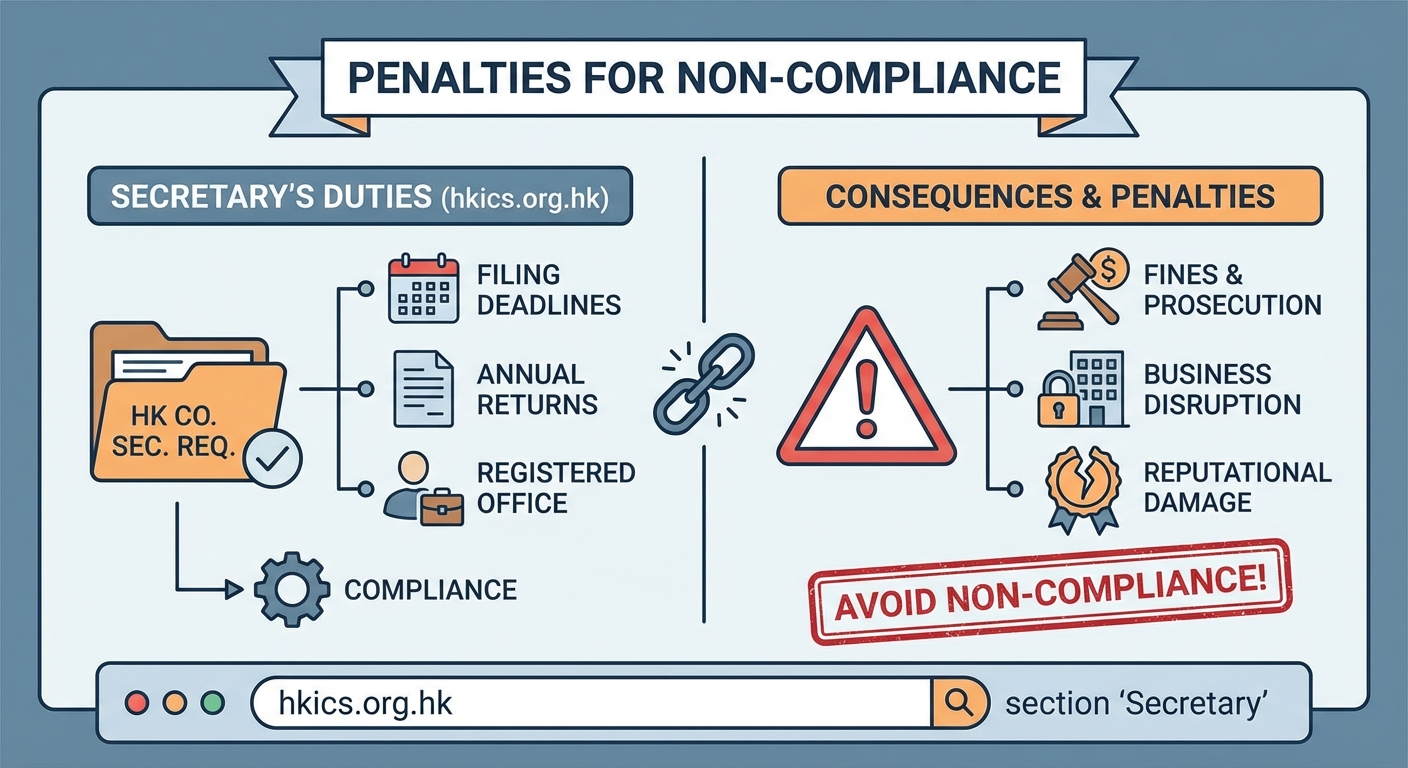
Late annual return filing is the most frequent breach. You must submit your annual return within 42 days of the return date, which falls on the anniversary of incorporation or the date you changed your financial year end.
The penalty starts at HK$870 if you file within three months of the deadline. It climbs to HK$2,610 if you file between three and six months late. Beyond six months, you face HK$3,480 plus potential prosecution.
But the financial penalty is just the beginning. Late filing can trigger a prosecution summons. If convicted, you could pay up to HK$50,000 and face ongoing daily fines of HK$700 until you comply.
Failure to maintain proper registers carries heavier consequences. The Companies Ordinance requires you to keep registers of members, directors, company secretaries, and significant controllers. Missing or incomplete registers can result in fines up to HK$100,000 and imprisonment for up to 12 months upon conviction.
Here are the most common violations business owners face:
- Late or missing annual return filing
- Failure to maintain statutory registers at the registered office
- Not notifying changes in directors, company secretary, or registered office within 15 days
- Missing or inadequate accounting records
- Failure to file a business registration certificate renewal
- Not keeping the register of significant controllers up to date
- Holding annual general meetings outside the statutory timeframe
- Missing company name display at the registered office
The escalation process
The Companies Registry does not immediately prosecute every late filing. They follow a structured enforcement approach.
- You receive an automatic reminder shortly after missing a deadline.
- If you still do not file, you get a formal warning letter outlining the potential legal consequences.
- Continued non-compliance triggers a summons requiring you to appear in court.
- Upon conviction, the court imposes fines and may order daily penalties until you comply.
- Persistent violations can lead to company strike-off proceedings and director disqualification.
The registry publishes a list of convicted companies quarterly. This public record damages your business reputation and makes it harder to secure financing, partnerships, or government contracts.
Personal liability for directors and company secretaries
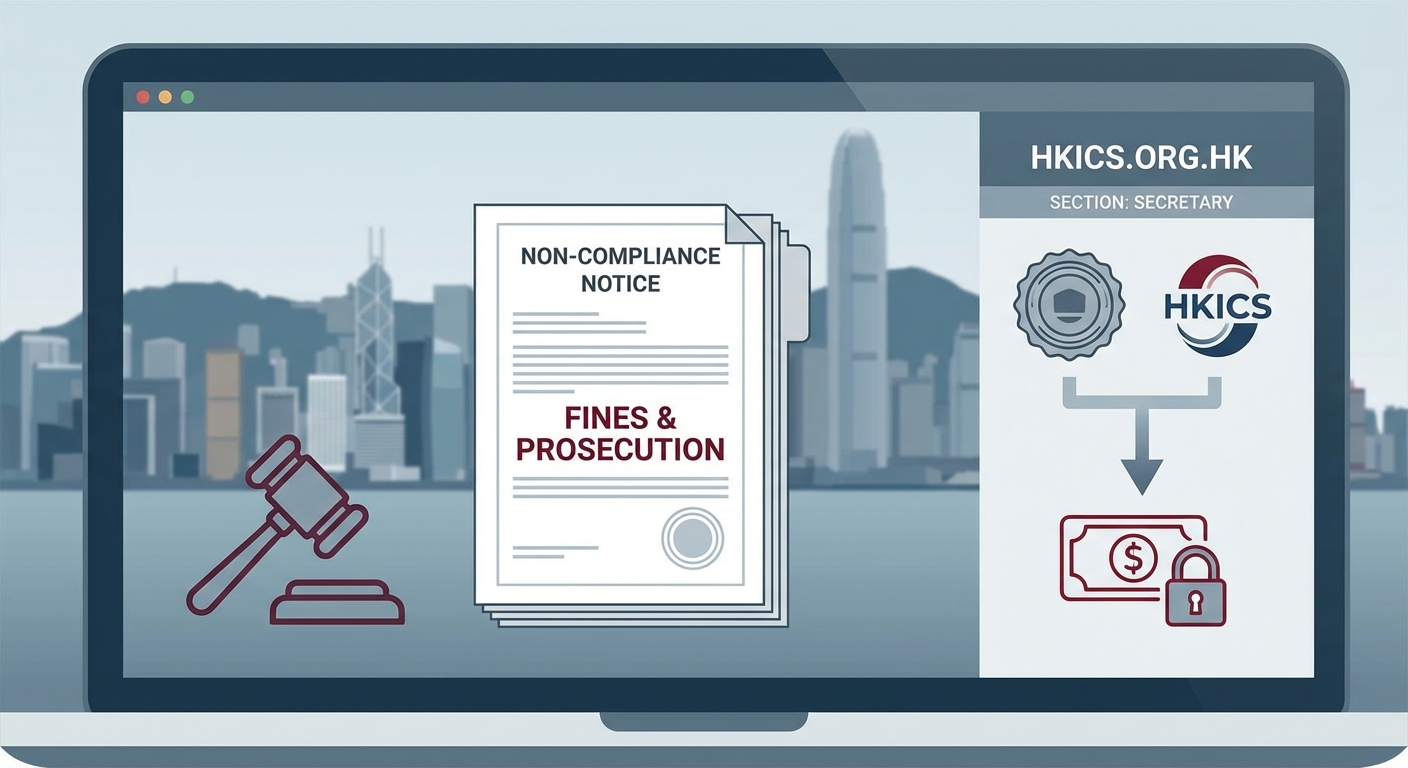
Many business owners assume company penalties stay with the company. That is wrong.
Directors and company secretaries are personally liable for ensuring compliance. If your company fails to meet its obligations, you can be prosecuted individually even if you were not directly responsible for the administrative work.
The law presumes you knew about the requirements. Ignorance is not a defense.
A director cannot escape liability by delegating secretarial duties to staff or service providers. The ultimate responsibility remains with the board. Courts have consistently held that directors must actively supervise compliance, not simply assume others are handling it.
If convicted, you face personal fines, a criminal record, and potential disqualification from serving as a director for up to five years. This disqualification applies to all Hong Kong companies, not just the one involved in the violation.
Accounting and record-keeping penalties
The Companies Ordinance requires you to keep accounting records that sufficiently explain your transactions and financial position. These records must be retained for at least seven years.
Inadequate accounting records can result in fines up to HK$300,000 and imprisonment for up to two years. The severity reflects how seriously Hong Kong treats financial transparency.
The records must be detailed enough that someone with reasonable accounting knowledge can prepare financial statements from them. Rough notes or incomplete spreadsheets do not meet the standard.
You must keep these records at your registered office or notify the Companies Registry of their alternative location. Failure to do so adds another layer of potential penalties.
Significant controllers register violations
Since 2018, all Hong Kong companies must maintain a register of persons with significant control. This register identifies individuals or entities that own more than 25% of shares, voting rights, or the right to appoint or remove directors.
The register must be kept at the registered office or filed with the Companies Registry. You must update it within 15 days of any change.
Non-compliance carries serious consequences. Companies face fines up to HK$25,000 and daily penalties of HK$700. Responsible officers can be fined up to HK$25,000 and imprisoned for up to six months.
The registry actively enforces these requirements. They conduct random inspections and investigate complaints. Many companies discovered this the hard way after assuming the requirement was merely administrative.
Comparison of major violations
| Violation Type | Company Fine | Officer Fine | Imprisonment Risk | Daily Penalty |
|---|---|---|---|---|
| Late annual return (under 3 months) | HK$870 | N/A | No | N/A |
| Late annual return (over 6 months) | HK$3,480 + prosecution | Up to HK$50,000 | No | HK$700 |
| Missing statutory registers | Up to HK$100,000 | Up to HK$100,000 | Up to 12 months | Possible |
| Inadequate accounting records | Up to HK$300,000 | Up to HK$300,000 | Up to 2 years | N/A |
| Missing significant controllers register | Up to HK$25,000 | Up to HK$25,000 | Up to 6 months | HK$700 |
| Failure to notify changes (directors, secretary, address) | Up to HK$50,000 | Up to HK$50,000 | No | HK$700 |
Strike-off and deregistration consequences
If your company remains non-compliant for an extended period, the Registrar can initiate strike-off proceedings. This means your company gets removed from the register and ceases to exist legally.
Strike-off does not erase your obligations. You remain personally liable for any debts, unpaid taxes, or legal claims against the company. Creditors can apply to restore the company to the register specifically to pursue claims against you.
The process typically unfolds like this:
- The Registrar sends a letter stating the intention to strike off the company.
- You have 30 days to object or bring the company into compliance.
- If you do not respond, the Registrar publishes a notice in the Gazette.
- After another waiting period, the company is struck off.
- All assets vest in the Government.
Getting a company restored after strike-off is expensive and time-consuming. You need to apply to court, pay all outstanding fees and penalties, and demonstrate why restoration serves the public interest.
Cumulative effect of multiple violations
Penalties compound when you have multiple violations. A company that files late annual returns, maintains incomplete registers, and fails to update its significant controllers register faces separate penalties for each breach.
The Companies Registry can prosecute all violations simultaneously. You might find yourself defending multiple charges, each carrying its own fine and potential imprisonment term.
Courts consider your compliance history when determining sentences. First-time offenders typically receive lighter penalties than repeat violators. A pattern of non-compliance signals disregard for the law and results in harsher punishment.
Practical steps to avoid penalties
Prevention is straightforward but requires discipline. Set up systems that ensure you never miss a deadline or overlook a requirement.
Create a compliance calendar marking every important date. Annual return deadlines, business registration renewal dates, and statutory meeting requirements should all be tracked.
Assign clear responsibility for each compliance task. Whether you handle it internally or use a corporate services provider, someone must own each obligation.
Review your statutory registers quarterly. Confirm they are complete, accurate, and kept at the proper location. Update them immediately when changes occur.
Maintain accounting records contemporaneously. Do not wait until year-end to organize your financial information. Regular bookkeeping prevents gaps that could trigger penalties.
Consider these protective measures:
- Engage a qualified company secretary who understands Hong Kong requirements
- Implement digital reminders for all statutory deadlines
- Conduct annual compliance audits to catch issues before they become violations
- Keep all corporate documents in one secure, accessible location
- Document every board resolution and company decision properly
- Train staff on basic compliance requirements relevant to their roles
Defense options and mitigation
If you receive a prosecution notice, you have limited defenses. The law is strict and courts rarely accept excuses.
Demonstrating that you took reasonable steps to comply can help mitigate penalties. Evidence of systems, procedures, and good-faith efforts shows you did not simply ignore your obligations.
Prompt remediation matters. If you immediately file missing returns, update registers, and implement better systems, courts may impose lighter sentences.
Legal representation is essential. A lawyer experienced in Companies Ordinance prosecutions can negotiate with the registry, present mitigating factors effectively, and potentially reduce penalties.
Some companies successfully argue that technical issues, serious illness, or extraordinary circumstances prevented compliance. These defenses rarely succeed completely but may reduce fines or avoid imprisonment.
The broader impact on business operations
Compliance violations create ripple effects beyond immediate penalties. Banks scrutinize your company more carefully. Some refuse to open accounts or provide financing for companies with compliance issues.
Business partners and clients check public records. A history of violations raises red flags about your reliability and professionalism.
Government tenders and contracts often require clean compliance records. A single conviction can disqualify you from lucrative opportunities.
Your company’s ability to raise capital suffers. Investors want assurance that management takes governance seriously. Compliance failures suggest operational weaknesses that extend beyond secretarial matters.
Why professional support makes financial sense
Many business owners try to handle company secretarial work themselves to save money. This often backfires.
The cost of professional company secretarial services is modest compared to potential penalties. A qualified provider ensures deadlines are met, registers are properly maintained, and statutory requirements are fulfilled.
They also provide valuable advice on governance best practices, help you understand complex requirements, and serve as a buffer between your business and regulatory authorities.
Professional support becomes especially important as your company grows. Multiple directors, complex shareholding structures, and frequent changes make compliance more challenging.
The peace of mind alone justifies the expense. You can focus on running your business rather than worrying about missed deadlines and potential prosecutions.
Staying compliant in the long term
Hong Kong company secretarial penalties are serious, but they are entirely avoidable. The requirements are clear. The deadlines are predictable. The consequences are well-documented.
Treat compliance as a core business function, not an administrative afterthought. Build it into your operational rhythm. Make it someone’s explicit responsibility. Review it regularly.
The investment of time and money is minimal compared to the cost of violations. A single prosecution can cost tens of thousands of dollars in fines, legal fees, and lost opportunities.
Your business reputation depends on maintaining good standing with the Companies Registry. Keep your records current, file on time, and take your obligations seriously. The alternative is simply not worth the risk.