

Starting a business in Hong Kong means dealing with paperwork, government forms, and legal requirements. The good news? The process is straightforward once you know what to expect. This guide walks you through everything from choosing your business structure to submitting your application with the Companies Registry.
Registering a business in Hong Kong requires selecting a company type, reserving a unique name, preparing incorporation documents, appointing directors and a company secretary, and filing with the Companies Registry. The entire process typically takes one to four business days for local companies and includes registration fees, business registration certificates, and ongoing compliance obligations that every entrepreneur must understand before launch.
Understanding Business Structures in Hong Kong
Your first decision shapes everything that follows. Hong Kong offers several business structures, each with different legal implications and registration requirements.
A private limited company stands as the most popular choice. It limits your personal liability and creates a separate legal entity. Your personal assets stay protected if the business faces financial trouble.
Sole proprietorships work well for freelancers and small operators. You get simplicity and lower costs, but you assume unlimited personal liability. Your personal finances connect directly to business debts.
Partnerships let two or more people share ownership. General partnerships split liability among all partners. Limited partnerships allow some partners to limit their exposure while others maintain full liability.
Branch offices and representative offices serve foreign companies entering the Hong Kong market. Branch offices can conduct business directly. Representative offices handle liaison activities only.
Here’s how these structures compare:
| Business Type | Liability | Setup Complexity | Tax Treatment |
|---|---|---|---|
| Private Limited Company | Limited to share capital | Moderate | Separate entity taxation |
| Sole Proprietorship | Unlimited personal | Low | Personal income tax |
| Partnership | Shared among partners | Low to moderate | Pass-through taxation |
| Branch Office | Parent company liable | High | Taxed as non-resident |
Choosing and Reserving Your Company Name
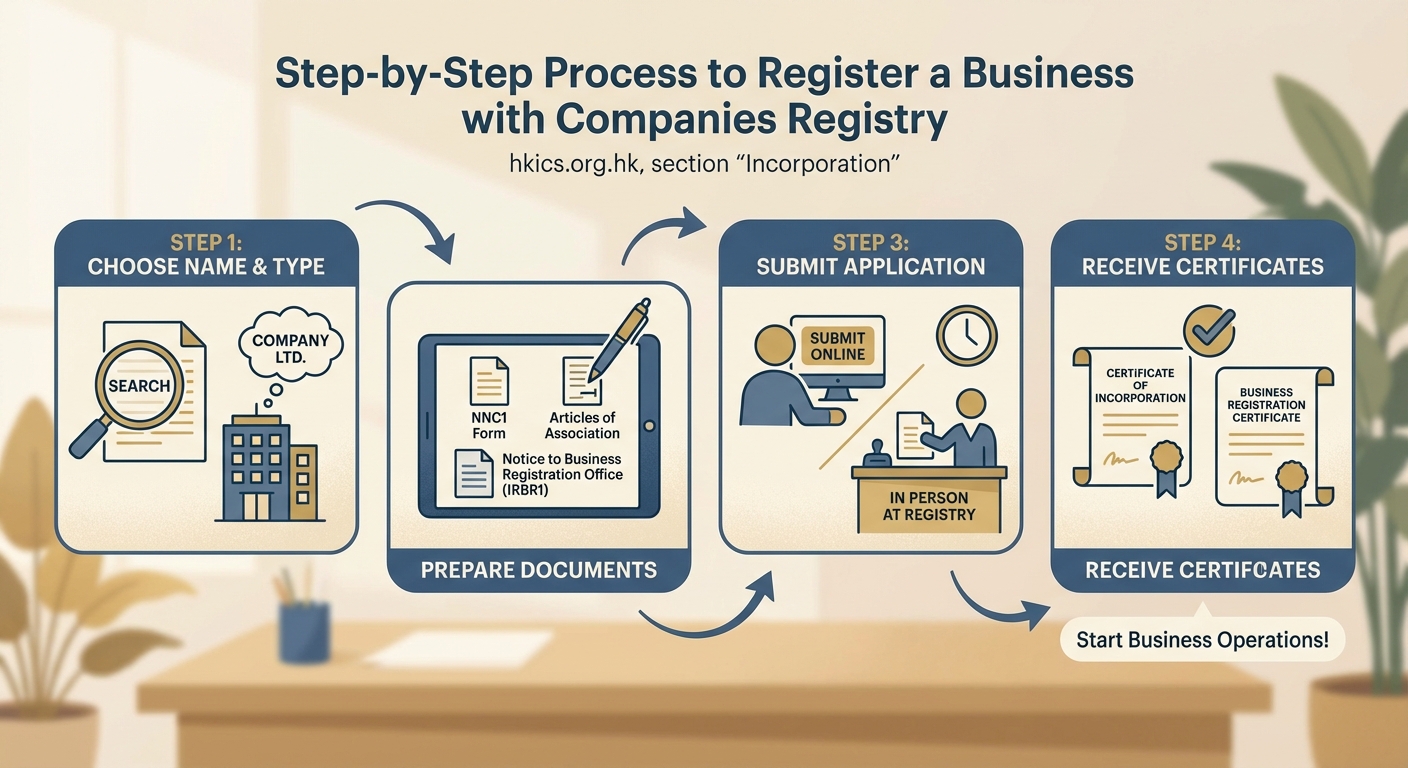
Your company name must be unique and comply with Hong Kong regulations. The Companies Registry maintains a searchable database of existing names.
Start by checking name availability through the Companies Registry’s online portal. Your proposed name cannot be identical or too similar to existing registered companies. The registry considers phonetic similarity, not just spelling.
Certain words require approval. Terms like “bank,” “insurance,” “trust,” “chamber of commerce,” and “government” need special permission from relevant authorities. Using these without approval will delay your application.
Your company name must end with “Limited” for private companies. Chinese names are optional but must be registered simultaneously if you want to use them officially.
Avoid names that suggest illegal activities, government connections, or misleading business activities. The registry rejects names that could deceive the public about your company’s nature or connections.
Reserve your approved name before filing incorporation documents. Name reservations last for specific periods, giving you time to prepare remaining paperwork.
Preparing Your Incorporation Documents
Accurate documentation prevents delays and rejections. The Companies Registry requires specific forms and supporting materials.
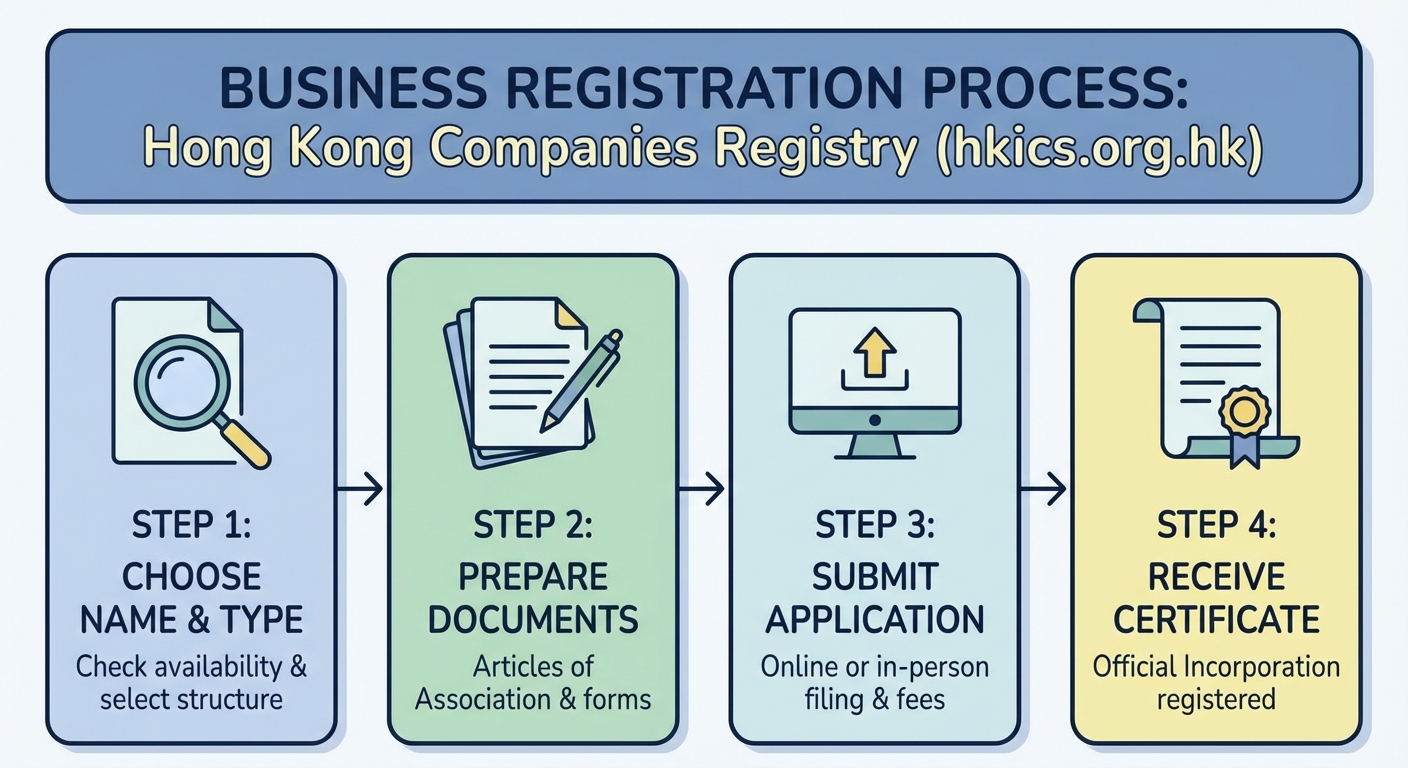
Articles of Association define your company’s internal rules. They cover shareholder rights, director powers, meeting procedures, and share transfer rules. You can adopt standard articles or customize them for your needs.
Incorporation Form NNC1 captures basic company information. This form requires:
- Proposed company name
- Registered office address in Hong Kong
- Share capital details and shareholder information
- Director and company secretary particulars
- Business nature description
Your registered office must be a physical address in Hong Kong. Post office boxes don’t qualify. This address receives official correspondence and legal notices.
Share capital information includes the number of shares, share classes, and par value. Hong Kong allows companies to issue shares with no par value, simplifying capital structure.
Director information requires full names, identification numbers, residential addresses, and consent to act. Each director must sign declarations confirming eligibility and accepting appointment.
Meeting Director and Secretary Requirements
Every Hong Kong company needs at least one director and one company secretary. These roles carry legal responsibilities.
Directors must be natural persons aged 18 or above. They can be Hong Kong residents or foreigners. At least one director should ordinarily reside in Hong Kong, though this isn’t strictly mandatory for private companies.
Company secretaries handle compliance and corporate administration. They maintain statutory registers, file annual returns, and ensure the company meets legal obligations.
A qualified company secretary keeps your business compliant and protects you from penalties. This role isn’t just administrative paperwork. It’s about understanding Hong Kong corporate law and maintaining good standing with regulators.
Individual company secretaries must ordinarily reside in Hong Kong. Corporate secretaries must have a registered office or place of business in Hong Kong. The same person cannot serve as both sole director and company secretary.
Professional qualifications matter for company secretaries. Acceptable credentials include:
- Hong Kong Institute of Chartered Secretaries membership
- Solicitor or barrister practicing in Hong Kong
- Certified public accountant
- Corporate service provider licensed under anti-money laundering regulations
Many entrepreneurs hire professional corporate service providers to handle company secretary duties. This ensures compliance while letting you focus on business operations.
Filing Your Application with the Companies Registry
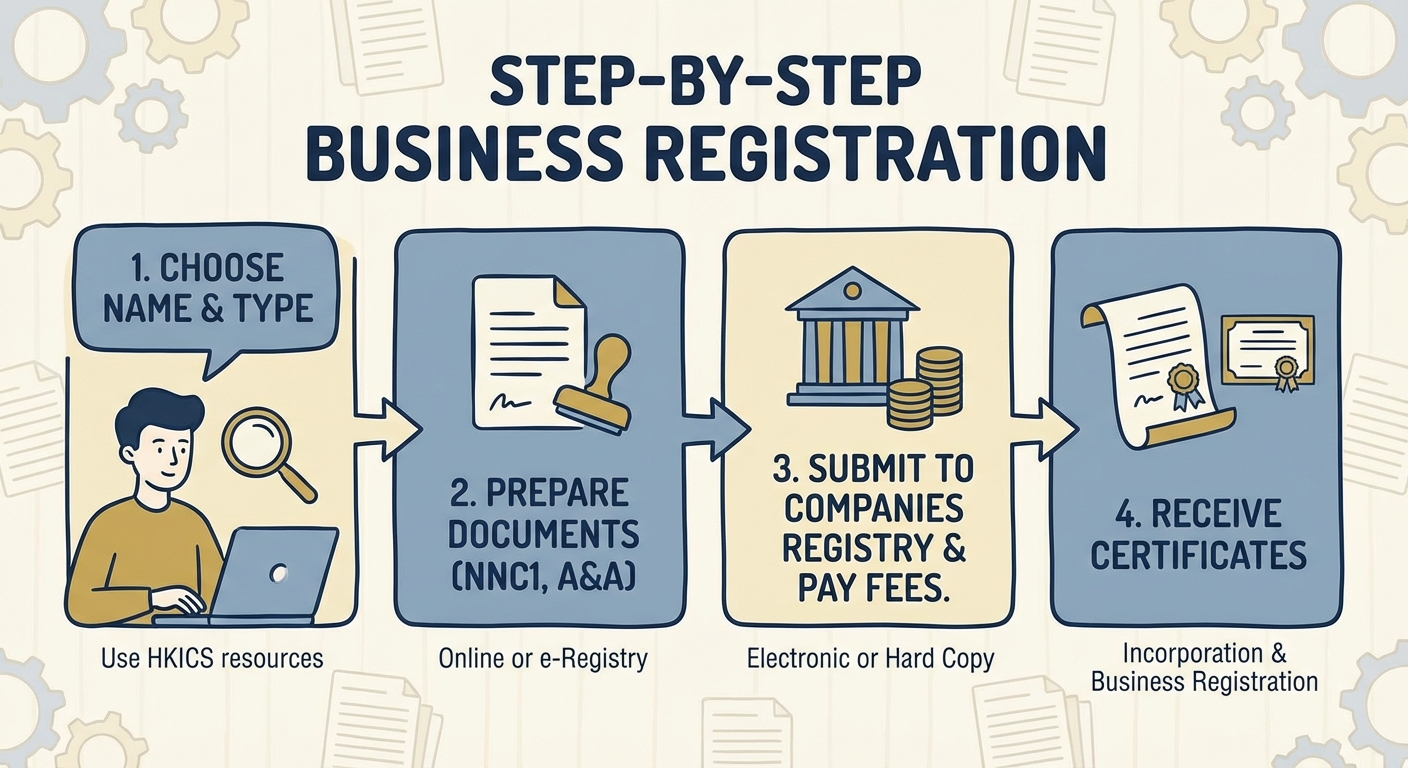
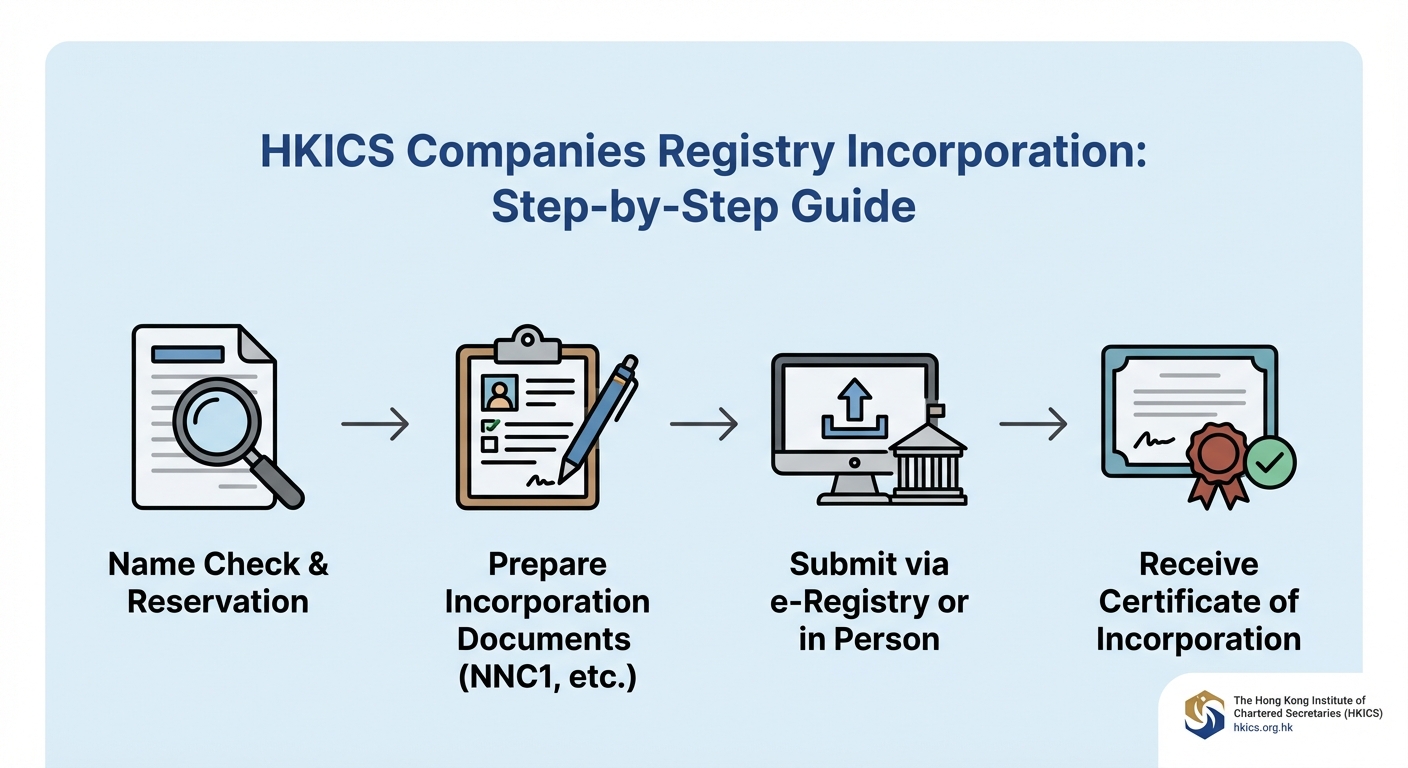
Submit your incorporation package through the Companies Registry’s e-Registry portal or in person at their office. Electronic filing costs less and processes faster.
The incorporation package includes:
- Completed Form NNC1
- Articles of Association
- Copies of identification documents for directors, shareholders, and company secretary
- Proof of registered office address
- Payment of registration fees
Registration fees vary by share capital amount. Companies with share capital up to HKD 10,000 pay lower fees. Higher capitalization incurs additional charges.
Business registration happens simultaneously. You’ll receive both a Certificate of Incorporation and a Business Registration Certificate. The incorporation certificate proves your company’s legal existence. The business registration certificate allows you to operate legally.
Processing times depend on submission method and application completeness. Electronic submissions typically complete within one business day for standard applications. Paper submissions take longer, usually three to four business days.
The registry may request clarifications or additional documents. Respond promptly to avoid delays. Common issues include unclear business descriptions, incomplete director information, or name similarity concerns.
Setting Up Post-Registration Requirements
Registration marks the beginning, not the end. Several immediate tasks ensure proper business setup.
Open a corporate bank account as soon as possible. Banks require your incorporation documents, business registration certificate, director identification, and proof of business address. Account opening can take several weeks, so start early.
Register for taxes with the Inland Revenue Department. Your company receives a tax file automatically, but you must file annual tax returns even with no income. Profits tax applies to Hong Kong-sourced income at competitive rates.
Obtain necessary business licenses or permits. Requirements depend on your industry. Restaurants need food licenses. Import/export businesses require trade licenses. Professional services may need specific regulatory approvals.
Create statutory registers and maintain them at your registered office. Required registers include:
- Register of members (shareholders)
- Register of directors and company secretaries
- Register of charges
- Significant controllers register
The significant controllers register identifies persons with significant control over your company. This anti-money laundering requirement helps maintain Hong Kong’s financial transparency.
Understanding Ongoing Compliance Obligations
Registration creates ongoing responsibilities. Missing deadlines brings penalties and potential prosecution.
Annual returns must be filed within 42 days of your company’s anniversary. This return updates the Companies Registry about current directors, shareholders, and registered office. Late filing incurs automatic penalties that increase daily.
Business registration renewal happens annually. You’ll receive a renewal notice before expiry. Pay on time to avoid penalties and maintain legal trading status.
Financial statements require preparation according to Hong Kong Financial Reporting Standards. Small companies may qualify for simplified reporting. All companies must maintain proper accounting records.
Tax returns go to the Inland Revenue Department annually. Even companies with no activity must file nil returns. The department issues assessments based on your submitted profits tax return.
Annual general meetings aren’t mandatory for private companies under current law, but your articles may require them. Written resolutions can replace physical meetings for most decisions.
Maintain accurate minutes of director meetings and shareholder resolutions. These records prove proper corporate governance and protect directors from liability claims.
Common Mistakes That Delay Registration
Learning from others’ errors saves time and frustration. These issues frequently slow applications:
Incomplete identification documents top the list. The registry needs clear copies of passports or identity cards for all directors and shareholders. Expired documents aren’t acceptable. Certified copies may be required for certain situations.
Unclear business descriptions cause rejections. Vague terms like “general trading” or “consulting” need specificity. Describe actual activities: “import and distribution of electronic components” or “management consulting for hospitality businesses.”
Missing signatures invalidate forms. Every required signatory must sign and date documents. Electronic signatures work for online submissions but must meet registry standards.
Address verification problems delay processing. Your registered office address must be verifiable. Provide utility bills, tenancy agreements, or official documents proving the address exists and you can use it.
Name similarity issues arise even after preliminary checks. The registry’s final review may identify conflicts missed earlier. Have backup name options ready.
Costs and Timeline Expectations
Budget appropriately for registration and initial setup. Costs include both government fees and professional services.
Government fees for company incorporation start around HKD 1,720 for electronic filing with share capital up to HKD 10,000. Paper filing costs more. Business registration adds approximately HKD 250 for one year or HKD 3,950 for three years.
Professional service fees vary widely. Corporate service providers charge between HKD 2,000 and HKD 8,000 for basic incorporation packages. Premium services with ongoing support cost more.
Bank account opening is free at most banks, but minimum deposit requirements apply. Some banks charge for corporate accounts depending on transaction volumes.
Timeline from start to finish:
- Name reservation: Same day to two business days
- Document preparation: One to three days depending on complexity
- Registry processing: One to four business days
- Bank account opening: Two to six weeks
- Tax registration: Automatic with incorporation
Total time from decision to operational business: Two to eight weeks. Most of this time involves bank account opening rather than registration itself.
Getting Professional Help
Many entrepreneurs hire corporate service providers to handle registration. This makes sense if you’re unfamiliar with Hong Kong requirements or don’t have time for paperwork.
Professional services typically include:
- Name search and reservation
- Document preparation and review
- Company secretary services
- Registered office provision
- Filing with government authorities
- Ongoing compliance support
Choose providers carefully. Check their credentials, experience, and client reviews. Licensed trust and company service providers must register under Hong Kong’s anti-money laundering regime.
Costs for professional help range from basic incorporation packages around HKD 3,000 to comprehensive first-year services exceeding HKD 15,000. Compare what’s included before deciding.
DIY registration saves money but requires time and attention to detail. The Companies Registry provides guidance, but you’re responsible for accuracy and compliance.
Your Path Forward as a Business Owner
Registration transforms your business idea into a legal entity ready for operations. The process demands attention to detail but follows a clear path.
Start by choosing your business structure carefully. Consider liability protection, tax implications, and administrative complexity. Most entrepreneurs benefit from limited company status despite slightly higher setup requirements.
Prepare thorough documentation before filing. Missing information causes delays that frustrate entrepreneurs eager to launch. Take time to get everything right the first time.
Don’t overlook post-registration requirements. Compliance obligations continue long after you receive your certificates. Build good habits early by maintaining proper records and meeting deadlines.
Professional help makes sense for many founders. Corporate service providers handle technical details while you focus on building your business. The cost often proves worthwhile for peace of mind and time savings.
Your registered company opens doors to banking relationships, customer contracts, and business growth. The administrative work pays off when you’re operating legally and professionally in one of Asia’s most dynamic business environments.