

The way companies govern themselves has never been static. From merchant guilds in medieval Europe to today’s complex multinational boards, the history of corporate governance reflects centuries of trial, error, and reform. Each major shift came from real world crises, technological leaps, or changing expectations about who companies should serve.
Corporate governance evolved through distinct phases: medieval guilds established early accountability, the Industrial Revolution created the modern corporation, the 20th century brought regulatory frameworks after major scandals, and the 21st century introduced stakeholder capitalism and ESG principles. Understanding this timeline helps professionals navigate current governance challenges and anticipate future reforms in global markets.
Ancient roots and early accountability structures
Long before stock exchanges existed, merchants needed ways to manage collective ventures. Ancient Roman societas publicanorum operated as tax farming partnerships with shared ownership and rudimentary governance rules. These entities required basic oversight because multiple investors pooled capital for large projects like building aqueducts or collecting provincial taxes.
Medieval trade guilds took accountability further. Guilds in Venice, Florence, and the Hanseatic League cities created formal rules about who could make decisions, how profits would be divided, and what happened when members disagreed. The Venetian colleganza contracts from the 12th century specified exact duties for traveling merchants and their financial backers, creating early fiduciary relationships.
The Dutch East India Company, founded in 1602, represents a watershed moment. It issued shares that could be traded, created a separation between owners and managers, and faced the world’s first shareholder activism when investors demanded financial transparency in 1622. This pattern of separation and the conflicts it created would define corporate governance debates for the next four centuries.
Industrial Revolution and the birth of modern corporations

The 19th century transformed governance needs completely. Railroads, steel mills, and textile factories required capital beyond what families or partnerships could provide. Incorporation laws in Britain and the United States made it easier to form companies with limited liability, protecting investors from personal ruin if ventures failed.
This protection came with a problem. Owners could no longer watch managers daily. The principal agent problem emerged as a central challenge. How do you ensure managers act in shareholders’ interests when they control day to day operations?
Early solutions varied by country:
- British companies relied on prominent directors whose reputations guaranteed good behavior
- American firms developed more formal board structures with specific committees
- German corporations created two tier boards separating management from supervision
- Japanese zaibatsu used family control and cross shareholdings to align interests
The 1844 Joint Stock Companies Act in Britain required registration and some disclosure. The 1862 Companies Act established limited liability as standard. These laws created the template many countries still follow: incorporation in exchange for transparency and certain governance minimums.
Regulatory responses to corporate failures
Major scandals have always driven governance reform. Each crisis revealed gaps in existing rules and public tolerance for executive misconduct.
The 1929 stock market crash exposed rampant insider trading, manipulated accounts, and conflicts of interest. The U.S. Securities Act of 1933 and Securities Exchange Act of 1934 created mandatory disclosure requirements and established the Securities and Exchange Commission. For the first time, companies had to file regular reports with standardized financial information.
Britain’s Companies Act 1948 followed similar principles after post war reconstruction highlighted the need for stronger oversight. It required audited accounts, limited director powers, and gave shareholders more rights to challenge management decisions.
The 1970s brought new pressures. Watergate investigations uncovered corporate slush funds and illegal political contributions. The Foreign Corrupt Practices Act of 1977 made bribery illegal and required companies to maintain accurate books. This marked a shift: governance wasn’t just about protecting shareholders anymore but also about corporate behavior in society.
The shareholder value era and its consequences
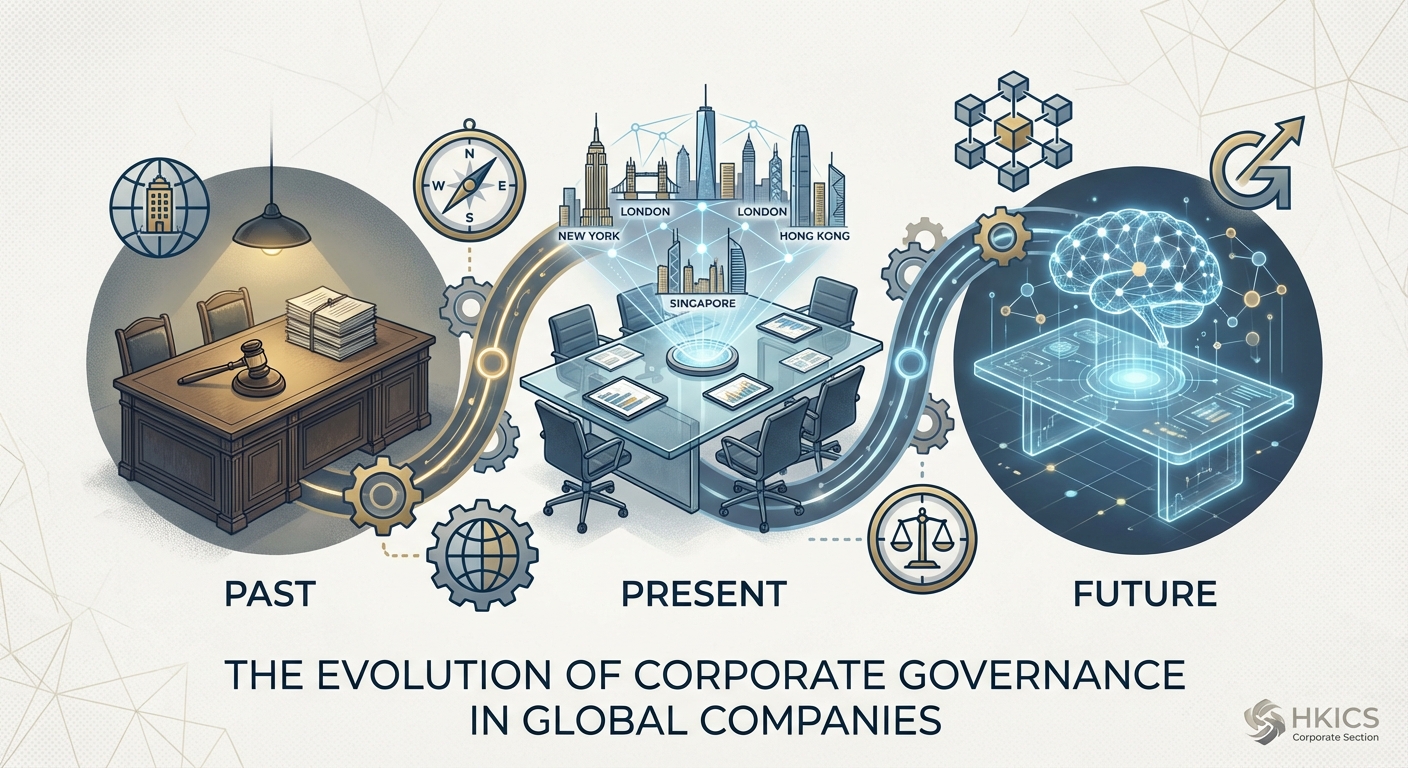
The 1980s and 1990s centered governance around one idea: maximize shareholder value. Academic research, particularly from economists like Michael Jensen, argued that aligning executive pay with stock prices would solve the principal agent problem. Stock options became the preferred tool.
This approach produced mixed results. Share prices did rise in many cases. But the focus on short term stock performance created perverse incentives. Executives sometimes manipulated earnings, delayed necessary investments, or took excessive risks to hit quarterly targets.
Three major corporate collapses shook confidence in this model:
- Enron (2001): Accounting fraud hidden by complex off balance sheet entities and complicit auditors
- WorldCom (2002): $11 billion in fraudulent accounting entries to inflate profits
- Tyco (2002): Executive looting and unauthorized bonuses while the board looked away
These failures shared common features. Boards failed to ask tough questions. Auditors prioritized consulting fees over independence. Executives faced massive incentives to manipulate results. Shareholders had little real power to intervene before collapse.
Sarbanes Oxley and the compliance revolution
The U.S. Congress passed the Sarbanes Oxley Act in 2002 with overwhelming bipartisan support. It remains the most significant governance reform in American history.
Key provisions reshaped corporate behavior:
- CEOs and CFOs must personally certify financial statements
- Audit committees must have independent members with financial expertise
- External auditors cannot provide certain consulting services to audit clients
- Companies must maintain internal controls over financial reporting
- Whistleblower protections prevent retaliation against employees who report problems
The law imposed real criminal penalties. Executives could face prison for knowingly certifying false statements. This personal liability changed boardroom dynamics overnight.
Other countries followed with their own reforms. The UK Combined Code (now the UK Corporate Governance Code) emphasized “comply or explain” rather than rigid rules. Australia, Canada, and many European nations updated their governance frameworks throughout the 2000s.
| Reform Approach | Key Features | Main Advantage | Primary Challenge |
|---|---|---|---|
| Rules based (U.S.) | Specific requirements, criminal penalties | Clear standards, strong enforcement | Can become checklist compliance |
| Principles based (UK) | Broad guidelines, explain deviations | Flexibility, encourages good faith | Harder to enforce, varies by company |
| Hybrid (Australia) | Mix of mandatory rules and recommendations | Balances clarity and adaptation | Complexity in determining what applies |
The global financial crisis and systemic risk
The 2008 financial crisis revealed that good governance at individual firms wasn’t enough. Systemically important institutions could threaten entire economies. Risk management became a board level responsibility, not just a technical function.
Governance failures at banks showed troubling patterns. Boards lacked members who understood complex derivatives. Risk committees met infrequently and had limited authority. Executive compensation rewarded short term profit without accounting for long term risk. When losses materialized, taxpayers bore the cost.
Reforms targeted these specific problems. The Dodd Frank Act in the United States required say on pay votes, clawback provisions for executive compensation, and risk committees at large banks. Basel III capital requirements forced banks to hold more reserves and limited leverage.
European regulators took a harder line on banker bonuses, capping variable pay and requiring deferral of awards. The goal was breaking the link between excessive risk taking and immediate personal reward.
“The crisis taught us that governance isn’t just about preventing fraud. It’s about ensuring boards understand the businesses they oversee and can challenge management assumptions before small problems become systemic failures.” – Financial Stability Board, 2009
Stakeholder capitalism and ESG integration
The 2010s brought fundamental questions about corporate purpose. Should companies serve only shareholders, or do they have obligations to employees, communities, and the environment?
This wasn’t entirely new. Debates about corporate social responsibility date back decades. But several factors accelerated the shift:
- Climate change made environmental impact impossible to ignore
- Social media amplified reputational risks from labor practices or discrimination
- Investors realized that environmental, social, and governance factors affect long term value
- Younger employees and customers demanded companies align with their values
The Business Roundtable’s 2019 statement marked a symbolic turning point. Nearly 200 U.S. CEOs declared that companies should serve all stakeholders, not just shareholders. Critics called it empty rhetoric. Supporters saw it as recognizing economic reality.
ESG reporting frameworks proliferated. The Global Reporting Initiative, Sustainability Accounting Standards Board, and Task Force on Climate-related Financial Disclosures all created standards for measuring and disclosing non financial performance. By 2020, over 90% of S&P 500 companies published sustainability reports.
Regulators began mandating ESG disclosure. The European Union’s Corporate Sustainability Reporting Directive requires detailed environmental and social reporting from large companies. Similar rules emerged in Hong Kong, Singapore, and other financial centers.
Technology and governance in the digital age
Digital transformation creates new governance challenges. Cybersecurity breaches can destroy customer trust overnight. Data privacy violations trigger massive fines under regulations like GDPR. Artificial intelligence raises questions about algorithmic bias and accountability.
Boards now need technology expertise, not just financial or operational knowledge. Many companies added chief information security officers and chief data officers. Board committees focused on technology risk became common at large firms.
Blockchain and distributed ledger technology promise new governance models. Decentralized autonomous organizations attempt to encode governance rules in smart contracts, removing human discretion. Whether these experiments succeed remains uncertain, but they challenge assumptions about how organizations can be structured.
Shareholder engagement went digital too. Virtual annual meetings became standard during the pandemic and remained popular afterward. Proxy voting platforms make it easier for retail investors to participate. Social media allows activist investors to build campaigns and pressure boards publicly.
Current trends shaping governance practice
Several developments are actively reshaping how companies govern themselves today.
Board diversity has moved from aspiration to requirement in many markets. California mandated gender diversity on boards before courts struck down the law. European countries like Norway, France, and Germany set quotas years earlier. Even without mandates, investors increasingly vote against nominating committees at companies with homogeneous boards.
Activist investors wield more influence than ever. Hedge funds like Elliott Management and Third Point successfully push for strategic changes, board seats, and capital allocation shifts. Passive index funds like Vanguard and BlackRock, which can’t sell underperforming holdings, engage actively on governance issues instead.
Climate governance has become central. Investors demand that boards oversee climate risks, set emissions targets, and link executive pay to sustainability metrics. Shareholder proposals on climate issues receive majority support even at energy companies. Some jurisdictions now require climate risk disclosure in financial filings.
Executive compensation remains controversial. The ratio between CEO and median worker pay has grown dramatically in the United States. Say on pay votes give shareholders a voice, but most proposals pass easily. Clawback provisions and longer vesting periods aim to align pay with sustainable performance.
The table below shows how governance priorities have shifted:
| Era | Primary Focus | Key Stakeholder | Main Mechanism |
|---|---|---|---|
| Pre 1930s | Prevent fraud | Creditors | Legal liability |
| 1930s to 1970s | Disclosure and transparency | Shareholders | Mandatory reporting |
| 1980s to 2000s | Shareholder value | Equity investors | Stock based compensation |
| 2000s to 2010s | Compliance and risk | Regulators | Rules and penalties |
| 2020s onward | Stakeholder value and sustainability | Multiple groups | ESG metrics and engagement |
Lessons from governance evolution
Studying this history reveals patterns that help predict future developments.
Crises drive change. Nearly every major governance reform followed a scandal or market collapse. Enron led to Sarbanes Oxley. The financial crisis produced Dodd Frank. Expect future crises to generate new rules.
One size never fits all. Governance needs vary by company size, industry, ownership structure, and national context. Family controlled firms face different challenges than widely held corporations. Banks require stricter oversight than software companies. Effective governance adapts to circumstances.
Unintended consequences are common. Stock options were supposed to align interests but sometimes encouraged fraud. Compliance requirements protect investors but also impose costs that discourage smaller companies from going public. Every reform creates new trade offs.
Cultural change matters more than rules. You can mandate independent directors, but you can’t mandate courage to challenge a dominant CEO. Effective governance requires boards that ask hard questions, management that welcomes scrutiny, and shareholders who engage constructively.
Governance continues evolving. The history of corporate governance isn’t finished. New technologies, business models, and social expectations will create fresh challenges. Understanding how we got here helps navigate where we’re going.
Building on centuries of progress
The journey from medieval guilds to modern ESG frameworks shows that corporate governance responds to changing economic realities and social expectations. Each generation inherits structures created by previous crises and reforms them to address current challenges.
For students and academics, this history provides context for current debates. For practitioners, it offers lessons about what works, what fails, and why. For governance specialists, it reveals that no system is permanent. The rules and norms we follow today will seem as outdated to future professionals as 19th century railroad governance seems to us now.
The best governance systems balance accountability with flexibility, protect stakeholders without strangling innovation, and adapt as circumstances change. That balance has never been easy to achieve. But four centuries of experience provide a foundation for meeting whatever challenges come next.