Form NDB1 Return of Allotment of Debentures or Debenture Stock Hong Kong
How to file Form NDB1 to report the allotment of debentures or debenture stock with the Hong Kong Companies Registry.
NDB1 at a glance
- Official title
- Return of Allotment of Debentures or Debenture Stock
- Issued by
- Companies Registry
We link the issuing authority's own index rather than hosting a copy, because the form is revised there and an out-of-date copy is worse than none.
Form NDB1 Return of Allotment of Debentures or Debenture Stock Hong Kong
Form NDB1 is the statutory document for notifying the Companies Registry of an allotment of debentures or debenture stock by a Hong Kong company. A company must file the Form NDB1 Return of Allotment of Debentures or Debenture Stock Hong Kong whenever it issues debentures or creates debenture stock, whether for cash or non-cash consideration. This applies to all companies incorporated under the Companies Ordinance (Cap. 622).
The form creates the official record of a company's debt financing. A share allotment increases equity capital. A debenture allotment represents borrowing. The Companies Registry maintains this information on the public register, letting creditors ascertain the company's indebtedness.
NDB1 Allotment of Debentures Hong Kong
Allotment of debentures is the process of issuing debenture certificates or creating debenture stock and allocating them to holders. In Hong Kong, this includes any issue of debentures that creates a charge over the company's assets.
An allotment may be made to one holder or several. Companies issue debentures as security for a bank loan, create a series under a trust deed, or issue convertible debentures that can later be exchanged for shares.
Form NDB1 captures the particulars of the allotment: the class of debentures, the number issued, the consideration received, and the holder's identity. The form must be accompanied by a certified true copy of any trust deed or other document containing the debentures' terms.
Return of Allotment Debenture Stock
Debenture stock differs from individual debentures. It represents a single debt instrument divided into units, similar to shares. A company may create debenture stock instead of issuing separate debenture certificates to each holder.
The return of allotment for debenture stock requires the same information as for individual debentures. The form must also specify the total amount of stock created and the nominal value per unit. If the debenture stock is issued in series, the company must indicate the series number and the total amount authorised for that series.
The Companies Registry treats debenture stock as a single class of debt security. Particulars filed on Form NDB1 become part of the company's public record. Any person can inspect the register.
Form NDB1 Companies Registry Guide
The Companies Registry publishes a guide to completing Form NDB1 on its website at the specified forms index. Key points include:
- The form must be signed by a director, the company secretary, or an authorised person.
- All particulars must be completed in English or Chinese. Bilingual completion is permitted.
- The consideration for the allotment must be stated in Hong Kong dollars. If the consideration is non-cash, a description of the assets or services received must be provided.
- A certified true copy of any trust deed, mortgage, or other document creating or defining the rights of debenture holders must accompany the form.
- The form must be filed within one month of the allotment date.
The Companies Registry e-Services portal allows electronic submission of Form NDB1. Paper filing is also accepted at the Registry's counter.
Information Required on Form NDB1
Form NDB1 requires the following particulars:
- Company name and company registration number.
- Date of the allotment.
- Class of debentures or debenture stock (for example, "First Mortgage Debentures" or "Convertible Debentures").
- Number of debentures allotted or amount of debenture stock created.
- Total nominal value of the debentures or debenture stock.
- Consideration received by the company, stated in cash or as a description of non-cash assets.
- Name and address of each debenture holder or, if the debentures are issued to a trustee, the name and address of the trustee.
- If the debentures are issued in series, the series number and total amount authorised.
The form also requires the company to state whether the debentures are secured by a charge. If a charge exists, the company must have already filed Form NM1 (Statement of Particulars of Charge) or Form NM8 (Particulars of a Charge Created for a Series of Debentures) within one month of the charge creation.
Filing Deadline and Late Delivery
Form NDB1 must be delivered to the Companies Registry within one month of the allotment date. This one-month period runs from the date the debentures are allotted, not from the date of any subsequent documentation.
If the form is delivered late, the company must pay a higher registration fee. The Companies Registry does not publish fixed late fees for Form NDB1; the fee depends on the length of the delay. The company should check the current fee schedule on the Registry's website.
Late filing is an offence under the Companies Ordinance (Cap. 622). The company and every responsible officer may be liable to a fine. The Registry may also refuse to register the form if the delay is excessive.
Difference Between Form NDB1 and Form NSC1
Form NDB1 applies to debt securities. Form NSC1 (Return of Allotment) applies to shares. The two forms serve different purposes and require different information.
Key differences include:
- Form NSC1 reports the allotment of shares, which increases the company's issued share capital. Form NDB1 reports the allotment of debentures, which creates a debt obligation.
- Form NSC1 requires details of the class of shares, number allotted, nominal value, and amount paid or credited as paid. Form NDB1 requires the same for debentures but also asks for the consideration received and the identity of the holder.
- Form NSC1 must be filed within one month of the allotment. Form NDB1 has the same deadline.
- Form NSC1 does not require a certified true copy of any trust deed. Form NDB1 requires one if the debentures are issued under a trust deed.
- Form NSC1 updates the company's register of members. Form NDB1 updates the company's register of debenture holders, which the company must maintain under section 662 of the Companies Ordinance (Cap. 622).
Company Records After Filing
After filing Form NDB1, the company must update its register of debenture holders. The register must contain the particulars of each debenture holder, including their name and address, the amount of debentures held, and the date of entry.
The register of debenture holders must be kept at the company's registered office or at another location notified to the Companies Registry on Form NR2 (Notice of Location of Registers and Company Records). The register is open to inspection by any debenture holder or any member of the company.
The company must also retain a copy of the filed Form NDB1 and any accompanying documents as part of its company records. These records must be kept for at least seven years after the debentures are redeemed or cancelled.
Where to Obtain and Submit Form NDB1
Form NDB1 is available for download from the Companies Registry specified forms index. The Registry revises its forms periodically, so the company should always use the current version.
Electronic submission is available through the Companies Registry e-Services portal. The portal accepts payment by credit card or electronic cheque. Paper forms can be delivered to the Companies Registry counter at Queensway, Hong Kong, or sent by post.
The company should retain a copy of the filed form and the Registry's acknowledgement for its records. The acknowledgement confirms the date of registration and the fee paid.
How to fill out Form NDB1
Page one of the official form. Every field named below appears on it in the same order.
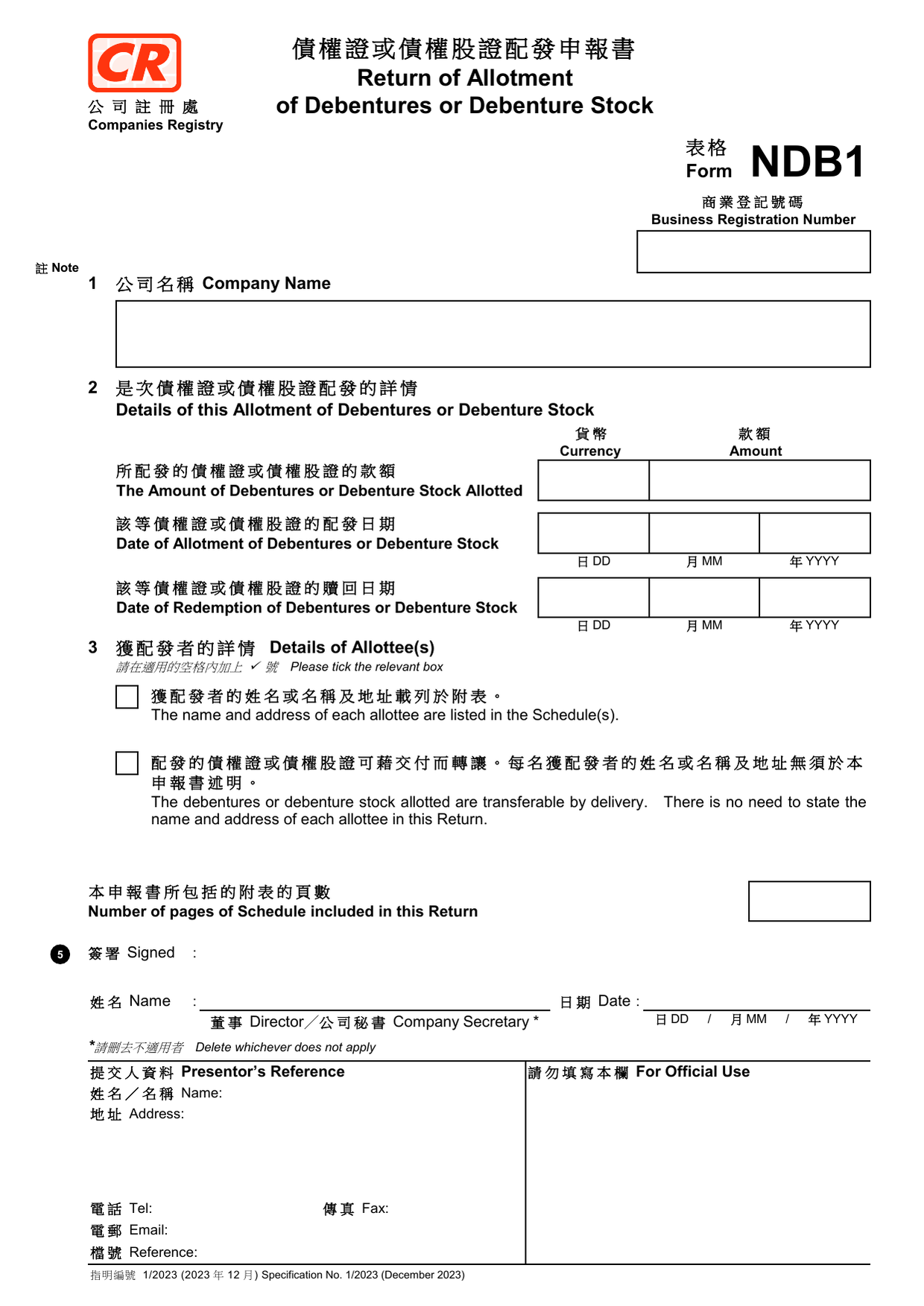
Download the current form - always file the version on the issuing authority's site, not a copy.
Sources
More on the forms library.