Completing Form SBUL1 for a Return of Stock Borrowing Transactions
File Form SBUL1 to report stock borrowing transactions in Hong Kong. This guide explains who needs to file and how to complete the return accurately.
SBUL1 at a glance
- Official title
- Return of Stock Borrowing Transactions
- Issued by
- Inland Revenue Department
We link the issuing authority's own index rather than hosting a copy, because the form is revised there and an out-of-date copy is worse than none.
Form SBUL1 Return of Stock Borrowing Transactions
File Form SBUL1 with the Securities and Futures Commission (SFC) to report stock borrowing and lending activities. This is the prescribed document for participants in the Hong Kong securities lending market. The SFC uses the return to monitor transaction volume, counterparties and deal terms.
The requirement sits under the Securities and Futures (Stock Market Lending) Rules (Cap. 571 sub-legislation). Any person who carries on a business of stock borrowing or lending, or who enters into such transactions for a client, must submit this return. It captures aggregate data for a reporting period, typically quarterly or as directed by the SFC.
Who Must File the SBUL1 Stock Borrowing Return
File the SBUL1 stock borrowing return if you are:
- An exchange participant of the Stock Exchange of Hong Kong engaging in stock borrowing for your own account or for clients.
- A licensed corporation or registered institution conducting stock borrowing and lending.
- An intermediary in stock borrowing transactions, including lenders and borrowers who are not exchange participants.
You are not required to file if you borrow or lend securities solely for settlement purposes and do not carry on a business of stock borrowing. The SFC provides guidance on the distinction between a genuine stock borrowing transaction and a settlement-only arrangement.
Hong Kong Stock Borrowing Form: Sections and Content
The Hong Kong stock borrowing form is structured in distinct parts. Each section requires specific data the SFC uses to compile market statistics and monitor compliance with the Cap. 571 rules.
Part A: Participant Information - Name and SFC licence number or exchange participant code. - Business registration number and registered address. - Contact details for the person responsible for the return.
Part B: Summary of Stock Borrowing Transactions during the Reporting Period - Total number of stock borrowing transactions executed. - Total value of securities borrowed and lent, by market value. - Breakdown by type of security (equities, exchange-traded funds, debt securities). - Data on transactions through the Central Clearing and Settlement System (CCASS) and off-exchange transactions.
Part C: Counterparty Breakdown - Number and value of transactions with exchange participants, licensed corporations, banks and other entities. - Geographic breakdown of counterparties (Hong Kong, Mainland China, other jurisdictions). - Whether transactions were on a principal or agency basis.
Part D: Securities Lent and Collateral - Total value of securities lent and the types of collateral received (cash, securities, letters of credit). - Haircut applied to collateral. - Whether collateral is held by the participant or a custodian.
Part E: Borrowing and Lending Rates - Range of fees or rates charged on stock borrowing transactions. - Whether rates are fixed, variable or negotiated.
Part F: Default and Settlement Data - Number of transactions where the borrower failed to return securities on time. - Value of outstanding borrowings at the end of the reporting period. - Any disputes or claims relating to stock borrowing transactions.
How to File Stock Borrowing Return SBUL1
Submit the completed form to the SFC. Your filing channel depends on your status:
- Exchange participants use the SFC's online reporting system via the SFC Portal.
- Licensed corporations and registered institutions may file through the SFC Portal or by paper submission to the SFC's Enforcement Division.
Submit the return within one calendar month after the reporting period ends. Late filing may bring a warning letter or, for repeated non-compliance, enforcement action including a fine or licence suspension.
The form must be signed by your responsible officer or an authorised representative. The SFC may request supporting documentation, such as trade confirmations, settlement records or a counterparty exposure breakdown.
Stock Borrowing Transactions Report: Common Errors
Several fields in the stock borrowing transactions report are frequently completed incorrectly.
- Double-counting transactions. Do not report a borrowing transaction as a lending transaction in the same return. Report each transaction once, from your perspective as borrower or lender.
- Omitting off-exchange transactions. Report all stock borrowing transactions, including bilateral arrangements outside CCASS. Do not report only CCASS-settled trades.
- Incorrect valuation date. Use the closing price on the execution date to calculate market value, not the settlement date.
- Missing collateral details. If collateral is not marked to market daily, state the revaluation frequency. Do not leave this field blank.
The SFC publishes a completed example of Form SBUL1 on its website. Refer to that example before submitting your return.
Keeping Records of Stock Borrowing Transactions
You must retain records of the underlying transactions for at least seven years. These records must include:
- The identity of each counterparty.
- The date and time of each transaction.
- The terms of borrowing, including fees, collateral and return date.
- Settlement confirmation or payment records.
The SFC may inspect these records during a routine or for-cause examination. Failure to maintain adequate records is a separate breach of the Cap. 571 rules, even if the return itself was accurate.
Consequences of Non-Compliance
Failure to file the return, filing a false return, or filing late without reasonable excuse may result in:
- A reprimand or warning from the SFC.
- A pecuniary penalty under the Securities and Futures Ordinance (Cap. 571).
- Suspension or revocation of your licence or registration.
- Referral to the Market Misconduct Tribunal for serious cases that may constitute insider dealing or market manipulation.
The SFC may also publicly name a sanctioned participant, damaging reputation and the ability to conduct business.
Where to Find the Form SBUL1
The official Form SBUL1 is on the Securities and Futures Commission's website at www.sfc.hk. The SFC revises the form periodically. Download the current version from the SFC's forms index; a stale copy may be rejected.
The form is available in PDF and online formats. The online version includes validation checks to reduce submission errors. Paper filers must submit the original signed copy to the SFC's office at 8 Queen's Road Central, Hong Kong.
If you are unsure whether a transaction is reportable, submit a written enquiry to the SFC. A response from the SFC's Intermediaries Division provides certainty before the filing deadline.
How to fill out Form SBUL1
Page one of the official form. Every field named below appears on it in the same order.
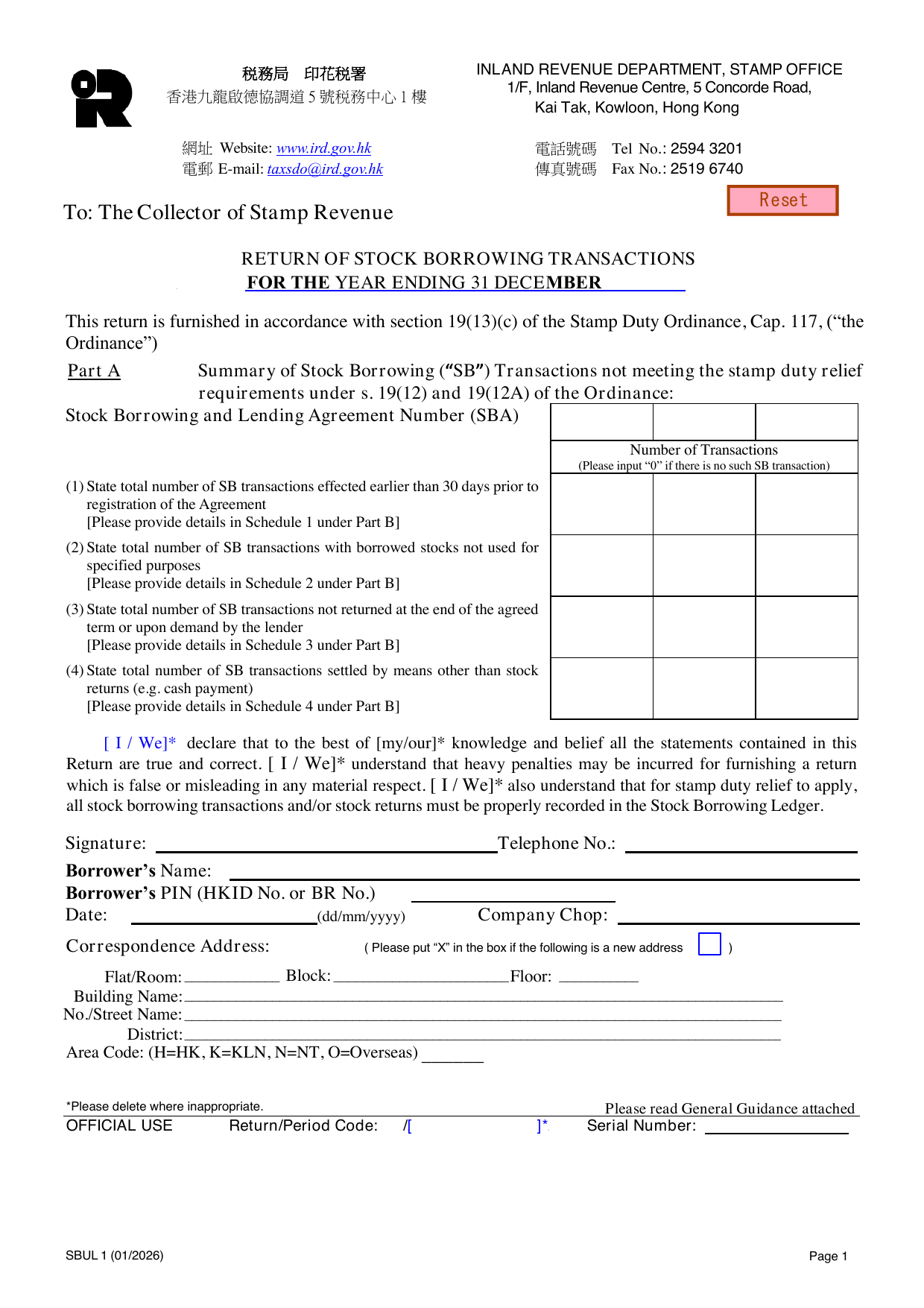
Part A - Summary of Stock Borrowing Transactions Not Meeting Stamp Duty Relief
Stock Borrowing and Lending Agreement Number (SBA) Enter the SBA number assigned to the stock borrowing and lending agreement under which the transactions were made. This number is obtained from the Stamp Office when the agreement is registered.
Number of Transactions For each of the four categories below, enter the total number of stock borrowing transactions that fall into that category. If there are none, enter “0”. Each category requires a separate schedule in Part B.
-
(1) State total number of SB transactions effected earlier than 30 days prior to registration of the Agreement
Count transactions where the stock borrowing took place more than 30 days before the SBA was registered. Provide details in Schedule 1 of Part B. -
(2) State total number of SB transactions with borrowed stocks not used for specified purposes
Count transactions where the borrowed stocks were not used for the purposes specified in the Ordinance (e.g., not for settlement of a sale). Provide details in Schedule 2 of Part B. -
(3) State total number of SB transactions not returned at the end of the agreed term or upon demand by the lender
Count transactions where the borrowed stocks were not returned by the contractual return date or when the lender demanded them. Provide details in Schedule 3 of Part B. -
(4) State total number of SB transactions settled by means other than stock returns (e.g. cash payment)
Count transactions where the borrowing was settled by cash or other non-stock means instead of returning the original stocks. Provide details in Schedule 4 of Part B.
Declaration and Borrower Details
Signature - The borrower (or an authorised officer) must sign.
Telephone No. - A contact number for the borrower.
Borrower’s Name - Full legal name of the borrowing entity.
Borrower’s PIN (HKID No. or BR No.) - For an individual, the Hong Kong Identity Card number. For a company, the Business Registration number (found on the BR certificate).
Date (dd/mm/yyyy) - The date of signing.
Company Chop - Company seal, if applicable.
Correspondence Address - Enter the full address. If this is a new address, put an “X” in the box before the address fields.
Part B - Schedules of Transactions
Each schedule corresponds to a category from Part A. The number of transactions entered in Part A for that schedule must match the number of rows you complete here.
For each transaction in a schedule, provide:
- Stock Borrowing Ledger Item No. - The reference number from your stock borrowing ledger.
- Stock Code and Stock Name - The code and name of the borrowed stock (e.g., 0005.HK HSBC Holdings).
- Quantity of Stock Borrowed - The number of shares or units borrowed.
- Initial Stock Borrowing Date - The date the stock was first borrowed.
- Duty fully paid on these SB transactions? (YES/NO) - Answer YES only if stamp duty has been fully paid on the borrowing. If NO, you must pay duty.
- Date of Payment of stamp duty, if applicable, and please attach Supporting Documents - If duty was paid, enter the payment date and attach evidence (e.g., stamped instruments).
Schedule 1 - Use the “Latest Date on which the Borrowing Stocks should be returned” column instead of “Initial Stock Borrowing Date”. This is the contractual return date.
Schedule 3 - Use the “Latest Date on which the Borrowing Stocks should be returned” column. This is the date by which the stocks should have been returned.
Schedule 4 - Use the “Date of Settlement” column instead of “Initial Stock Borrowing Date”. This is the date the settlement (e.g., cash payment) occurred.
Important: If you need more space, use supplementary sheets. Each schedule’s footnote reminds you that related stock returns may also require stamp duty payment - present those instruments to the Stamp Office.
Download the current form - always file the version on the issuing authority's site, not a copy.
Sources
More on the forms library.