Maintaining a Stock Borrowing Ledger with Form SBUL3
Use Form SBUL3 to maintain a proper stock borrowing ledger for Hong Kong transactions. This guide covers the required entries and compliance standards.
SBUL3 at a glance
- Official title
- Stock Borrowing Ledger
- Issued by
- Inland Revenue Department
We link the issuing authority's own index rather than hosting a copy, because the form is revised there and an out-of-date copy is worse than none.
Form SBUL3 Stock Borrowing Ledger: Purpose and Compliance Role
The Form SBUL3 Stock Borrowing Ledger is a statutory record. Every licensed participant in the Hong Kong stock borrowing and lending market must maintain it under Securities and Futures Commission (SFC) rules. This ledger is the primary compliance tool for documenting all stock borrowing transactions a participant executes, whether as borrower or lender. It is a continuous internal record, not a transactional return filed with the SFC. Keep the ledger at your place of business in Hong Kong and make it available for inspection upon request. This record makes every transfer of securities under a stock borrowing agreement traceable from initiation to settlement. That traceability supports market integrity and lets regulators monitor for abusive practices like naked short selling or settlement failures.
A participant is any corporation or individual licensed or registered to carry on business in securities dealings in Hong Kong. The ledger must capture the full lifecycle of each borrowing transaction: the agreement date, counterparty identity, security description, quantity, delivery and return dates, and any fees or interest payable. The Securities and Futures Ordinance (Cap. 571) and the SFC Code of Conduct provide the legal framework for these obligations. Failure to maintain the ledger properly can result in disciplinary action, fines, or licence suspension.
Hong Kong Stock Borrowing Ledger Requirements
Every participant engaged in stock borrowing must maintain a Hong Kong stock borrowing ledger that meets the SFC's minimum content requirements. The ledger must be a permanent record; entries cannot be deleted or overwritten. Make corrections by adding new entries with an explanation. An electronic ledger is permitted provided it can be reproduced in hard copy within a reasonable time. The SFC expects the ledger to contain, at minimum, the following fields for each transaction:
- transaction reference number
- date and time of the borrowing agreement
- name and code of the borrower or lender
- name, code and quantity of the security borrowed
- borrowing fee or lending charge, if any
- agreed date and method of delivery
- actual date of delivery and return
- any collateral posted or received
Maintain the Hong Kong stock borrowing ledger in English or Chinese. If entries are made in another language, annex an English or Chinese translation. Retain the ledger for a period of not less than seven years after the last entry is made, in accordance with the Securities and Futures (Keeping of Records) Rules. A participant that outsources back-office operations must ensure the service provider maintains a compliant ledger and can produce it for inspection.
Maintain Stock Borrowing Ledger SBUL3: Step-by-Step Procedure
Maintain stock borrowing ledger SBUL3 correctly by following a systematic entry process. Update the ledger on a trade-date basis. Record entries no later than the end of the business day on which the borrowing agreement is reached. For each transaction, identify whether you are acting as borrower or lender and record the counterparty's full legal name and participant code. The security description must include the Hong Kong stock code, the security name as listed on the Stock Exchange of Hong Kong, and the quantity expressed in board lots or exact number of shares.
When securities are delivered, record the Central Clearing and Settlement System (CCASS) transaction reference. Upon return, the entry must cross-reference the original borrowing transaction number and state the actual return date. If the return is a cash equivalent, the ledger must state the reason and the amount paid. Record any substitutions or partial returns. After each series of transactions, reconcile the ledger positions with the CCASS inventory records and the stock borrowing agreement file. A monthly reconciliation sign-off by a responsible officer is considered best practice.
Stock Borrowing Record Keeping: Best Practices and Common Errors
Sound stock borrowing record keeping requires more than filling in fields. The most common compliance deficiency identified in SFC inspections is the failure to maintain a contemporaneous record. Entries backdated days or weeks after the transaction date may be treated as non-compliant even if the data is accurate. Implement system controls that prevent post-dating and audit trails that log every change. Another frequent error is omitting the identity of the stock borrowing agreement under which the transaction was effected. The SFC requires that each ledger entry link to a specific registered agreement using the agreement reference number from the SBUL2 registration form.
A second common error is omitting collateral details. Where collateral secures the stock loan, the ledger must record the collateral type, the amount, and the valuation date and method. If the collateral is rehypothecated, the ledger must note this. Record any margin calls and collateral adjustments. These details are critical for establishing that the transaction is genuine stock lending and not a disguised sale. The SFC may compare ledger entries with CCASS statements and bank account statements to verify that securities and cash movements match.
Ensure the ledger captures all stock borrowing transactions, not only those entered into directly with another participant. Borrowing from a client or lending to a client must be recorded in the same ledger, with the client designated as the counterparty. If you use an automated lending programme or securities lending agency arrangement, the transactions must still be recorded individually in the SBUL3 ledger. The use of aggregated or bulk entries is not permitted unless the SFC has given prior written approval.
Submission and Inspection of the SBUL3 Ledger
The Form SBUL3 Stock Borrowing Ledger is not submitted to the SFC on a regular filing schedule. It is a record that must be produced upon demand within the timeframe specified in the SFC's notice, typically within one business day. The SFC will give at least 24 hours' notice for a routine inspection but may require immediate production in an investigation. Keep the ledger at the Hong Kong place of business specified in your licence registration and notify the SFC of any change of address where the ledger is kept.
During an inspection, the SFC may request the following supporting documents with the ledger:
- the registered stock borrowing agreements (Form SBUL2)
- the transactional returns (Form SBUL1)
- CCASS statements for the relevant period
- bank statements showing collateral movements
- internal policies and procedure manuals for stock borrowing
- reconciliation reports and sign-off records
The SFC inspection team will typically examine a sample of transactions to determine whether the ledger entries are complete, accurate and timely. Remedy any discrepancies identified within the time frame directed by the inspector. A participant that fails to provide the ledger on demand may be considered to be in breach of its licence conditions and may face disciplinary proceedings. The maximum penalty for non-compliance includes a fine of up to HK$500,000 and suspension of the participant's licence for a specified period.
Distinction Between Form SBUL3 and Other Stock Borrowing Forms
Do not confuse the SBUL3 ledger with Form SBUL1 or Form SBUL2, which serve distinct compliance functions. Form SBUL1 is the transactional return that reports each stock borrowing transaction to the SFC and the Stock Exchange of Hong Kong; it is filed within one business day of the transaction. Form SBUL2 is the agreement registration form used to register a stock borrowing and lending agreement with the SFC before any transactions can be effected under it. The SBUL3 ledger is the internal record that captures all transactions under registered agreements.
A participant must maintain all three records concurrently. The SBUL2 agreement provides the legal framework, the SBUL1 return notifies the regulator of each execution, and the SBUL3 ledger provides the audit trail for every movement of securities and cash. The SFC may cross-reference the three documents during an inspection to verify consistency. A participant that has filed SBUL1 returns but cannot produce the corresponding SBUL3 ledger entries may be found to have inadequate record-keeping systems. Conversely, a ledger that reflects transactions not reported on SBUL1 raises questions about compliance with the reporting rules. The SFC expects the three records to be reconcilable at any point in time.
How to fill out Form SBUL3
Page one of the official form. Every field named below appears on it in the same order.
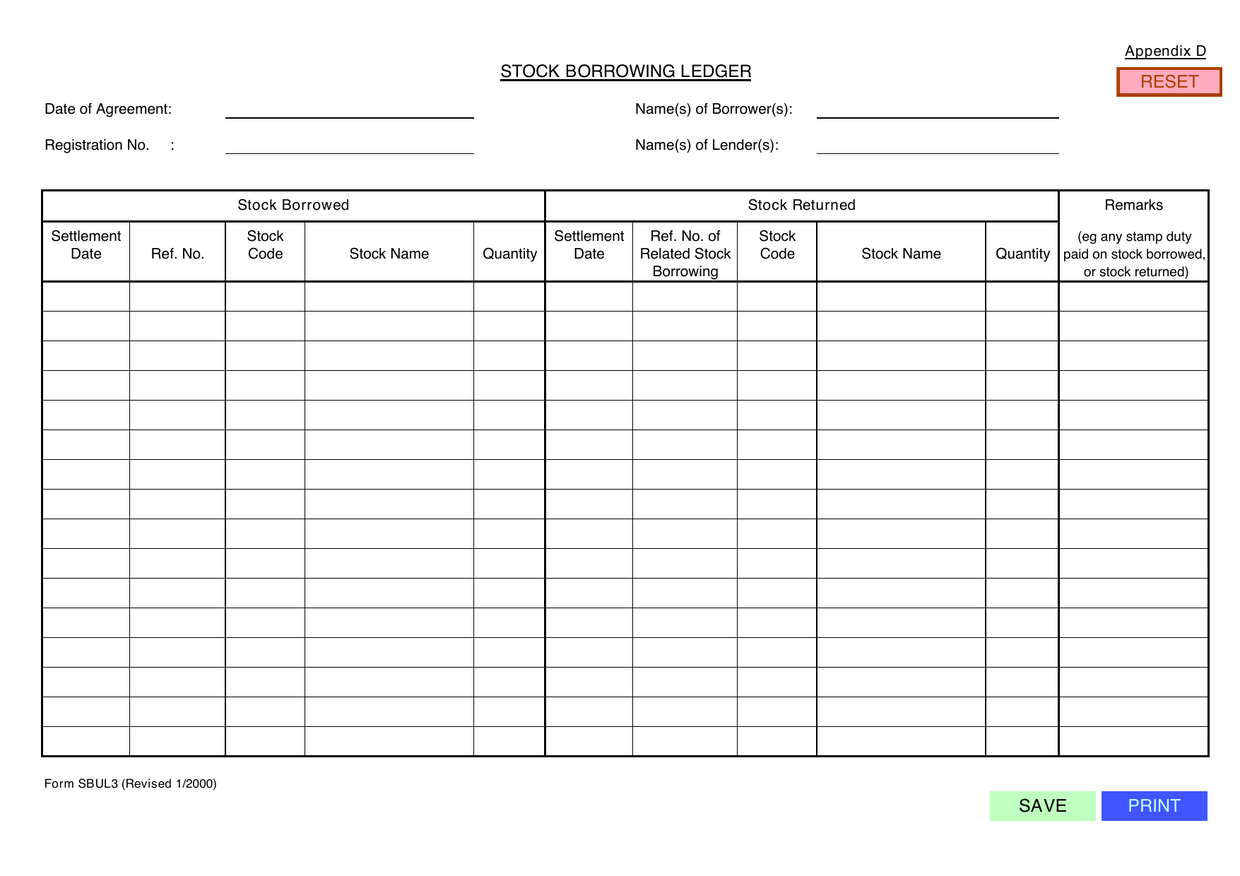
Date of Agreement
Enter the date on which the stock borrowing agreement was executed. This is the date the parties signed the agreement. Do not use the date settlement happens; use the contract date.
Name(s) of Borrower(s)
The full legal name(s) of the party or parties borrowing the stock. If there are multiple borrowers, list each name. Do not abbreviate unless the borrower is a registered entity whose official name includes an abbreviation.
Registration No.
The registration number of the borrower, as shown on the borrower’s Business Registration Certificate issued by the Inland Revenue Department. For a company borrower, this is not the company number; it is the business registration number (eight digits). If the borrower is an individual who does not hold a business registration, leave this box blank.
Name(s) of Lender(s)
The full legal name(s) of the party or parties lending the stock. List each lender separately if there are multiple.
Stock Borrowed
Columns under this heading record the stock taken on loan. Complete each row as follows:
- Settlement Date: The date on which the borrowed stock was actually delivered to the borrower. This must match the settlement date shown on the related stock borrowing confirmation or trade confirmation.
- Stock Ref. No.: The stock reference number assigned to this borrowing transaction by the parties or the clearing system (e.g., a unique internal deal reference).
- Stock Code: The exchange or clearing house code for the stock (for example, the Hong Kong stock code for shares listed on the Stock Exchange of Hong Kong).
- Stock Name: The full name of the stock as it appears on the exchange or in the lender’s records.
- Quantity: The number of shares or units borrowed. Enter the exact quantity, not the contract value.
Stock Returned
Columns under this heading record when loaned stock is later returned. Complete each row as follows:
- Settlement Date: The date on which the returned stock was delivered back to the lender.
- Ref. No. of Related Stock Borrowing: The stock reference number of the original borrowing transaction to which this return relates. This links the return to the corresponding borrowing. A common error is to leave this blank; it must be completed to match the borrowing entry.
- Stock Code: Same stock code as in the borrowing entry.
- Stock Name: Same stock name as in the borrowing entry.
- Quantity: The number of shares or units returned. If only part of a borrowing is returned, enter that quantity.
Remarks
Optional but useful. Common entries include “stamp duty paid on stock borrowed” or “stamp duty paid on stock returned.” Use this column to note any special conditions, fees, or adjustments. Do not leave information about stamp duty outside this column; record it here if it is relevant to the entry.
Signing and Filing
There is no signature block on the form. The form is a ledger; the filer should ensure all entries are complete and accurate. If additional rows are needed, use a continuation sheet (do not overwrite margins). The form is dated “Revised 1/2000”; use the current version.
Download the current form - always file the version on the issuing authority's site, not a copy.
Sources
More on the forms library.