

When financial markets start trembling and economic forecasts turn murky, central banks step into the spotlight. These powerful institutions hold the keys to monetary policy, and their decisions ripple through every corner of the global economy. Understanding their playbook matters whether you’re analyzing policy shifts, managing investments, or studying economic theory.
Central banks combat economic uncertainty through three primary tools: adjusting interest rates to influence borrowing costs, implementing quantitative easing to inject liquidity into markets, and using forward guidance to shape expectations. They balance inflation control with employment goals while monitoring financial stability indicators. Their responses vary based on the uncertainty’s nature, whether stemming from geopolitical events, financial crises, or structural economic shifts.
The fundamental toolkit central banks deploy
Central banks operate with a surprisingly focused set of instruments. Each tool serves a specific purpose, and understanding how they work together reveals the strategic thinking behind monetary policy decisions.
Interest rate adjustments form the cornerstone of central bank responses. When uncertainty threatens economic growth, central banks typically lower their benchmark rates. This makes borrowing cheaper for businesses and consumers, encouraging spending and investment. The Federal Reserve, European Central Bank, and Bank of England all slashed rates during the 2020 pandemic shock, bringing them close to zero within weeks.
The mechanism works through transmission channels. Lower rates reduce mortgage payments, business loan costs, and credit card interest. Companies find expansion projects more attractive. Households feel more confident making large purchases. The economy gets a boost precisely when uncertainty might otherwise freeze decision making.
Quantitative easing enters the picture when rate cuts alone prove insufficient. Central banks purchase government bonds and sometimes corporate securities, injecting fresh money into the financial system. This pushes down longer term interest rates and supports asset prices.
The Bank of Japan pioneered large scale quantitative easing in the early 2000s. The Federal Reserve adopted similar measures during the 2008 financial crisis, eventually expanding its balance sheet from under $1 trillion to over $4 trillion. These programs aim to keep credit flowing even when traditional lending channels seize up.
Forward guidance represents the communication strategy. Central banks signal their likely future actions, helping markets and businesses plan ahead. Clear messaging reduces one source of uncertainty even while addressing others.
“The single most important thing we can do during uncertain times is communicate clearly about our policy intentions. Markets need anchors, and our words provide them.” This principle guides modern central banking communication strategies across major economies.
Responding to different types of uncertainty
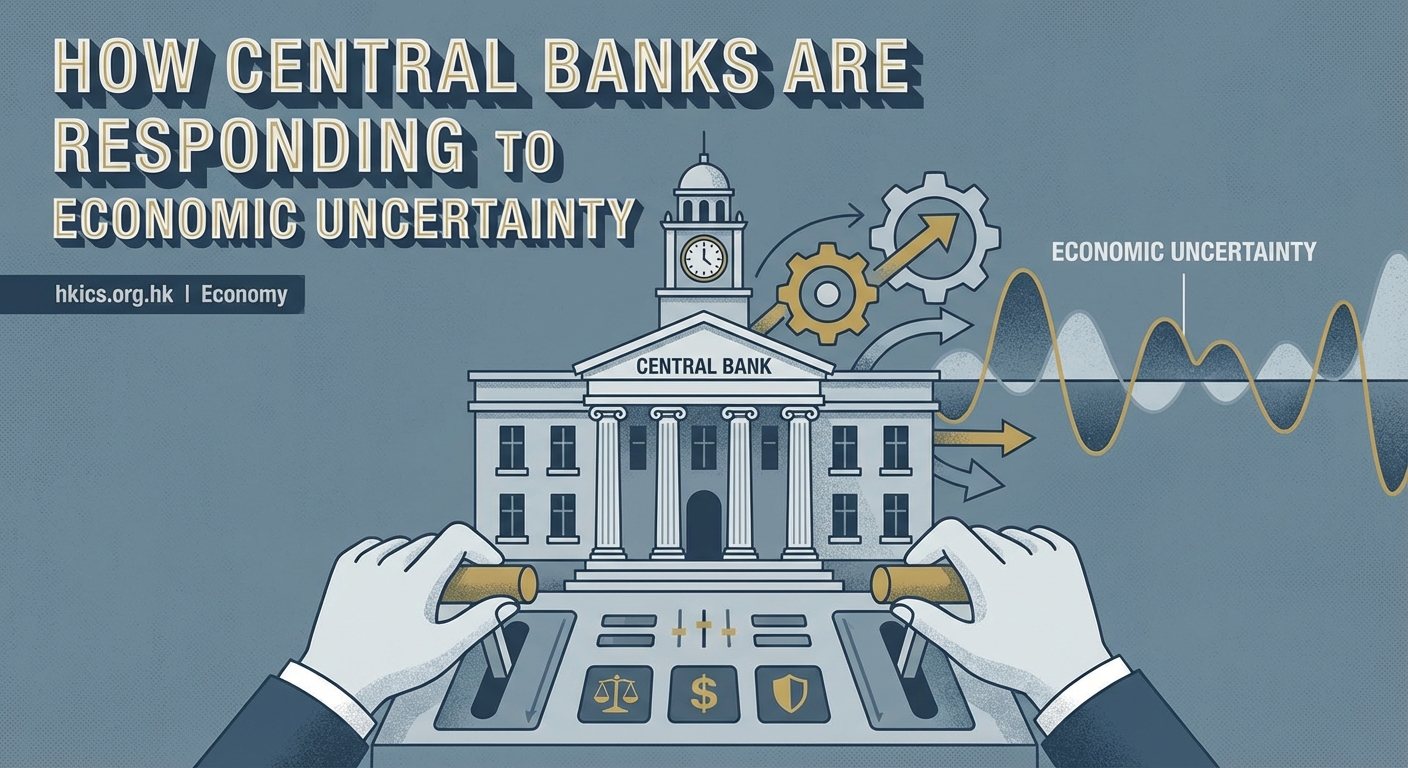
Not all uncertainty looks the same, and central banks adjust their responses accordingly. A supply shock demands different medicine than a demand collapse or a financial system crisis.
Demand side uncertainty typically emerges during recessions or slowdowns. Consumer confidence drops. Businesses postpone investments. Central banks respond with accommodative policies designed to stimulate spending. Rate cuts and asset purchases work well here because the problem stems from insufficient economic activity.
Supply side shocks present trickier challenges. When oil prices spike or supply chains break down, inflation rises while growth slows. This combination, called stagflation, limits central bank options. Stimulating demand risks worsening inflation. Tightening policy to fight inflation could deepen the slowdown.
Central banks facing supply shocks often adopt a “look through” approach. They tolerate temporary inflation spikes, maintaining supportive policies to prevent demand from collapsing. The key word is temporary. If supply disruptions persist, central banks must eventually prioritize price stability even at the cost of slower growth.
Financial system uncertainty requires yet another approach. When banks stop lending to each other or credit markets freeze, central banks act as lenders of last resort. They provide emergency liquidity to solvent institutions facing temporary funding problems.
The 2008 crisis showcased this role dramatically. Central banks created new lending facilities, accepted broader collateral, and coordinated international currency swap lines. These actions prevented a liquidity crisis from becoming a solvency crisis that could have collapsed the entire financial system.
The decision making process behind policy responses
Central banks follow structured processes when responding to uncertainty. Understanding these steps reveals why some responses come quickly while others take months.
-
Data collection and analysis form the foundation. Central banks monitor hundreds of indicators, from employment reports to credit spreads to business surveys. During uncertain periods, they increase monitoring frequency and expand their data sources.
-
Economic modeling helps project different scenarios. Staff economists run simulations showing how various policy choices might affect inflation, growth, and financial stability. These models incorporate uncertainty explicitly, generating probability distributions rather than single point forecasts.
-
Committee deliberation brings together diverse perspectives. Most major central banks use committees rather than single decision makers. Members debate the appropriate response, weighing risks and considering unintended consequences. Minutes from these meetings offer valuable insights into their thinking.
Balancing competing objectives under pressure

Central banks juggle multiple goals simultaneously, and uncertainty makes the balancing act harder. The primary mandate varies by institution, but most face similar tensions.
Price stability typically ranks as the top priority. Central banks target specific inflation rates, usually around 2% annually. When uncertainty threatens to push inflation far from target, they must act decisively.
Employment considerations matter too, especially for central banks with dual mandates like the Federal Reserve. Supporting maximum employment sometimes conflicts with inflation control. During uncertain times, central banks must judge which risk poses the greater threat.
Financial stability emerged as an explicit concern after 2008. Central banks now monitor leverage, asset bubbles, and systemic risks. They may tighten policy even with inflation at target if financial imbalances grow dangerous.
Exchange rate stability matters more for smaller, open economies. Sharp currency movements can import inflation or deflation, complicating domestic policy goals. Some central banks intervene in foreign exchange markets during periods of excessive volatility.
| Policy Tool | Primary Effect | Implementation Speed | Typical Uncertainty Response |
|---|---|---|---|
| Interest rate changes | Borrowing costs | Immediate | Lower rates to support demand |
| Quantitative easing | Long term rates and liquidity | Days to weeks | Expand purchases during crises |
| Forward guidance | Expectations management | Immediate | Commit to supportive stance |
| Reserve requirements | Bank lending capacity | Weeks | Reduce requirements to free capital |
| Emergency lending facilities | Financial system liquidity | Hours to days | Activate during credit freezes |
Common mistakes and how central banks avoid them
Experience has taught central banks valuable lessons about what not to do during uncertain times. These pitfalls shape modern policy frameworks.
Acting too slowly ranks among the most dangerous errors. The Great Depression worsened partly because central banks failed to provide adequate liquidity. Modern central banks err on the side of acting decisively, knowing they can always reverse course later.
Overreacting to temporary shocks creates its own problems. If central banks aggressively ease policy every time uncertainty rises, they risk creating moral hazard and fueling asset bubbles. Distinguishing temporary volatility from fundamental shifts requires judgment.
Poor communication amplifies uncertainty rather than reducing it. Contradictory statements from different officials or sudden policy reversals without explanation undermine credibility. Central banks now coordinate messaging carefully and explain their reasoning transparently.
Ignoring financial stability while focusing solely on inflation proved costly in the 2000s. Low inflation coincided with dangerous credit growth. Central banks now take a broader view, monitoring financial conditions even when traditional indicators look benign.
Fighting the last war means applying lessons from previous crises inappropriately to new situations. Each period of uncertainty has unique characteristics. Central banks must adapt their responses rather than mechanically following historical playbooks.
Coordination with other policy makers
Central banks rarely act in isolation during major uncertainty episodes. Fiscal policy, regulatory changes, and international cooperation all play important roles.
Fiscal and monetary policy work best in tandem. Government spending programs can target specific sectors or populations while monetary policy provides broad based support. The 2020 pandemic response demonstrated this coordination, with massive fiscal stimulus complementing central bank actions.
Regulatory flexibility helps too. During crises, regulators may temporarily relax certain requirements, allowing banks to use capital buffers or modify reporting standards. This gives financial institutions breathing room to continue lending.
International coordination matters increasingly in our connected global economy. Central banks share information, align policy timing when appropriate, and maintain currency swap lines. The Federal Reserve’s dollar swap lines with other major central banks proved critical during both 2008 and 2020, ensuring dollar funding remained available worldwide.
Measuring effectiveness and adjusting course
Central banks constantly evaluate whether their policies are working as intended. This assessment process shapes subsequent decisions.
Financial market indicators provide the fastest feedback. Bond yields, stock prices, credit spreads, and currency movements react immediately to policy announcements. Central banks monitor these signals to gauge whether their actions are having the desired effect on financial conditions.
Real economy data takes longer to reflect policy impacts. Employment, inflation, and growth statistics appear with delays and get revised multiple times. Central banks must make decisions based on incomplete information, updating their assessment as new data arrives.
Inflation expectations deserve special attention. If businesses and households expect higher inflation, they adjust wages and prices accordingly, making the expectations self fulfilling. Central banks track market based measures and survey data to ensure expectations remain anchored near their targets.
Credit flows reveal whether monetary stimulus is reaching the real economy. Central banks examine bank lending standards, loan growth, and credit availability for different borrower types. If policy easing fails to boost credit, they may need additional measures.
Regional variations in central bank approaches
Different central banks face different constraints and adopt varying strategies when responding to uncertainty. These differences reflect institutional mandates, economic structures, and historical experiences.
The Federal Reserve operates with a dual mandate covering both price stability and maximum employment. This gives it flexibility to prioritize growth support during uncertainty, particularly when inflation runs below target. Its large, relatively closed economy allows significant policy independence.
The European Central Bank serves multiple countries with different economic conditions. This complicates policy making during uncertainty, as the appropriate response for Germany might differ from what Italy needs. The ECB must balance diverse national interests while maintaining price stability across the eurozone.
The Bank of Japan has fought deflation for decades, giving it unique experience with unconventional policies. It pioneered negative interest rates and yield curve control, tools other central banks later adopted. Japanese monetary policy remains highly accommodative even during periods other regions consider uncertain.
Emerging market central banks face additional challenges. Capital flight during uncertainty can force them to raise rates even when their economies need support. Currency stability often takes priority over domestic considerations. Many have built up foreign exchange reserves as insurance against sudden outflows.
The evolving nature of uncertainty and policy innovation
Central banks continuously adapt their tools and frameworks as new sources of uncertainty emerge. Recent years have brought fresh challenges requiring innovative responses.
Climate change represents a new category of uncertainty. Physical risks from extreme weather and transition risks from moving to a low carbon economy both affect financial stability. Some central banks now incorporate climate scenarios into their stress testing and consider environmental factors in asset purchases.
Digital currencies and financial technology create both opportunities and risks. Central banks are exploring their own digital currencies while monitoring private sector innovations. These developments could fundamentally change how monetary policy transmits through the economy.
Geopolitical fragmentation and deglobalization challenge assumptions underlying many policy models. Supply chains are reorganizing. Trade patterns are shifting. Central banks must consider how these structural changes affect the relationship between policy actions and economic outcomes.
Inequality has emerged as a concern even for institutions primarily focused on aggregate economic performance. Monetary policy affects different groups differently. Asset purchases boost asset prices, benefiting those who own financial assets. Central banks increasingly acknowledge these distributional effects when designing their responses.
Building credibility for future challenges
How central banks respond to current uncertainty shapes their ability to handle future episodes. Credibility acts as a form of capital that takes years to build but can be lost quickly.
Delivering on commitments matters enormously. When central banks promise to maintain supportive policies until specific conditions are met, they must follow through. Breaking promises undermines forward guidance effectiveness in future uncertain periods.
Maintaining independence from political pressure preserves credibility. Markets trust that central bank decisions reflect economic analysis rather than political expediency. This trust becomes especially valuable during uncertainty when clear headed policy making matters most.
Transparency about limitations helps too. Central banks cannot eliminate uncertainty or guarantee specific outcomes. Honest communication about what they can and cannot achieve sets realistic expectations and preserves trust when outcomes disappoint.
Learning from mistakes and adapting demonstrates intellectual honesty. Central banks that acknowledge past errors and explain how they have improved their frameworks earn respect. Rigid adherence to failed approaches destroys credibility faster than admitting imperfection.
Making sense of central bank actions in real time
For those watching central bank responses unfold, certain signals help interpret what policy makers are thinking and what might come next.
Statement language changes often telegraph future moves. When central banks shift from describing inflation as “transitory” to “persistent,” or from expressing “concern” to “significant concern,” these word choices matter. Policy adjustments typically follow rhetorical shifts.
Voting patterns reveal internal disagreements. When committee members dissent or vote margins narrow, uncertainty exists even among policy makers. These divisions often precede policy pivots as new information tips the balance.
Emergency meeting announcements signal serious concern. Central banks normally operate on regular schedules. Calling special meetings indicates they view the situation as requiring immediate action, suggesting significant uncertainty or risk.
The size and composition of policy responses indicate severity assessments. A quarter point rate cut suggests modest concern. A full point cut or unlimited asset purchases signals crisis mode. The tools deployed reveal what type of uncertainty central banks believe they face.
Preparing for the next wave of uncertainty
Economic uncertainty never disappears completely. It simply changes form. Central banks prepare continuously for challenges that may emerge months or years ahead.
Scenario planning exercises help identify potential pressure points. Central banks game out various adverse situations, from financial market disruptions to geopolitical shocks to natural disasters. These exercises reveal gaps in their toolkit and inform contingency planning.
Research programs investigate new policy tools and refine understanding of existing ones. Academic partnerships and internal analysis help central banks stay ahead of economic changes. This research foundation supports faster, more effective responses when uncertainty strikes.
Communication strategies evolve based on effectiveness assessments. Central banks study how markets and the public interpret their messages, adjusting language and channels to improve clarity. Better communication reduces uncertainty even when economic conditions remain challenging.
International relationships strengthen the collective response capacity. Regular meetings, information sharing agreements, and standing swap line arrangements ensure central banks can coordinate quickly when global uncertainty demands joint action.
Turning theory into practical understanding
Central banks wield enormous influence over economic outcomes during uncertain times. Their responses follow logical patterns rooted in decades of experience and economic theory. Interest rates move to influence borrowing and spending. Asset purchases inject liquidity when credit freezes. Clear communication guides expectations when the future looks foggy.
The specific response depends on the uncertainty’s source and the central bank’s mandate. Demand shocks get stimulative medicine. Supply shocks require careful balancing. Financial crises demand emergency liquidity provision. Each situation calls for judgment about which tools to deploy and how aggressively to act.
Watching central banks in action becomes easier once you understand their decision making framework and recognize the signals they send. Pay attention to their words as much as their actions. Notice what they emphasize and what concerns they downplay. These institutions telegraph their intentions more clearly now than ever before, giving attentive observers valuable insights into how monetary policy will likely evolve as uncertainty unfolds.