

Every Hong Kong company must file financial statements each year. It’s not optional. Whether you run a small startup or manage a growing business, understanding this process saves time, money, and headaches. Getting it wrong can mean penalties, rejected filings, or worse.
Preparing financial statements in Hong Kong requires following the Companies Ordinance and Hong Kong Financial Reporting Standards. You must include a balance sheet, profit and loss account, cash flow statement, and notes. Most companies need an audit unless they qualify for exemptions. Filing happens within 42 days of your AGM, and late submissions carry penalties.
What financial statements must Hong Kong companies prepare
Hong Kong law requires specific documents. The Companies Ordinance sets out what you need.
Your financial statements must include:
- Balance sheet showing assets, liabilities, and equity
- Profit and loss account (income statement) detailing revenue and expenses
- Cash flow statement tracking money in and out
- Notes to the accounts explaining your accounting policies and providing additional details
- Directors’ report outlining business activities and results
The format depends on your company size. Small private companies can use simplified reporting. Larger businesses need full disclosure under Hong Kong Financial Reporting Standards (HKFRS).
Most companies also need an auditor’s report. This independent review confirms your statements give a true and fair view. Only very small companies can skip the audit if they meet specific criteria.
Understanding Hong Kong Financial Reporting Standards
HKFRS forms the backbone of financial reporting here. These standards align closely with International Financial Reporting Standards (IFRS).
The Hong Kong Institute of Certified Public Accountants issues and updates these standards. They cover everything from revenue recognition to lease accounting.
For small and medium entities, there’s HKFRS for Private Entities. This simplified framework reduces complexity while maintaining quality. It’s perfect for companies without public accountability.
You need to state which framework you’re using in your notes. Consistency matters. Once you pick a framework, stick with it unless circumstances change significantly.
Preparing your balance sheet
The balance sheet captures your financial position at a specific date. Usually, that’s your financial year end.
Start with assets. List everything your company owns or controls:
- Non-current assets like property, equipment, and long-term investments
- Current assets including cash, inventory, and receivables due within 12 months
- Total assets by adding both categories
Next, show liabilities. These are amounts you owe:
- Current liabilities due within 12 months (trade payables, short-term loans)
- Non-current liabilities like long-term debt or deferred tax
- Total liabilities by summing both
Finally, calculate equity. This is what belongs to shareholders after paying all debts.
The fundamental equation must balance: Assets = Liabilities + Equity.
Present comparative figures from the prior year. This helps readers spot trends and changes.
Creating your profit and loss account
This statement shows whether you made money or lost it during the year.
Begin with revenue. Include all income from your ordinary business activities. Be specific about different revenue streams if they’re significant.
Subtract cost of sales. This includes direct costs of producing goods or delivering services.
The result is gross profit. From here, deduct operating expenses:
- Staff salaries and benefits
- Rent and utilities
- Marketing and advertising
- Depreciation on assets
- Administrative costs
Add any other income like interest earned or gains on asset sales. Subtract finance costs like loan interest.
The bottom line shows profit or loss before tax. Then deduct tax expense to arrive at profit or loss for the year.
“The profit and loss account tells your company’s story. Every line should make sense to someone reading it for the first time. If you can’t explain a number, dig deeper before finalizing.”
Preparing the cash flow statement
Cash is king. This statement proves it by tracking actual money movements.
Organize cash flows into three categories:
Operating activities include cash from customers and payments to suppliers and employees. Start with profit, then adjust for non-cash items like depreciation. Add or subtract changes in working capital.
Investing activities cover purchases and sales of long-term assets. Buying equipment shows as cash out. Selling investments appears as cash in.
Financing activities relate to funding sources. Taking out loans brings cash in. Repaying debt or paying dividends sends cash out.
The net change in cash should reconcile your opening and closing cash balances. If it doesn’t, you’ve made an error somewhere.
Writing comprehensive notes to accounts
Notes aren’t optional extras. They’re mandatory explanations that make your numbers meaningful.
Start with accounting policies. Explain how you:
- Recognize revenue
- Value inventory
- Depreciate fixed assets
- Account for taxes
- Handle foreign currency
Then provide detailed breakdowns. For example, if property and equipment total $500,000, break this down by category. Show cost, accumulated depreciation, and net book value for each class.
Disclose related party transactions. If you rent premises from a director or buy goods from an associated company, state the relationship and transaction amounts.
Include contingent liabilities. These are possible obligations depending on future events, like pending lawsuits or guarantees given.
Common preparation mistakes and how to avoid them
| Mistake | Why it happens | How to fix it |
|---|---|---|
| Mixing personal and business expenses | Poor bookkeeping separation | Maintain separate bank accounts and records |
| Missing accruals and prepayments | Cash basis thinking | Review all expenses at year end for timing |
| Incorrect depreciation rates | Using tax rates instead of accounting rates | Apply rates that reflect actual asset usage |
| Incomplete disclosure | Not understanding requirements | Use a disclosure checklist based on HKFRS |
| Misclassifying items | Lack of accounting knowledge | Consult your accountant before finalizing |
Many errors stem from inadequate record keeping throughout the year. Don’t wait until year end to organize your books.
The audit requirement and exemptions
Most Hong Kong companies need an audit. A qualified auditor reviews your statements and issues an opinion.
The auditor checks whether:
- Your statements comply with HKFRS
- They give a true and fair view
- Proper books and records were kept
- The statements match underlying records
Small private companies can claim audit exemption if they meet both tests:
- Annual revenue not exceeding HK$25 million
- Total assets not exceeding HK$25 million
Even if exempt, you still prepare full financial statements. You just skip the audit. Many banks and landlords still want audited statements, so consider this before claiming exemption.
Dormant companies also avoid audits if they had no significant transactions during the year.
Filing your financial statements with the Companies Registry
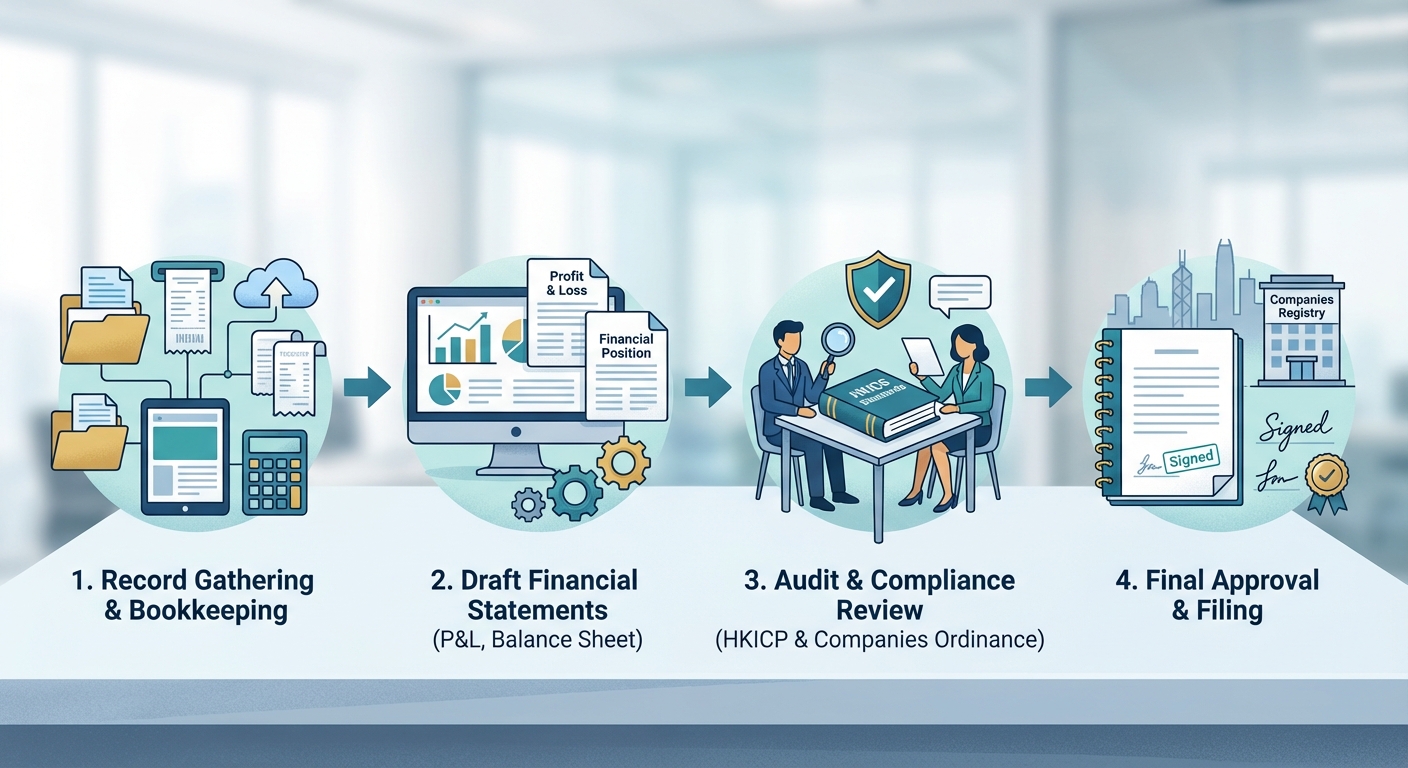
After preparing and auditing your statements, you must file them. This happens at your Annual General Meeting (AGM).
Timeline matters:
- Hold your AGM within 9 months of your financial year end
- File the annual return within 42 days after the AGM
- Include your financial statements with the annual return
The annual return form (NAR1) accompanies your statements. It confirms company details, directors, shareholders, and capital structure.
Filing happens through the e-Registry portal or by paper submission. Electronic filing is faster and confirms receipt immediately.
Late filing triggers automatic penalties. The first penalty is HK$870. Further delays bring higher fines and potential court proceedings.
Working with accountants and service providers
Unless you have accounting expertise, professional help makes sense. The cost often pays for itself through accuracy and time saved.
A good accountant will:
- Maintain your books throughout the year
- Prepare draft financial statements
- Coordinate with auditors
- Handle filing requirements
- Advise on tax planning
Choose someone familiar with Hong Kong requirements. Ask about their experience with companies like yours. Get clear fee quotes upfront.
Provide complete records promptly. The more organized your information, the smoother the process and lower the cost.
Some companies use bookkeepers for monthly work and accountants for year-end statements. This tiered approach can be cost effective.
Digital tools for financial statement preparation
Modern accounting software simplifies preparation significantly. Cloud based platforms let you track transactions in real time.
Popular options in Hong Kong include:
- Xero for small to medium businesses
- QuickBooks for straightforward accounting needs
- MYOB for companies wanting local support
- Sage for more complex requirements
These platforms generate financial statements automatically from your transaction data. You still need to review and adjust them, but the heavy lifting is done.
Look for software that:
- Handles Hong Kong tax requirements
- Supports HKD and multiple currencies
- Integrates with your bank
- Allows accountant access
- Produces HKFRS compliant reports
Many accountants prefer clients using specific software. Ask before committing to a platform.
Special considerations for different business types
Your company structure affects preparation requirements.
Sole proprietorships and partnerships follow simpler rules. They don’t file with the Companies Registry but still need statements for tax purposes.
Group companies face consolidation requirements. Parent companies prepare consolidated statements combining all subsidiaries.
Foreign companies with Hong Kong branches must prepare statements for the branch and file them annually.
Listed companies have extensive additional requirements under Stock Exchange rules. They publish interim and annual reports with strict deadlines.
Non-profit organizations use different frameworks focusing on funds and activities rather than profit.
Keeping your financial records organized year round
Good statements start with good records. Don’t leave everything until year end.
Set up systems now:
- Use accounting software from day one
- Scan and file receipts immediately
- Reconcile bank accounts monthly
- Track inventory regularly if applicable
- Document unusual transactions as they happen
Create a month end routine. Review your accounts, check for errors, and make necessary adjustments. This spreads the work evenly and catches problems early.
Maintain a filing system for supporting documents. When your accountant asks for a specific invoice from six months ago, you should find it in minutes.
Back up your data regularly. Cloud accounting provides automatic backups, but if you use desktop software, schedule weekly backups to external storage.
Understanding your completed financial statements
Once prepared, take time to understand what your statements say. They’re not just compliance documents. They’re business intelligence.
Look at key ratios:
- Current ratio (current assets divided by current liabilities) shows short-term financial health
- Gross profit margin reveals pricing and cost control effectiveness
- Return on equity measures how well you’re using shareholder funds
Compare this year to last year. Which numbers improved? Which worsened? Why?
Your statements might reveal:
- Cash flow problems despite showing profit
- Inventory building up unsold
- Receivables taking longer to collect
- Rising costs eating into margins
Use these insights to make better decisions. Financial statements aren’t just about looking backward. They inform where you go next.
Getting your statements right the first time
Preparation doesn’t need to be stressful. Start early and follow a systematic approach.
The Companies Ordinance and HKFRS provide clear rules. Follow them carefully. When uncertain, ask your accountant or auditor before finalizing.
Keep accurate records throughout the year. This single habit makes year end dramatically easier.
File on time. Mark your AGM deadline on the calendar and work backward to ensure everything’s ready.
Your financial statements represent your company to the world. Banks review them for loans. Investors study them before committing funds. Regulators check them for compliance.
Getting them right matters. Take the process seriously, seek help when needed, and build systems that make next year even smoother.