

Getting corporate governance right in Hong Kong isn’t just about ticking regulatory boxes. It’s about building a framework that protects your company, satisfies stakeholders, and keeps you ahead of compliance requirements that seem to shift every quarter.
Corporate governance best practices in Hong Kong require company secretaries to balance regulatory compliance with practical board management. This includes implementing proper disclosure controls, maintaining accurate statutory records, ensuring board effectiveness, managing ESG reporting obligations, and staying current with Securities and Futures Commission and Stock Exchange requirements. Strong governance protects companies from regulatory penalties while building stakeholder confidence and operational resilience.
Understanding the Hong Kong governance landscape
Hong Kong operates under a unique regulatory environment that blends common law traditions with modern securities regulation. The Companies Ordinance provides the statutory foundation, while the Listing Rules add layers of requirements for public companies.
Company secretaries sit at the center of this framework. You’re responsible for ensuring directors understand their duties, meetings follow proper procedure, and disclosures meet legal standards.
The Securities and Futures Commission has increased enforcement activity over the past few years. Penalties for governance failures have grown more severe. Listed companies face particular scrutiny around connected transactions, disclosure timing, and board independence.
Small and medium enterprises often assume governance standards only matter for large corporations. That’s a costly mistake. Proper governance protects minority shareholders, facilitates fundraising, and reduces personal liability for directors.
Core responsibilities for company secretaries
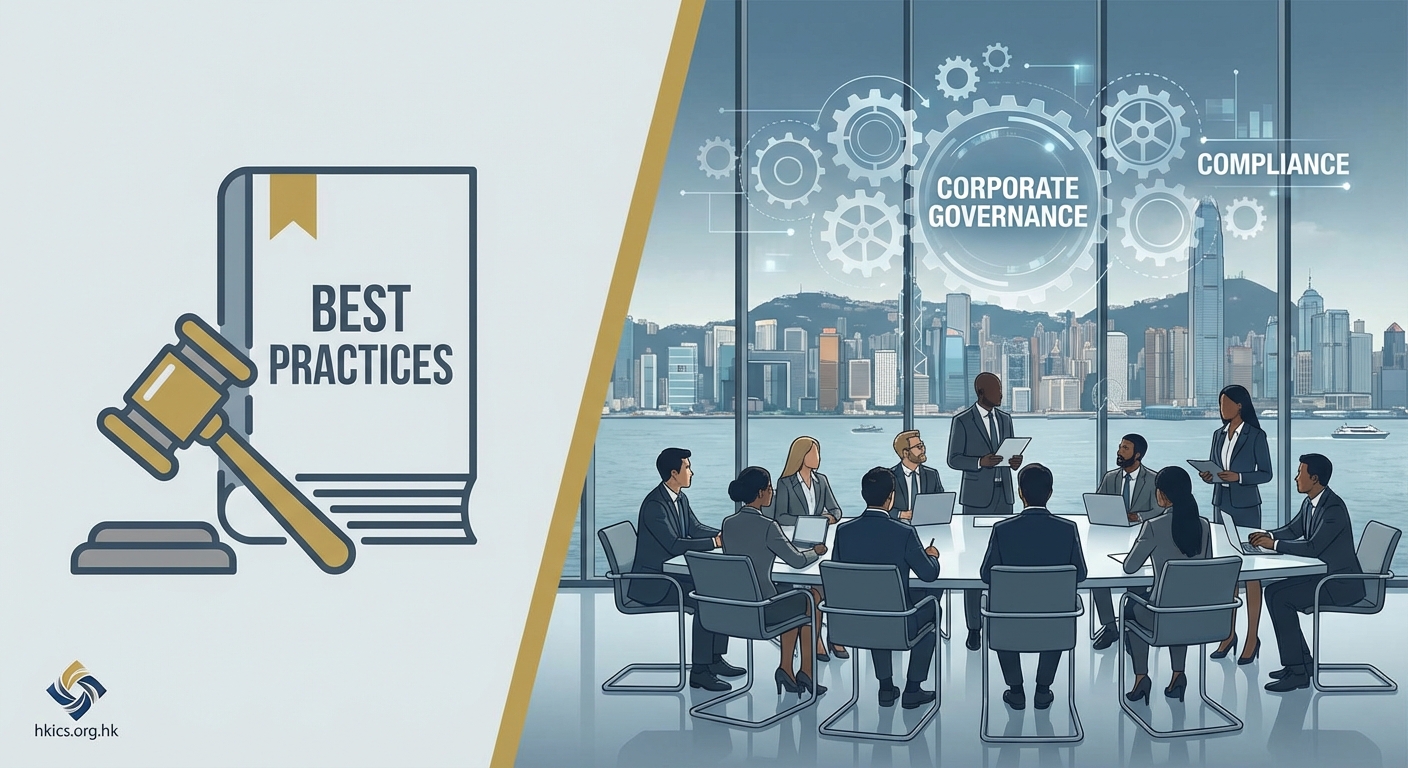
Your role extends far beyond filing annual returns. You’re the guardian of corporate compliance and the advisor who keeps directors out of trouble.
Statutory compliance and record keeping
Maintaining accurate statutory registers is non-negotiable. The Companies Registry can request inspection at any time, and missing or incomplete records trigger penalties.
Your registers must include:
- Register of members with current shareholdings
- Register of directors and company secretaries
- Register of controllers (persons with significant control)
- Register of charges over company assets
- Minutes of all board and shareholder meetings
Each register has specific content requirements under the Companies Ordinance. The register of controllers, introduced in 2018, catches many companies off guard. You need systems to identify beneficial owners and keep information current.
Document retention policies matter more than most companies realize. Keep board minutes permanently. Financial records must be retained for seven years. Correspondence with regulators should never be destroyed without legal advice.
Board meeting management
Effective board meetings don’t happen by accident. They require preparation, proper notice, and careful minute taking.
Here’s a practical process for managing board meetings:
- Circulate the agenda and papers at least three days before the meeting (seven days for listed companies)
- Confirm quorum requirements and director availability
- Prepare conflict of interest declarations for any sensitive items
- Take detailed minutes focusing on decisions and rationale, not verbatim discussion
- Circulate draft minutes within 48 hours while memories are fresh
- Obtain chairman approval before final circulation
- Maintain both a working file and a formal minute book
Minutes serve as legal evidence of board decisions. Write them assuming they’ll be read by regulators, auditors, or judges. Avoid recording sensitive preliminary discussions that don’t lead to formal resolutions.
For listed companies, pay special attention to timing around price-sensitive information. Directors can’t trade in company shares during blackout periods. Your meeting schedule should account for these restrictions.
Building an effective governance framework
Strong governance requires more than compliance with minimum standards. You need policies, procedures, and controls that work in practice.
Board composition and independence
The Listing Rules require at least three independent non-executive directors, representing at least one-third of the board. But independence isn’t just about meeting technical tests.
Real independence means directors who will challenge management, ask difficult questions, and protect minority shareholders. When recruiting independent directors, look beyond their resume. Consider whether they have the time, expertise, and temperament to be effective.
Board diversity has moved from nice-to-have to regulatory expectation. The Stock Exchange requires listed companies to have at least one female director. But effective diversity goes beyond gender to include skills, experience, and perspectives.
Create a skills matrix for your board. Map current directors against the competencies your company needs. Use this analysis to guide recruitment and identify gaps in collective board capability.
Committee structures
Audit, remuneration, and nomination committees serve as governance workhorses for listed companies. Each committee needs clear terms of reference, appropriate composition, and sufficient meeting frequency.
The audit committee deserves particular attention. At least one member must have accounting or financial management expertise. The committee should meet with external auditors without management present at least annually.
Common audit committee failures include:
| Weakness | Consequence | Better Practice |
|---|---|---|
| Rubber stamping management proposals | Missed risks and control failures | Require detailed papers and challenge assumptions |
| Insufficient time for complex matters | Rushed decisions on critical issues | Schedule longer meetings for accounts approval |
| Limited technical expertise | Inability to assess accounting judgments | Provide training or add members with relevant skills |
| Poor relationship with auditors | Late discovery of problems | Hold private sessions and encourage direct communication |
Remuneration committees face growing scrutiny around executive pay. Document the rationale for compensation decisions. Compare pay levels against industry peers. Avoid rewards for mediocre performance that erode shareholder confidence.
Disclosure and transparency obligations
Hong Kong places heavy emphasis on timely, accurate disclosure. Company secretaries must understand what needs to be disclosed, when, and how.
Continuous disclosure requirements
Listed companies must announce inside information as soon as reasonably practicable. Inside information means information that would likely materially affect share prices.
The test sounds simple but proves difficult in practice. When does a potential acquisition become inside information? What about disappointing sales figures or the loss of a major customer?
Err on the side of disclosure. The penalties for late disclosure far exceed any benefit from delayed announcement. When in doubt, consult your legal advisors and consider whether the information would influence your own investment decision.
Develop a disclosure committee that can convene on short notice. Include the company secretary, chief financial officer, and legal counsel at minimum. Create a decision tree for common scenarios to speed up assessment.
Financial reporting standards
Annual and interim reports must comply with Hong Kong Financial Reporting Standards. Your auditors handle the technical accounting, but company secretaries ensure the broader report meets regulatory requirements.
The corporate governance report within your annual report deserves careful attention. It must explain how you’ve applied the Corporate Governance Code, including any deviations from recommended practices.
Many companies treat the corporate governance report as boilerplate. That’s a wasted opportunity. Use it to explain your governance approach, highlight improvements, and demonstrate board effectiveness.
Managing conflicts of interest
Director conflicts arise constantly in Hong Kong’s interconnected business environment. Family relationships, cross-directorships, and business dealings create potential conflicts that must be properly managed.
The Companies Ordinance requires directors to declare interests in transactions. But good governance goes further. Establish a conflicts register and update it at every board meeting.
When a material conflict exists, the interested director should leave the meeting during discussion and voting. Document this in the minutes. For connected transactions under the Listing Rules, follow the specific approval and disclosure requirements.
Related party transactions require particular care. Even arm’s length dealings with connected persons must be disclosed and often require independent shareholder approval. Miss these requirements and you face regulatory sanctions plus potential shareholder litigation.
Environmental, social and governance reporting
ESG has moved from voluntary initiative to regulatory requirement. Listed companies must publish ESG reports under the Listing Rules, with mandatory disclosure across environmental and social metrics.
Company secretaries typically coordinate ESG reporting, working across departments to gather data. Start by identifying your material ESG issues. What environmental and social factors actually affect your business?
Common ESG reporting mistakes include:
- Treating it as a compliance exercise rather than strategic opportunity
- Failing to collect reliable data throughout the year
- Making vague commitments without measurable targets
- Ignoring stakeholder concerns and feedback
- Copying competitor reports without customization
Build ESG into your annual reporting calendar. Assign clear responsibilities for data collection. Consider external assurance for key metrics to build credibility.
The regulatory expectations around climate-related disclosures continue to evolve. Stay informed about developments in climate reporting standards and prepare for enhanced requirements.
Technology and governance systems
Modern company secretarial work requires robust systems. Spreadsheets and paper files can’t handle the complexity and volume of governance obligations.
Entity management software helps you maintain statutory registers, track filing deadlines, and generate required reports. Look for systems that integrate with your accounting and legal platforms.
Board portal software transforms meeting management. Directors receive papers securely on tablets, can annotate documents, and access historical materials easily. The environmental benefits matter too, saving thousands of pages of printing.
But technology creates new risks. Cybersecurity for governance systems deserves serious attention. A breach exposing board minutes or strategic plans could be devastating. Implement strong access controls, encryption, and regular security audits.
Training and professional development
Corporate governance standards evolve constantly. What worked five years ago may not meet current expectations.
Directors need regular training on their duties and emerging governance issues. Organize annual sessions covering legal obligations, industry trends, and specific risks facing your company. New directors require comprehensive onboarding covering company operations, governance framework, and strategic priorities.
Company secretaries must invest in their own development. Professional qualifications from recognized bodies provide both knowledge and credibility. Attend seminars on regulatory updates. Join professional networks to share experiences and learn from peers.
The Hong Kong Institute of Chartered Secretaries offers valuable resources and training programs. Their qualification pathway provides structured learning in company secretarial practice, corporate governance, and compliance management.
Risk management and internal controls
Strong governance requires effective risk management. The board should maintain a risk register identifying key threats to company objectives.
Your role includes ensuring the risk management process works properly. Risks should be reviewed regularly, with clear ownership and mitigation plans. The audit committee needs visibility of high-priority risks and control effectiveness.
Internal controls prevent errors, detect problems, and deter fraud. Document your key controls around financial reporting, asset protection, and regulatory compliance. Test whether controls actually operate as designed.
Many companies maintain impressive control documentation that bears little relationship to actual practice. Walk through processes periodically. Talk to the people doing the work. Identify where documented procedures and reality diverge.
Handling regulatory inspections and investigations
Despite your best efforts, you may face regulatory scrutiny. The Companies Registry, Securities and Futures Commission, or Stock Exchange may request information or launch investigations.
Stay calm and be professional. Provide requested information promptly and accurately. Avoid volunteering information beyond what’s requested, but never withhold relevant materials.
Engage legal counsel experienced in regulatory matters early. They can help you understand the scope of the inquiry, prepare appropriate responses, and protect legal privilege where applicable.
Document your cooperation fully. Keep records of all communications with regulators. This documentation may prove valuable if matters escalate.
Building stakeholder confidence through governance
Good governance isn’t just about avoiding problems. It builds confidence among investors, lenders, customers, and employees.
Transparent communication helps stakeholders understand how your company is governed. Publish your key governance policies on your website. Make board committee terms of reference available. Explain your approach to director independence and board evaluation.
Shareholder engagement extends beyond the annual general meeting. Consider investor briefings on governance matters. Respond thoughtfully to shareholder questions and concerns. Take proxy advisor feedback seriously, even when you disagree.
For private companies, governance excellence can differentiate you when seeking investment or strategic partners. Sophisticated investors assess governance quality as part of due diligence. Strong governance reduces perceived risk and can improve valuation.
Practical steps for governance improvement
You can’t fix everything at once. Prioritize improvements that address your biggest gaps or highest risks.
Start with a governance health check:
- Review your statutory registers for completeness and accuracy
- Assess whether board and committee terms of reference remain current
- Evaluate the quality and timeliness of board papers
- Check compliance with disclosure obligations over the past year
- Survey directors on board effectiveness and areas for improvement
Use this assessment to create an action plan. Tackle critical compliance gaps immediately. Schedule medium-term improvements around reporting cycles. Build longer-term enhancements into your strategic planning.
Benchmark your practices against peers and governance guidance. The Corporate Governance Code provides a useful framework. Industry associations often publish governance resources tailored to specific sectors.
Making governance work for your company
Corporate governance best practices in Hong Kong require ongoing commitment, not one-time compliance. The regulatory environment will keep evolving. Stakeholder expectations will continue rising. New risks will emerge.
Your job is to build a governance framework that’s both robust and practical. One that protects your company while enabling effective decision making. One that satisfies regulators while serving business objectives.
Start with the fundamentals. Get your statutory compliance right. Ensure board meetings are properly conducted. Maintain accurate records. Then build from there, adding sophistication as your company grows and circumstances change.
Remember that governance is ultimately about people. The best policies and procedures mean nothing without directors who take their duties seriously and a company secretary who provides sound advice. Focus on building that culture of responsibility and integrity, and the technical compliance will follow more naturally.