Form IR1360B instalment application for corporations
Corporations can manage tax cash flow with Form IR1360B. Our guide explains the application process for corporate tax instalments.
IR1360B at a glance
- Official title
- Instalment Application for Corporations
- Issued by
- Inland Revenue Department
We link the issuing authority's own index rather than hosting a copy, because the form is revised there and an out-of-date copy is worse than none.
Form IR1360B Instalment Application for Corporations
When a company limited by shares in Hong Kong cannot pay its profits tax liability in a single lump sum, the Inland Revenue Department permits an application to spread the payment over several months. The Form IR1360B instalment application for corporations is the prescribed document for this purpose. It is designed specifically for companies, as distinct from the partnership version (Form IR1360A) or the individual version. The form asks for company particulars, details of the tax debt, and a reasoned proposal for an instalment schedule.
Corporate Tax Instalment Hong Kong
Hong Kong operates a provisional tax system under the Inland Revenue Ordinance (Cap. 112). A corporation that has received a profits tax assessment for a year of assessment must normally pay the total amount by the due date stated on the notice of assessment. If the company's financial position makes immediate full payment impractical, the Inland Revenue Department may grant an instalment arrangement. The application must be made before the due date, or at least before the department has taken enforcement action. Late applications are rarely accepted unless the company can show exceptional circumstances.
The department assesses each application on its merits. A company that has a history of late payment or non-compliance may find its application rejected. The key factor is whether the company can demonstrate that it genuinely cannot pay the full amount now but will be able to do so over a defined period.
IRD Form IR1360B
Form IR1360B is obtainable from the Inland Revenue Department's website or from any IRD office. The form requires the company to state its business registration number, the tax reference number, the year of assessment concerned, and the amount of tax assessed. The company must also provide a detailed explanation of why it cannot pay the full amount. Common reasons include a temporary cash flow shortage caused by delayed receipts from customers, an unexpected business expense, or a downturn in trading.
The form asks for a proposed instalment schedule. The company must specify how many instalments it proposes, the amount of each instalment, and the dates on which it will pay them. The department may accept a schedule of up to 12 monthly instalments, though shorter periods are more common. The first instalment is usually due within 30 days of the date the application is approved.
Company Tax Payment by Instalments
The instalment plan is not a waiver of the tax liability. Interest continues to accrue on the outstanding balance at the prescribed rate under section 71 of the Inland Revenue Ordinance. The company must pay each instalment on the agreed date. Missing an instalment without prior notice may cause the department to cancel the arrangement and demand the full balance immediately, plus any additional penalties.
The company should calculate the instalment amounts carefully. Proposing instalments that the company cannot realistically meet will lead to rejection. The department expects the company to have reviewed its financial position and to have a credible plan for generating the cash needed.
Hong Kong Corporation Tax Instalment Plan
The Inland Revenue Department does not publish a standard template for an instalment plan. Each company must propose its own schedule on Form IR1360B. The department then either accepts the proposal, suggests an alternative schedule, or rejects the application outright. If the department suggests an alternative schedule, the company may accept it or withdraw the application and pay the full amount.
A company that has multiple outstanding tax assessments may apply for a single instalment plan covering all of them. The form allows the company to list each assessment separately. The department will consider the total debt when evaluating the proposal.
Profits Tax Instalment for Companies
The instalment application covers profits tax only. It does not apply to other taxes such as property tax or salaries tax, which have their own procedures. The company must have received a notice of assessment before applying. A company that has not yet been assessed cannot use Form IR1360B; it must wait until the assessment is issued.
The company must also have filed all outstanding profits tax returns. The department will not consider an instalment application from a company that has not complied with its filing obligations. This includes the annual profits tax return (Form BIR51) and any supplementary forms that may be required.
Company Financial Information and Supporting Documentation
The Inland Revenue Department expects the company to provide evidence of its financial position. This typically includes:
- Management accounts for the current financial period
- A cash flow forecast showing projected receipts and payments
- Bank statements for the last three to six months
- Aged debtor and creditor listings
- A board resolution authorising the application
The board resolution is important because it demonstrates that the company's directors have considered the company's financial position and have approved the instalment proposal. The company secretary should prepare the resolution and ensure it is properly recorded in the company's minute book.
The department may also ask for a letter from the company's auditor or accountant confirming the accuracy of the financial information provided. A company that cannot provide such a letter should explain why.
Assessment of Application
The Inland Revenue Department assesses each Form IR1360B application on a case-by-case basis. The factors considered include:
- The company's payment history with the IRD
- The company's current financial position
- The reasonableness of the proposed instalment schedule
- Whether the company has complied with all tax filing obligations
- Whether the company has any other outstanding tax debts
The department may approve the application in full, approve it with modified terms, or reject it. If the application is rejected, the company must pay the full amount by the original due date or face a surcharge. The department does not charge a fee for processing the application.
Instalment Schedule and Payment Methods
Once the department approves the instalment schedule, the company must pay each instalment by the due date. Payment can be made through the usual channels: Bank Autopay, PPS, online banking, or by cheque. The company should keep a record of each payment and the date it was made.
If the company's financial position improves earlier than expected, it may pay the remaining balance in full without penalty. Conversely, if the company anticipates difficulty meeting a future instalment, it should contact the department before the due date to discuss a revision.
Practical Considerations for the Company Secretary
The company secretary is often the person who prepares and submits Form IR1360B. The secretary should ensure that the form is complete and accurate. Incomplete forms are returned, and the company may miss the deadline for applying. The secretary should also keep a copy of the completed form and the department's response for the company's records.
The secretary should also verify that the company's registered office address is current. The Inland Revenue Department will send all correspondence to the address on its records. If the address has changed, the company should file Form IR1249 (Change of Postal Address) before submitting the instalment application.
Where to Obtain Form IR1360B
Form IR1360B is available for download from the Inland Revenue Department's forms index at https://www.ird.gov.hk/eng/paf/bus.htm. The department also provides a guide to completing the form. The company should use the current version of the form, as the department revises forms periodically. A stale version may be rejected.
The completed form should be sent to the Inland Revenue Department at the address stated on the form. The department recommends sending it by registered post or courier to ensure proof of delivery. The company should allow at least two weeks for the department to process the application.
How to fill out Form IR1360B
Page one of the official form. Every field named below appears on it in the same order.
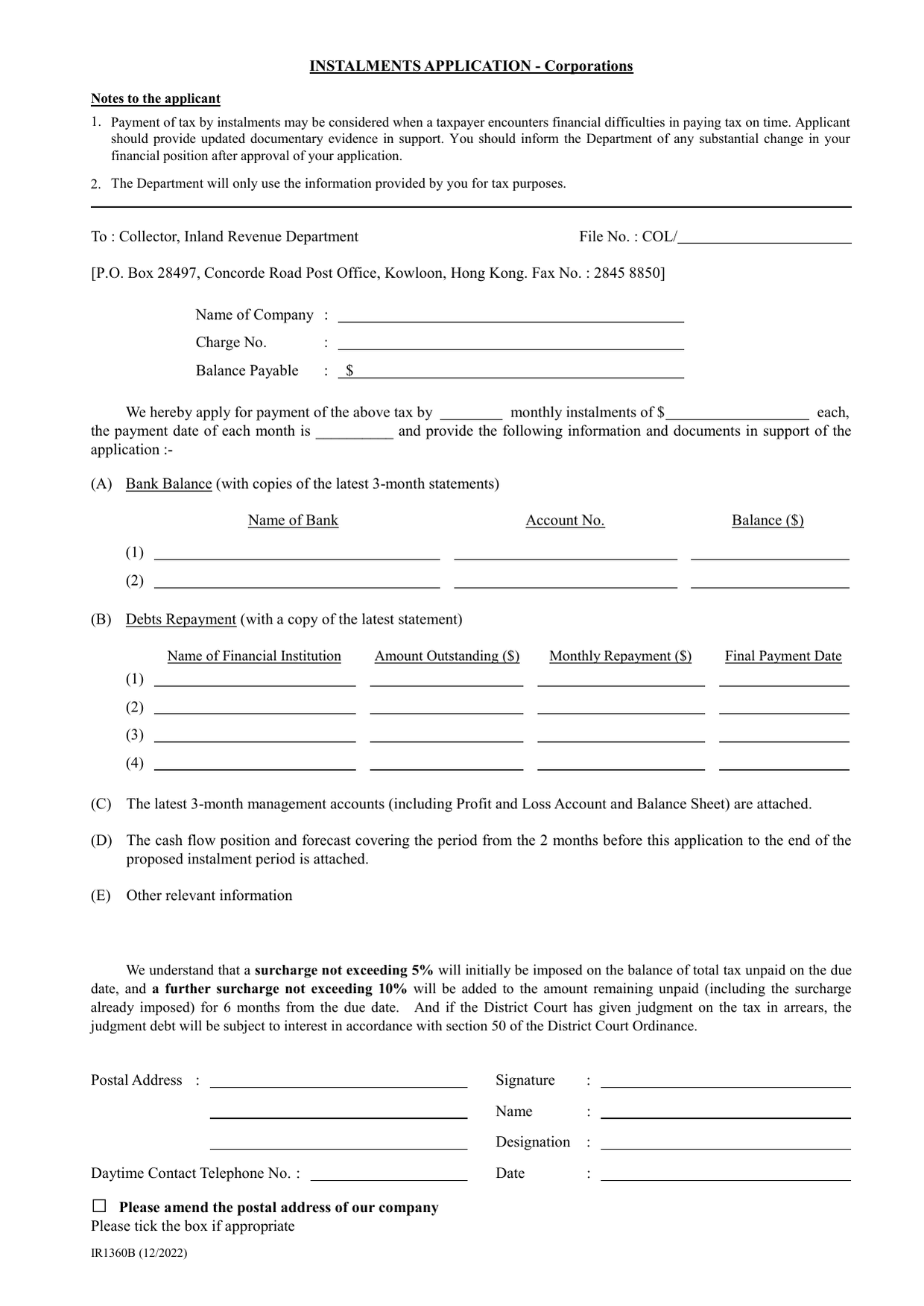
Notes to the applicant
Read the two notes before filling in the form. Note 1 explains that instalments may be granted only when you face genuine financial difficulty paying tax on time. You must provide updated documentary evidence to support your application. If your financial position changes substantially after approval, you must inform the Department. Note 2 confirms that the information you provide will be used only for tax purposes.
To: Collector, Inland Revenue Department / File No.
Enter the file number assigned to your case in the box labelled "File No. : COL/". This number appears on any correspondence or demand note you have received from the Department. If you do not have a file number, leave it blank; the Department will assign one.
Name of Company
Enter the full legal name of the corporation as it appears on the relevant tax return or demand note.
Charge No.
Enter the charge number shown on the tax demand or notice of assessment. This is the reference number for the specific tax charge you are applying to pay by instalments.
Balance Payable
Enter the total amount of tax still unpaid as at the date of this application. This figure should match the outstanding balance shown on the latest demand or statement from the Department.
Application for Instalments
State the number of monthly instalments you propose (e.g., "6") and the amount of each instalment in the boxes after "monthly instalments of $ each". Then write the payment date of each month (e.g., "15th") in the blank provided.
(A) Bank Balance
List each bank account held by the company. For each account, provide the name of the bank, the account number, and the current balance. You must attach copies of the latest 3-month statements for each account listed.
(B) Debts Repayment
List each debt the company is repaying to a financial institution. For each entry, provide the name of the institution, the total amount outstanding, the monthly repayment amount, and the final payment date. Attach a copy of the latest statement for each debt.
(C) Management Accounts
You must attach the latest 3-month management accounts, including a Profit and Loss Account and a Balance Sheet. Tick the box if you are providing these documents.
(D) Cash Flow Position and Forecast
You must attach a cash flow statement covering the period from 2 months before this application to the end of the proposed instalment period, together with a forecast for the same period. Tick the box if you are providing this document.
(E) Other Relevant Information
Use this section to provide any additional information that supports your application, such as details of other creditors, pending litigation, or changes in trading circumstances.
Postal Address
Enter the company's postal address for all correspondence from the Department. If you want the Department to update its records to this address, also tick the box at the bottom: "Please amend the postal address of our company".
Signature, Name, Designation, Date
The form must be signed by an authorised officer of the company (e.g., director, company secretary). Print the signatory's full name and designation (e.g., "Director") below the signature. Enter the date of signing.
Daytime Contact Telephone No.
Provide a telephone number where the Department can reach the signatory during business hours.
Surcharge Warning
The form reminds you that a surcharge not exceeding 5% will initially be imposed on the unpaid balance from the due date, and a further surcharge not exceeding 10% may be added after 6 months. If the District Court has already entered judgment, interest will apply under section 50 of the District Court Ordinance.
Download the current form - always file the version on the issuing authority's site, not a copy.
Sources
More on the forms library.