Form IR831 Notice of Objection or Revision Hong Kong
Learn how to use Form IR831 to object to or request a revision of a tax assessment in Hong Kong.
IR831 at a glance
- Official title
- Notice of Objection or Application for Revision of Assessment
- Issued by
- Inland Revenue Department
We link the issuing authority's own index rather than hosting a copy, because the form is revised there and an out-of-date copy is worse than none.
How to File Form IR831 Notice of Objection or Revision in Hong Kong
When the Inland Revenue Department issues an assessment for profits tax, salaries tax, property tax or stamping duty you believe is wrong, you must formally challenge it. The instrument for this is the form ir831 notice of objection or revision hong kong, the official document used to lodge an objection or request a revision under the Inland Revenue Ordinance (Cap. 112).
Time Limits for Filing an Objection
The Inland Revenue Ordinance sets a firm deadline. File Form IR831 within one month after the date of the notice of assessment. This one-month period begins from the date printed on the assessment notice, not the date you received it. Miss this deadline and the assessment becomes final and conclusive unless the department grants an extension.
Extensions are not automatic. The Inland Revenue Department may allow a late objection only if you can show the delay was due to illness, absence from Hong Kong, or other reasonable cause, and that you applied for the extension without unreasonable delay after the cause ceased. File within the one-month window wherever possible. If you cannot, submit the form as soon as you can with a written explanation of the delay.
When the subject of the objection is an assessment for stamping duty under the Stamp Duty Ordinance (Cap. 117), similar time limits apply, but check the specific deadline on the demand note.
Required Information for Form IR831
Form IR831 demands several categories of particulars to identify the assessment and the basis of your objection. You must provide:
- The assessment number and the year of assessment concerned.
- The type of tax under dispute: profits tax, salaries tax, property tax, or stamping duty.
- The amount of tax you consider properly chargeable.
- Full details of the grounds for objection. Vague statements such as "the assessment is too high" will be rejected. You must state the specific factual or legal reasons why the assessment is incorrect , for example, that a particular expense was wrongly disallowed, or that a source of income is not chargeable to tax.
- Supporting documents or computations that show the correct liability. If you rely on a legal argument, cite the relevant section of Cap. 112 or other authority.
The Inland Revenue Department will not consider an objection that does not clearly state the grounds. Omit the grounds and the department may return the form and ask you to resubmit, which risks losing the one-month window.
The Difference Between an Objection and a Revision
The form itself is named "Notice of Objection or Revision". There is a practical difference between the two, and you must tick the correct box.
An objection is used when you dispute the assessment in principle. You are saying the Inland Revenue Department has calculated the tax liability incorrectly, and you want it to be recalculated. An objection suspends the collection of the disputed tax until the department decides the case, unless the commissioner determines that the objection is frivolous or that collection is necessary to protect the revenue.
A revision is used when you agree with the assessment as a matter of law but believe there has been a computational or clerical error. For example, if the department omitted a deductible expense that you had already claimed in your tax return, you would request a revision rather than lodge an objection. A revision does not suspend collection, and the department may process it more quickly than a formal objection.
If you are unsure which box to tick, tick "objection" and explain both the factual and legal grounds. The department will treat the filing according to its substance.
Grounds for a Valid Objection
The Inland Revenue Ordinance requires that an objection must have reasonable grounds. The following are examples of grounds that the department will consider:
- The assessment includes income that is not chargeable to tax, such as a capital gain (unless it falls within the anti-avoidance provisions).
- The assessment disallows a deduction that is expressly permitted under Cap. 112, such as a bad debt, depreciation allowance, or qualifying research expenditure.
- The assessment applies the wrong tax rate or fails to apply a concession, such as the two-tiered profits tax rate for the first HK$2 million of assessable profits.
- The assessment has a procedural error, such as failing to give you the opportunity to be heard before issuing an estimated assessment.
You cannot object simply because you disagree with the department's view of the facts without providing evidence. The department will expect you to produce receipts, contracts, bank statements, or other documentary proof that supports your position.
How to File Form IR831
Submit Form IR831 by paper post or through the Business Tax Portal (e-Tax). The Inland Revenue Department encourages electronic filing for speed and traceability. If you file by paper, send the form to the relevant branch of the Inland Revenue Department , the Profits Tax Section, the Salaries Tax Section, or the Stamping Duty Section, as applicable. The address is printed on the assessment notice.
If you have a tax representative, that representative may file the form on your behalf. The form asks for the name and contact details of the representative, so complete that section accurately.
What Happens After You File
After the Inland Revenue Department receives your Form IR831, it will acknowledge receipt and assign a case officer. The officer will review the grounds and request further information if needed. The department must decide the objection within a reasonable time , typically six to twelve months for straightforward cases, longer for complex ones.
If the department agrees with your objection, it will issue a revised assessment. If it disagrees, it will confirm the original assessment. At that point, you may appeal to the Board of Review (Inland Revenue Ordinance) within one month of the date of the commissioner's decision.
Where to Obtain Form IR831
You may download Form IR831 from the Inland Revenue Department's forms index at https://www.ird.gov.hk/eng/paf/bus.htm. Always use the current version posted on that page, as the department revises forms periodically. A stale copy may be rejected.
IR831 Form Objection Assessment
The assessment notice you receive from the Inland Revenue Department will bear a date. That date starts the one-month clock for filing an objection. If you are objecting to an estimated assessment , one issued without a tax return , the same deadline applies. Do not wait for the department to send a reminder; the department does not send reminders for objection deadlines.
Hong Kong Tax Objection Form
Form IR831 is the sole form for objecting to any direct tax assessment under Cap. 112. There is no separate form for profits tax, salaries tax, or property tax. The same form covers all three. For stamping duty, use the same form but address it to the Stamping Duty Section.
Inland Revenue IR831
The form is published by the Inland Revenue Department and is listed in its standard set of forms. You do not need to pay a fee to file it. The department does not charge for considering an objection, but if the objection is ultimately unsuccessful, you may be liable for interest on the overdue tax from the original due date.
Revision of Assessment Form HK
If you are requesting a revision rather than an objection, the same Form IR831 applies. Check the "revision" box and provide the computational evidence that supports the correct figure. A revision is typically processed more quickly than an objection, but it does not suspend the obligation to pay the tax on time.
How to fill out Form IR831
Page one of the official form. Every field named below appears on it in the same order.
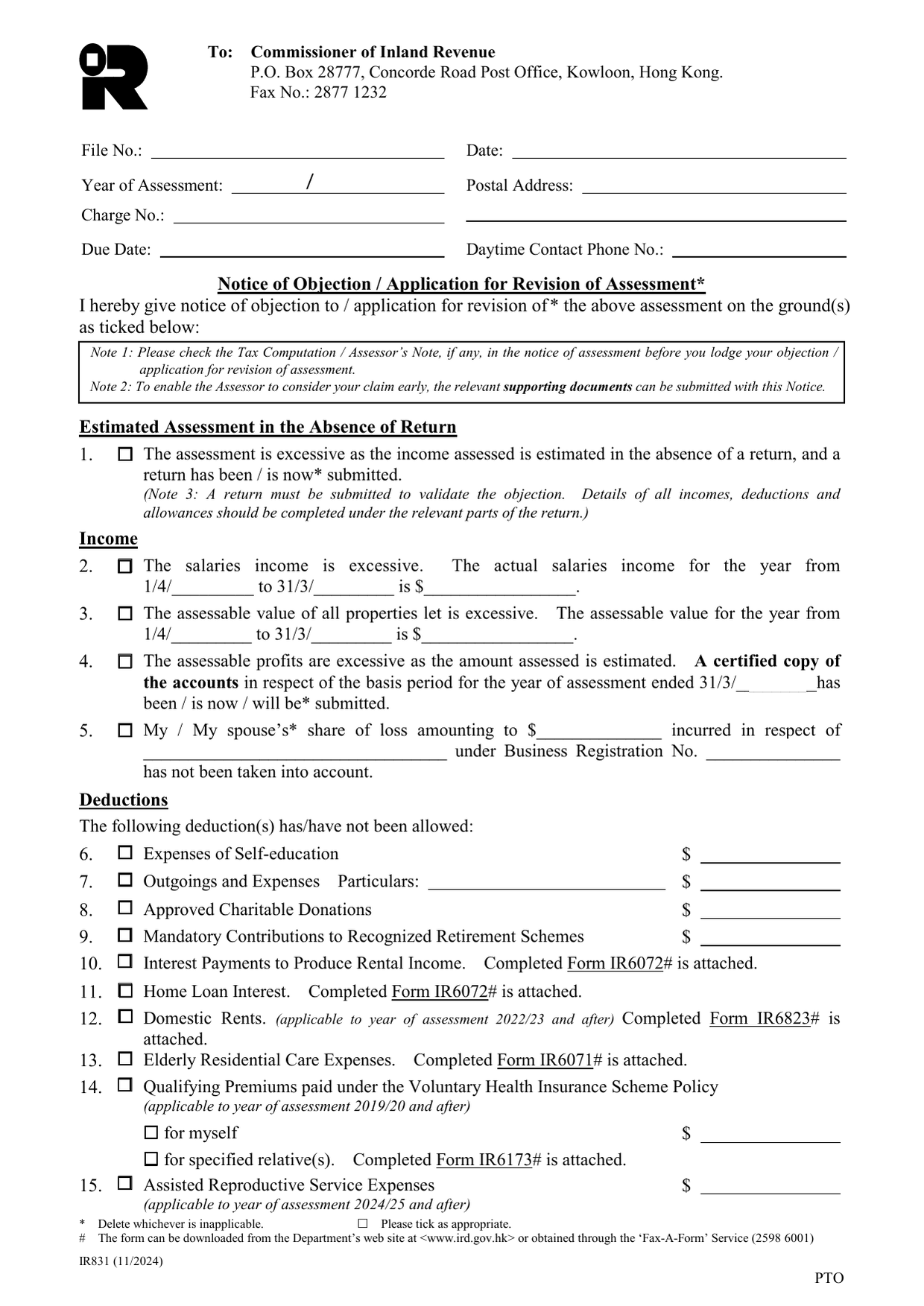
To: Commissioner of Inland Revenue / File No. / Date / Year of Assessment / Charge No. / Due Date / Postal Address / Daytime Contact Phone No.
Copy the File No. and Charge No. from the notice of assessment you are objecting to. Enter the Year of Assessment (e.g., 2023/24). The Due Date is the statutory deadline for lodging this objection (one month after the date of the notice of assessment). Provide your current Postal Address and a Daytime Contact Phone No. for correspondence.
Notice of Objection / Application for Revision of Assessment
Tick the box that applies. Delete "Notice of Objection" or "Application for Revision of Assessment" as appropriate. Read Note 1 and Note 2 before proceeding. If you tick a ground below, you must also tick the corresponding box next to the ground number.
Grounds for Objection / Revision
Estimated Assessment in the Absence of Return (Box 1): Tick only if the assessment was estimated because you did not file a return. You must submit the outstanding tax return with this form. The return must show all income, deductions and allowances.
Income (Boxes 2-5): - Box 2 (Salaries Income): State the actual salaries income and the correct year period (1/4/_ to 31/3/_). - Box 3 (Property Letting): State the actual assessable value and the correct year period. - Box 4 (Assessable Profits): Tick if the assessed profits are estimated. Indicate whether a certified copy of accounts has been, is now, or will be submitted. - Box 5 (Loss): Enter the share of loss not taken into account, the business name, and the Business Registration Number (found on the BR certificate).
Deductions (Boxes 6-16): Tick the deduction not allowed and enter the amount. For Boxes 10-14 and 16, the required supplementary form (e.g., IR6072, IR6823, IR6173) must be attached. For Box 16 (Qualifying Annuity Premiums/TVC), tick the appropriate sub-boxes and enter amounts.
Allowances (Boxes 17-23): Tick the allowance not granted. - Box 17 (Married Person's Allowance): Enter the date of marriage, spouse's name and HKID number. Confirm spouse had no chargeable income. - Box 18 (Child Allowance): For each child, enter name, date of birth, and code "1" (full-time education) or "2" (incapacitated). - Box 20 (Dependent Parent/Grandparent): Attach completed Form IR6071. - Box 21 (Dependent Brother/Sister): Attach completed Form IR6044. - Box 22 (Disabled Dependant Allowance): Enter the dependant's name and File No. under the Disability Allowance Scheme (if any). - Box 23 (Personal Disability Allowance): Enter your own File No. under the Disability Allowance Scheme (if any).
Other Grounds (Boxes 24-25): - Box 24 (Two-tiered Rates): Enter the business name and BRN. Tick the appropriate connected-entity statement and attach supplementary form SP1. - Box 25 (Others): Describe any other ground for objection.
Late Objection (if applicable)
If you are filing after the one-month deadline, state the causes that prevented you from lodging on time.
Signature
The Name of Applicant and Signature must be completed by the taxpayer (or authorized person). The form must be signed to be valid.
Download the current form - always file the version on the issuing authority's site, not a copy.
Sources
More on the forms library.