Form IRSD127 Application for Remission of Penalty for Late Stamping
Apply for a remission of penalty for late stamping in Hong Kong using Form IRSD127. This guide explains the grounds for remission and the application process.
IRSD127 at a glance
- Official title
- Application for Remission of Penalty for Late Stamping
- Issued by
- Inland Revenue Department
We link the issuing authority's own index rather than hosting a copy, because the form is revised there and an out-of-date copy is worse than none.
Form IRSD127 Application for Remission of Penalty for Late Stamping
The Form IRSD127 Application for Remission of Penalty for Late Stamping is the official document used to request that the Hong Kong Stamp Office cancel or reduce a penalty imposed because an instrument was stamped after the statutory deadline. The Stamp Office automatically levies a late stamping penalty under the Stamp Duty Ordinance (Cap. 117) when a document is presented for stamping outside the prescribed period. This application gives the person liable for the duty a formal channel to argue that the penalty should not apply.
IRSD127 Remission of Penalty
A remission of penalty means the Stamp Office agrees to waive all or part of the additional charge that accrued due to late stamping. The remission is not automatic; it must be applied for using Form IRSD127 and the Stamp Office must be satisfied that the late submission was not the result of wilful neglect or deliberate avoidance. The applicant bears the burden of demonstrating that there was a reasonable cause for the delay and that the circumstances justify excusing the penalty.
The penalty itself is calculated from the date the instrument ought to have been stamped. For a conveyance on sale of immovable property, for example, the instrument must be stamped within 30 days of execution if executed in Hong Kong, or within 30 days after it is received in Hong Kong if executed outside Hong Kong. A lease or agreement for lease has the same 30-day window. A chargeable agreement for sale of immovable property must be stamped within 30 days of the date of the agreement. For stock transfers, the period is 2 days after the execution of the instrument. The penalty for late stamping can be up to 10 times the stamp duty chargeable, depending on how late the stamping is.
Hong Kong Late Stamping Penalty
The late stamping penalty in Hong Kong is a surcharge imposed by the Stamp Office under section 5 of the Stamp Duty Ordinance (Cap. 117). The penalty rate increases the longer the instrument remains unstamped. The standard penalty is a fixed amount plus a percentage of the duty payable for each additional period the stamping is overdue.
For instruments executed in Hong Kong, the penalty is calculated as follows:
- If stamped within 1 month after the due date: HK$150 fixed penalty (or the amount of duty, whichever is less), plus 2% of the duty for each additional month or part thereof.
- If stamped more than 1 month but within 2 months after the due date: HK$250 fixed penalty (or the amount of duty, whichever is less), plus 2% of the duty for each additional month or part thereof.
- If stamped more than 2 months after the due date: HK$300 fixed penalty (or the amount of duty, whichever is less), plus 2% of the duty for each additional month or part thereof.
The maximum penalty is limited to the amount of stamp duty chargeable on the instrument. For instruments executed outside Hong Kong, the penalty is calculated from the date the instrument is first received in Hong Kong.
Apply for Penalty Remission IRSD127
To apply for penalty remission using IRSD127, the applicant must complete the form and provide a detailed explanation of why the instrument was not stamped on time. The form requires the following information:
- Name and address of the applicant - The person liable for the stamp duty or their authorised representative.
- Description of the instrument - Identify the instrument by date, nature (e.g., sale and purchase agreement, assignment, lease), and the amount of duty payable.
- Date of execution and date of stamping - The actual dates so the Stamp Office can calculate the penalty that has accrued.
- Reasons for late stamping - A full and honest account of the circumstances that caused the delay.
- Supporting documents - Evidence such as correspondence, medical certificates, or other proof that explains the delay.
The completed form is submitted to the Stamp Office, either by post or in person at the Inland Revenue Department's Stamp Office counter. There is no application fee for submitting Form IRSD127. The Stamp Office will consider the application and issue a decision in writing.
Waive Late Stamping Penalty
The Stamp Office has discretion to waive the late stamping penalty in full or in part. The decision is based on the facts of each case. The Stamp Office will typically consider the following factors when deciding whether to grant a waiver:
- Reasonable cause - Was there a genuine reason for the delay that was beyond the applicant's control? Examples include illness, absence from Hong Kong, a mistake by a professional adviser, or a misunderstanding of the stamping requirements.
- Prompt action - Did the applicant take steps to stamp the instrument as soon as the oversight was discovered? A delay of several months after discovery may weaken the case.
- Compliance history - Has the applicant been penalised for late stamping before? A first offence is more likely to be remitted than repeated non-compliance.
- Amount of duty involved - The Stamp Office may be more lenient when the penalty is disproportionate to the duty or when the applicant is an individual rather than a business.
Examples of circumstances that the Stamp Office has accepted as reasonable cause include: * The instrument was executed outside Hong Kong and was delayed in transit. * The applicant was hospitalised or had a serious illness. * The applicant relied on incorrect advice from a solicitor or stamp duty service provider. * The applicant was not aware that the instrument required stamping (though ignorance of the law is generally not a defence).
Grounds for Remission of Penalty on Form IRSD127
When completing Form IRSD127, the applicant must state the specific grounds on which the remission is sought. The Stamp Office requires a clear and credible explanation. The following grounds are commonly cited:
- Mistake or oversight by a professional - For example, a solicitor or conveyancing clerk failed to submit the instrument within the stamping period. The applicant should name the professional and provide their explanation.
- Illness or incapacity - Medical evidence, such as a doctor's certificate, should be attached.
- Absence from Hong Kong - The applicant was overseas and could not arrange for stamping. Travel records or correspondence may be required.
- Delay in obtaining information - The instrument could not be stamped because the necessary information (such as the purchase price or the identity of the parties) was not available in time.
- Administrative error - A processing delay by the Stamp Office or by a bank or financial institution.
The Stamp Office will not normally consider remission where the applicant made no effort to stamp the instrument for a prolonged period after the due date, or where the delay was due to financial difficulty or negligence.
Submitting Form IRSD127 to the Stamp Office
Form IRSD127 is submitted to the Stamp Office, which is a branch of the Inland Revenue Department in Hong Kong. The form can be:
- Submitted by post - Address it to the Stamp Office, Inland Revenue Department, 13th Floor, Inland Revenue Centre, 5 Concorde Road, Kai Tak, Kowloon, Hong Kong.
- Hand delivered - To the Stamp Office counter on the same floor.
- Submitted through a representative - A solicitor or tax agent may submit the form on behalf of the applicant.
The form should be accompanied by the instrument that is being stamped late (if not already stamped) and any supporting documents. The Stamp Office will acknowledge receipt and issue a reference number. The processing time varies depending on the complexity of the case, but applicants should allow several weeks.
If the Stamp Office refuses the application for remission, the applicant may request a review or appeal the decision within the time limits set out in the Stamp Duty Ordinance (Cap. 117). The applicant should also be aware that submitting Form IRSD127 does not stop the penalty from accruing while the application is pending; the instrument should be stamped as soon as possible to avoid further penalty.
Working with the Inland Revenue Department on Penalty Remission
The Inland Revenue Department's Stamp Office operates under the Stamp Duty Ordinance (Cap. 117). The assessment and collection of stamp duty, including the imposition of penalties, is handled by the department. When dealing with the Stamp Office on a remission application, it is important to:
- Respond promptly - If the Stamp Office requests further information, provide it within the time specified.
- Be honest - Do not misrepresent the facts. The Stamp Office can verify information and may refuse the application or take further action if false statements are made.
- Keep records - Retain copies of Form IRSD127, all correspondence, and supporting documents for future reference.
The Stamp Office has a published policy on remission of penalties, and applications are considered on a case-by-case basis. There is no guarantee that a remission will be granted.
Request for Consideration of Late Stamping
When the applicant has no valid defence for the late stamping, it may be appropriate to make a request for consideration rather than a full remission. A request for consideration acknowledges that the penalty is due but asks the Stamp Office to exercise its discretion to reduce the penalty because of mitigating circumstances. This can be done through Form IRSD127 by stating that the applicant accepts the delay was their responsibility but requests a reduction on humanitarian grounds, such as financial hardship or personal circumstances.
The Stamp Office has limited discretion to reduce penalties, but it will consider such requests. The applicant should be prepared to provide full details of the circumstances and evidence of hardship if relevant.
Summary of Key Points
Form IRSD127 is the correct channel to apply for remission of a late stamping penalty in Hong Kong. The application must set out the grounds for remission clearly and provide supporting evidence. The Stamp Office will consider the application and decide whether to waive or reduce the penalty. Success depends on demonstrating reasonable cause and prompt action. For further guidance, applicants should refer to the Inland Revenue Department's Stamp Office homepage or consult a professional stamp duty service provider.
How to fill out Form IRSD127
Page one of the official form. Every field named below appears on it in the same order.
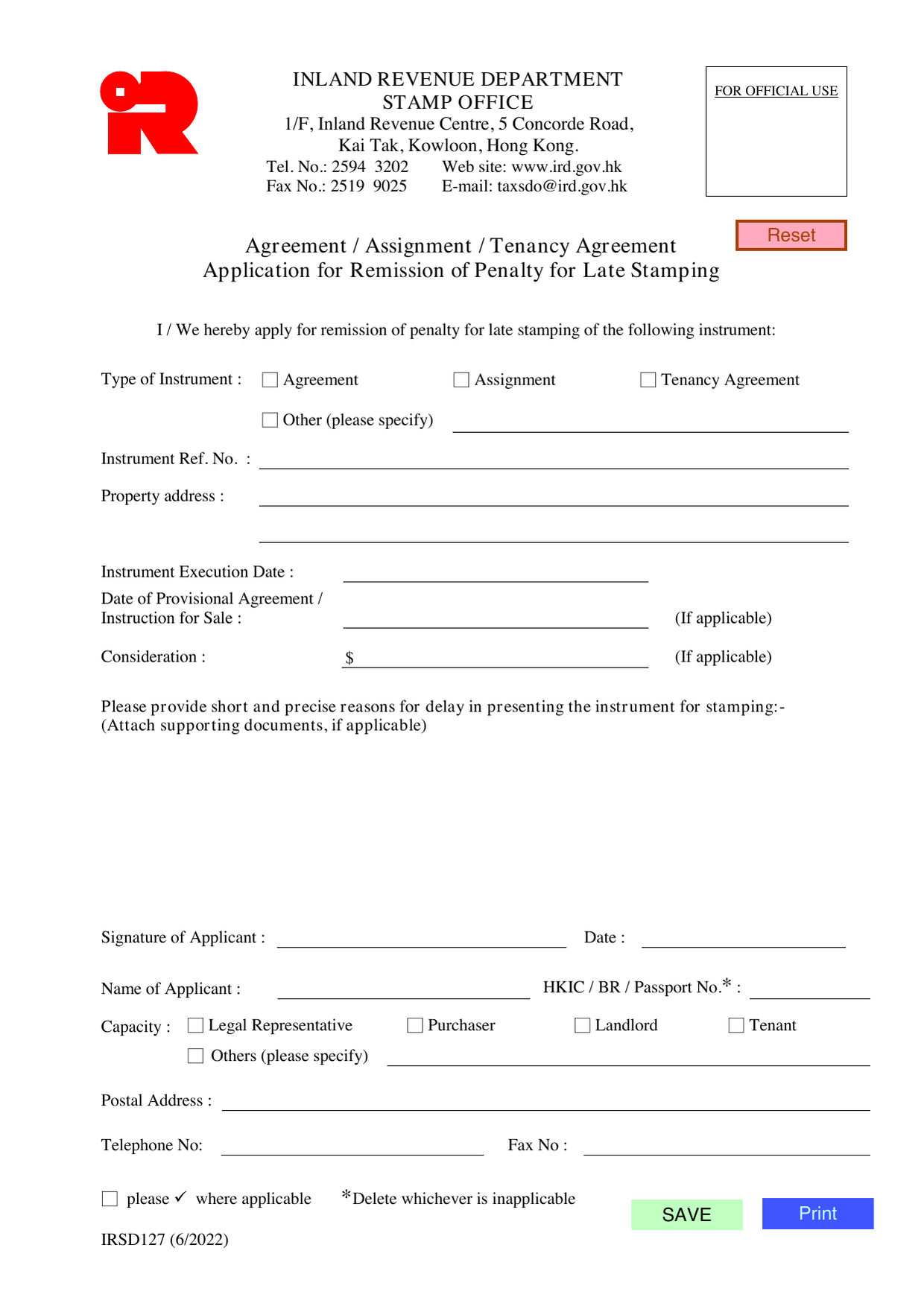
Type of Instrument
Check the box that matches the document you are stamping late: Agreement, Assignment, or Tenancy Agreement. If none of these apply, check Other and write the instrument type (e.g., “Deed of Variation”). Only one box should be checked.
Instrument Ref. No.
Enter the reference number printed on the instrument itself. This is usually the document’s serial or file number assigned by the solicitor or land registry. Do not use the company number or business registration number here.
Property address
Give the full address of the property that the instrument relates to. For a tenancy, include the flat, floor, building and street. For an assignment, this must match the address on the land register.
Instrument Execution Date
Write the date the instrument was signed (executed) by all parties. This is not the date of the provisional agreement. If you are late because you thought the date ran from the provisional agreement, that is a common error - the trigger for stamping is the execution date.
Date of Provisional Agreement / Instruction for Sale (If applicable)
Only fill this in if the instrument is an Agreement for Sale or a formal instruction to sell. This date is often earlier than the execution date and is used to calculate the penalty period. If the box is not relevant, leave it blank.
Consideration (If applicable)
State the monetary consideration (price or premium) in Hong Kong dollars. If the instrument is a tenancy agreement, this is the total rent payable over the term. For a gift or nominal consideration, write “Nil” or leave blank if the form says “If applicable”. Do not include non-cash consideration here.
Please provide short and precise reasons for delay in presenting the instrument for stamping
Write a clear explanation of why the document was not stamped on time. Acceptable reasons include oversight by a solicitor, illness of a party, or awaiting a missing certificate. Attach supporting documents (e.g., medical certificate, correspondence) if you have them. Vague statements like “I forgot” are usually rejected.
Signature of Applicant and Date
The applicant must sign and date the form. The date should be the day you submit the application. Unsigned applications are returned without action.
Name of Applicant
Print the full name of the person or entity applying. For a company, use the exact registered name.
HKIC / BR / Passport No.
Provide the Hong Kong Identity Card number, Business Registration number, or Passport number of the applicant. Delete whichever does not apply. Do not leave this blank - the processing officer uses this to verify identity.
Capacity
Check the box that describes your role: Legal Representative (e.g., solicitor), Purchaser, Landlord, Tenant, or Others (specify, e.g., “Company Secretary”). The capacity must match the signature - a solicitor cannot sign as “Purchaser” unless they are the buyer.
Postal Address
Give a Hong Kong address where the IRD can send the decision letter. A PO Box is acceptable.
Telephone No and Fax No
Provide a phone number (with area code) and fax number if available. The IRD may call to request further information.
Please ✔ where applicable
Mark the box next to “please ✔ where applicable” if you have attached supporting documents. If you do not, leave it unchecked.
Important note
No continuation sheet is provided on this form - if the reason for delay is lengthy, attach a separate sheet headed “IRSD127 continuation”. Only the applicant or a legal representative should sign; the form does not require a witness.
Download the current form - always file the version on the issuing authority's site, not a copy.
Sources
More on the forms library.