Form IR1454 mutual agreement procedure application
Apply for relief from double taxation by initiating a Mutual Agreement Procedure with Form IR1454.
IR1454 at a glance
- Official title
- Application to Initiate Mutual Agreement Procedure
- Issued by
- Inland Revenue Department
We link the issuing authority's own index rather than hosting a copy, because the form is revised there and an out-of-date copy is worse than none.
Form IR1454 Mutual Agreement Procedure Application
The Form IR1454 Mutual Agreement Procedure Application formally requests the Inland Revenue Department, acting as Hong Kong's competent authority, to initiate a mutual agreement procedure (MAP) with a treaty partner under a comprehensive double taxation agreement (DTA). This procedure allows the two competent authorities to negotiate a resolution for a tax dispute that arises when a taxpayer is, or is likely to be, taxed inconsistently with the DTA. The form triggers the government-to-government negotiation designed to relieve double taxation or adjust an assessment that breaches the treaty.
What Is the Mutual Agreement Procedure in Hong Kong
The mutual agreement procedure is a dispute resolution mechanism found in every DTA Hong Kong has concluded. Article 25 of the Hong Kong-Mainland China DTA, and equivalent articles in all other DTAs, state that where a person considers the actions of one or both contracting parties result or will result in taxation not in accordance with the treaty, that person may present their case to the competent authority of either contracting state. In Hong Kong, the competent authority is the Commissioner of Inland Revenue or an authorised representative. The MAP is not an appeal against an assessment under domestic law. It is a separate diplomatic channel through which the tax authorities agree on a common position that eliminates or reduces the taxation that violates the treaty.
When to Use Form IR1454 for Double Taxation Relief
Form IR1454 is the correct filing where a Hong Kong resident believes they have been taxed by a treaty partner in a way that conflicts with the DTA, or where the treaty partner's application of its domestic law results in double taxation not eliminated by the treaty's standard relief provisions. Typical situations include: a Hong Kong resident is taxed in the treaty partner on income that under the DTA is taxable only in Hong Kong; the treaty partner makes a transfer pricing adjustment to which Hong Kong has not granted a corresponding adjustment; or the taxpayer cannot obtain relief for foreign tax paid because of a dispute over residence or permanent establishment status. The form must be submitted within the time limit specified in the applicable DTA, which is generally three years from the first notification of the action resulting in taxation not in accordance with the treaty.
Information Required in the Particulars of Case
The application must present a full description of the taxpayer's case. Part 2 of Form IR1454 requires the taxpayer to set out the particulars of case, including the treaty articles believed to have been breached, the amounts of income involved, the tax years or periods of assessment in dispute, the domestic law provisions under which the treaty partner has assessed or is likely to assess the taxpayer, and the steps already taken to seek relief through domestic objection or appeal. The taxpayer must also explain why they consider the taxation is not in accordance with the DTA and provide any relevant correspondence with the treaty partner's tax authority. Supporting documents should include copies of assessment notices, tax returns, correspondence with the foreign tax authority, and any computations that illustrate the double taxation.
Role of the Competent Authority in a MAP Application
Once a valid Form IR1454 is received, the Inland Revenue Department acknowledges receipt and reviews the case to confirm the taxpayer is entitled to access the MAP under the relevant DTA. The competent authority then contacts its counterpart in the treaty partner jurisdiction and presents the taxpayer's position. The two competent authorities negotiate, typically through correspondence or face-to-face meetings, and attempt to reach a mutual agreement that eliminates the non-conforming taxation. The taxpayer is kept informed of progress but is not a direct party to the negotiations. If an agreement is reached, the competent authorities implement it through adjustments to assessments or by granting relief, which may require the taxpayer to comply with domestic procedural steps such as withdrawing a pending objection or appeal.
Submitting the Application to the Inland Revenue Department
Form IR1454 must be completed in English and signed by the taxpayer or their authorised representative. The application, together with all supporting documents, is submitted to the Commissioner of Inland Revenue at the address stated on the form. There is no statutory fee for filing a MAP application. The Inland Revenue Department encourages taxpayers to submit the application as soon as the facts giving rise to the dispute become known, rather than waiting for the conclusion of domestic objection or litigation proceedings, because the MAP often runs concurrently with domestic remedies.
Expected Timeline for Competent Authority Negotiations
There is no fixed statutory deadline for concluding a MAP. The Inland Revenue Department and its treaty partner are expected to use their best endeavours to resolve the case within two years from the date the case is presented to both competent authorities, as recommended by the OECD. In practice, the timeline depends on the complexity of the facts, the willingness of the treaty partner to engage, and whether the dispute involves transfer pricing or other technical issues. Hong Kong has committed to the Base Erosion and Profit Shifting minimum standard on MAP, which includes a peer review process that monitors the timeliness of case resolution.
Relationship Between MAP and Domestic Tax Dispute Resolution
A taxpayer may pursue a MAP while simultaneously pursuing a domestic objection against an assessment under the Inland Revenue Ordinance (Cap. 112). The MAP does not suspend the time limits for lodging an objection or appeal. The Inland Revenue Department advises taxpayers to protect their domestic rights by lodging a valid objection within the statutory period, even while a MAP application is pending. If the MAP resolves the dispute, the taxpayer is expected to withdraw the domestic objection or appeal. If the MAP fails to produce an agreement, the taxpayer retains the right to continue with domestic remedies.
When the MAP Cannot Provide Relief
Form IR1454 is not a substitute for a general claim for relief from double taxation under domestic law, such as a claim for foreign tax credit under section 49 of the Inland Revenue Ordinance. The MAP is available only where the double taxation arises because of a breach of the DTA. It is also not available for disputes that fall outside the scope of the treaty, such as questions of domestic tax policy not covered by a DTA article. The taxpayer should confirm that the specific income and tax in question is within the coverage of the applicable DTA before filing Form IR1454.
How to fill out Form IR1454
Page one of the official form. Every field named below appears on it in the same order.
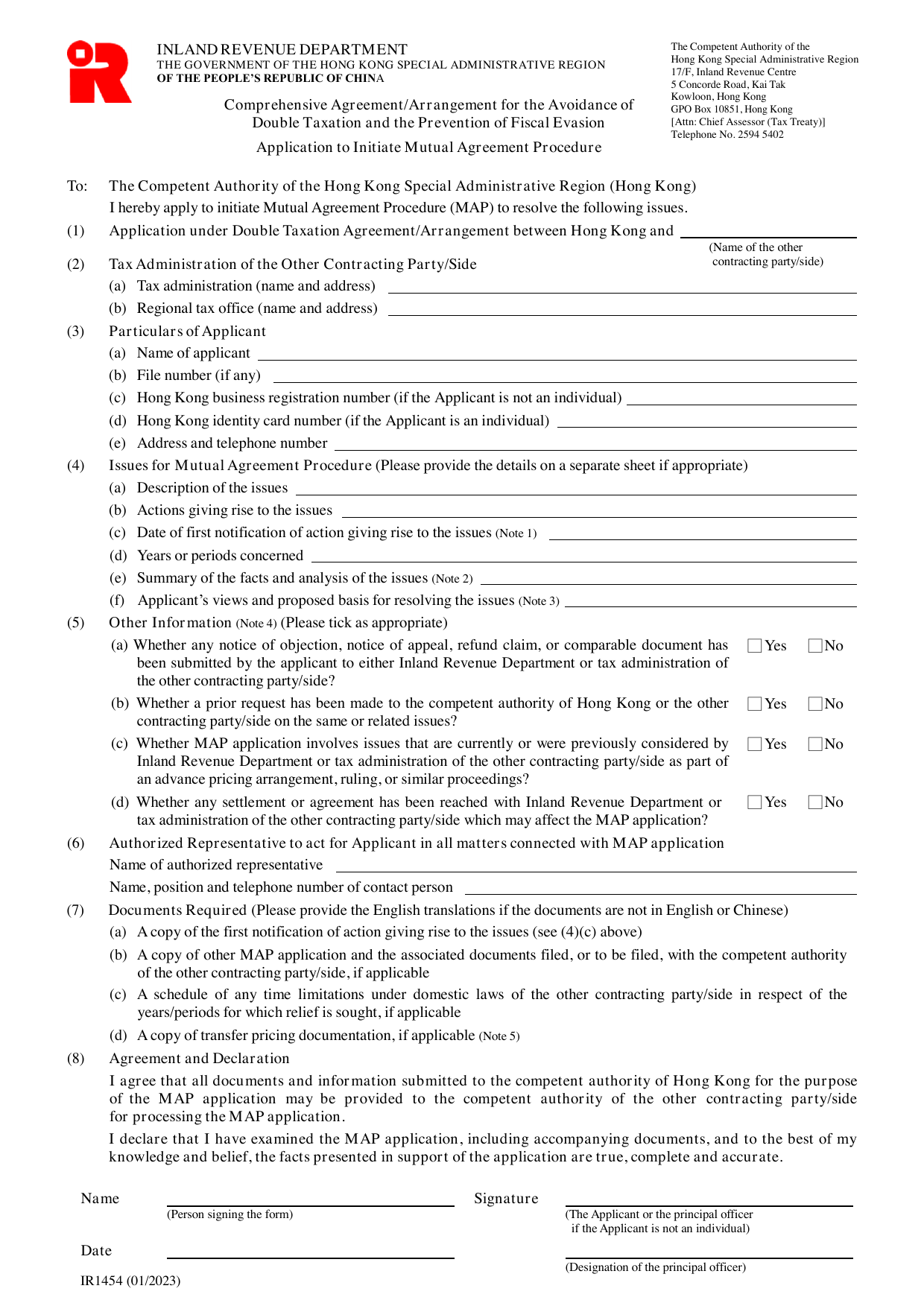
(1) Application under Double Taxation Agreement/Arrangement between Hong Kong and
Enter the name of the other contracting party or side (the jurisdiction with which Hong Kong has the double taxation agreement).
(2) Tax Administration of the Other Contracting Party/Side
- (a) Tax administration (name and address): The full name and postal address of the foreign tax authority.
- (b) Regional tax office (name and address): The specific regional office of that authority, if known.
(3) Particulars of Applicant
- (a) Name of applicant: Your full legal name (individual or entity).
- (b) File number (if any): Your Inland Revenue Department file number, if one has been assigned.
- (c) Hong Kong business registration number: Required if the applicant is not an individual. This is on the Business Registration Certificate.
- (d) Hong Kong identity card number: Required if the applicant is an individual.
- (e) Address and telephone number: Your current correspondence address and a daytime contact number.
(4) Issues for Mutual Agreement Procedure
Use a separate sheet if the space is insufficient.
- (a) Description of the issues: A clear statement of the tax dispute.
- (b) Actions giving rise to the issues: What the tax authority did (e.g., issued an assessment, denied a deduction).
- (c) Date of first notification of action giving rise to the issues: The date on the notice of assessment or equivalent document from the other tax authority. This date is critical because the MAP application must be filed within the time limit specified in the relevant double taxation agreement from this date.
- (d) Years or periods concerned: The tax years or accounting periods affected.
- (e) Summary of the facts and analysis of the issues: Provide names, addresses, tax IDs of related persons; the relationship and structure of transactions; and the specific article of the tax treaty you believe is being misapplied. (See Note 2 on the form.)
- (f) Applicant’s views and proposed basis for resolving the issues: Your argument and suggested solution.
(5) Other Information
Tick Yes or No for each. If you answer Yes to any question, provide full details on a separate sheet.
- (a) Whether you have filed an objection, appeal, refund claim, or similar document with either tax authority.
- (b) Whether you have already made a prior MAP request to either competent authority on the same issue.
- (c) Whether the MAP issue involves an advance pricing arrangement, ruling, or similar proceeding.
- (d) Whether any settlement or agreement has already been reached with either tax authority that could affect this MAP.
(6) Authorized Representative
Enter the name of your authorized representative (if any) and the name, position, and telephone number of the contact person.
(7) Documents Required
Attach copies (with English or Chinese translations if needed): - (a) The first notification of the action (e.g., the assessment notice). - (b) A copy of the MAP application filed (or to be filed) with the other competent authority. - (c) A schedule of any domestic-law time limits in the other jurisdiction. - (d) Transfer pricing documentation, if applicable (see Note 5).
(8) Agreement and Declaration
- Name: Print the name of the person signing.
- Signature: The applicant must sign. If the applicant is not an individual, the principal officer (e.g., director, partner) must sign.
- Date: The date of signing.
- Designation of the principal officer: The signer’s official title (e.g., Director, Sole Proprietor).
Download the current form - always file the version on the issuing authority's site, not a copy.
Sources
More on the forms library.