Completing the Profits Tax Computation on Form IR957
Learn how to accurately complete the Form IR957 profits tax computation for your Hong Kong company with our detailed guide.
IR957 at a glance
- Official title
- Profits Tax Computation
- Issued by
- Inland Revenue Department
We link the issuing authority's own index rather than hosting a copy, because the form is revised there and an out-of-date copy is worse than none.
Form IR957 Profits Tax Computation Guide
The Form IR957 profits tax computation reconciles a corporation’s accounting profit with its assessable profits or adjusted loss for a year of assessment. It accompanies the Profits Tax Return (BIR51), providing the Inland Revenue Department with a line-by-line breakdown of the taxable figure.
Hong Kong Profits Tax Computation Form: Purpose and Structure
Form IR957 is a supporting document, not a standalone return. It reconciles the accounting profit shown in the financial statements with the assessable profits reported to the Inland Revenue Department. The form contains a main computation section for assessable profits, a section for depreciation allowances and balancing charges, a section for losses carried forward, and a final section that applies the tax rate to arrive at the tax payable.
Every corporation filing a BIR51 must complete a Form IR957 unless the Inland Revenue Department directs otherwise. The form must be signed by the tax representative or a company director.
How to Fill in Form IR957
Start with the accounting profit or loss before taxation from the audited financial statements for the year of assessment. Add back any expenditure not deductible for profits tax purposes, such as capital expenditure, donations not meeting statutory conditions, private expenses, or fines and penalties. Then deduct any income not assessable, such as certain dividends from Hong Kong companies, profits from the sale of capital assets, or foreign-sourced income not remitted to Hong Kong.
The result is the adjusted profit or adjusted loss. A profit becomes the assessable profits before allowances. A loss is carried forward to offset future profits.
Common adjustments include: - Depreciation charged in the accounts (added back) and depreciation allowances claimed under the Inland Revenue Ordinance (deducted). - Profit or loss on disposal of fixed assets (added back or deducted) and balancing charges or balancing allowances. - Provisions for doubtful debts not specific to identified debts. - Entertainment expenses exceeding the statutory limit. - Interest income subject to profits tax and deductible interest expense.
Profits Tax Calculation HK: Applying the Correct Tax Rate
Calculate the tax liability by applying the relevant rate to the assessable profits. For the year of assessment 2024-25, the standard profits tax rate for corporations is 16.5 per cent. For unincorporated businesses, the rate is 15 per cent.
Hong Kong operates a two-tiered tax rates system. The first HK$2 million of assessable profits for a corporation is taxed at 8.25 per cent, with the remainder at 16.5 per cent. For unincorporated businesses, the first HK$2 million is taxed at 7.5 per cent, and the remainder at 15 per cent. Only one entity in a group of connected entities can claim the two-tiered rates; the taxpayer must complete Form BIRS1 to elect for this treatment.
Enter the assessable profits, apply the two-tiered rates, and calculate the tax payable in the designated section. Deduct losses brought forward from prior years from the assessable profits before applying the tax rates.
Form IR957 Instructions: Key Sections Explained
Section A - Assessable Profits or Adjusted Loss
This section reconciles accounting profit to adjusted profit. It lists all add-backs and deductions with a reference to the relevant schedule or note in the financial statements. The final figure is the net assessable profits or adjusted loss for the year.
Section B - Depreciation Allowance and Balancing Charge
Claim depreciation allowance on qualifying fixed assets used in the business. The Inland Revenue Department publishes annual depreciation rates for different asset classes. A balancing charge arises when the proceeds from the sale of an asset exceed its tax written down value; a balancing allowance arises when the proceeds are less. Enter these figures here and carry them into the main computation.
Section C - Losses Carried Forward
Record unrelieved tax losses from prior years here. Deduct these losses from the current year's assessable profits before calculating tax. Losses can be carried forward indefinitely but cannot be carried back.
Section D - Tax Computation
This section applies the tax rate to the assessable profits after losses. It accounts for any provisional tax paid in the prior year and calculates the balance of tax payable or refundable.
IR957 Filing Guide: Submission and Deadlines
File Form IR957 with the Profits Tax Return (BIR51), audited financial statements, and any supplementary forms. The filing deadline is stated on the return issued by the Inland Revenue Department. For most corporations, the return is due within one month of the issue date, though extensions may be granted if a tax representative is appointed.
Submit the form through the Business Tax Portal or the Tax Representative Portal. Mandatory electronic filing of profits tax returns began on 1 April 2026 for relevant entities of in‑scope multinational enterprise groups, from the year of assessment 2025‑26. Electronic filers must tag the financial statements and tax computation in iXBRL format.
Paper filing remains available for other taxpayers. The Inland Revenue Department has stated an intention to reach full electronic filing by 2030.
Assessable Profits and Allowable Deductions
The Inland Revenue Ordinance (Cap. 112) defines what is deductible. Allowable deductions include all outgoings and expenses incurred in the production of assessable profits, such as rent, salaries, interest on borrowed capital, repairs, and bad debts specifically written off. Capital expenditure is not deductible, nor are domestic or private expenses.
List each deduction on the form with a supporting reference. The Inland Revenue Department may request further evidence during the assessment process.
Tax Representative and the Business Tax Portal
Every corporation filing a profits tax return must appoint a tax representative, typically a Hong Kong resident individual or a firm of certified public accountants. The tax representative submits the return and Form IR957 and corresponds with the Inland Revenue Department.
The Business Tax Portal allows authorised representatives to file returns, view assessment history, and make payments online. The Tax Representative Portal provides similar functionality for tax representatives acting on behalf of multiple clients.
Assessment Year and Provisional Tax
The year of assessment runs from 1 April to 31 March. For example, the year of assessment 2024-25 covers profits earned from 1 April 2024 to 31 March 2025. Profits tax is charged on a preceding-year basis: the tax for a year of assessment is based on the profits of the accounting period ending in that year.
Provisional tax is payable in two instalments based on the prior year's assessment. The Form IR957 calculation includes a credit for provisional tax already paid, and the final tax payable or refundable is determined after the assessment is completed.
Common Errors When Completing Form IR957
- Failing to add back depreciation and instead claiming it twice.
- Omitting balancing charges on disposal of assets.
- Incorrectly applying the two-tiered tax rates when the company is part of a connected group.
- Not carrying forward losses correctly from prior years.
- Using the wrong tax rate for the year of assessment.
The Inland Revenue Department may issue an estimated assessment if the return is not filed on time, and penalties may apply for incorrect returns.
Where to Obtain Form IR957 and Further Guidance
The form and its instructions are available from the Inland Revenue Department forms index at https://www.ird.gov.hk/eng/paf/bus.htm. The department also publishes a guide to completing the profits tax computation, which provides worked examples for common scenarios. Taxpayers should always refer to the latest version of the form, as the department revises it periodically.
How to fill out Form IR957
Page one of the official form. Every field named below appears on it in the same order.
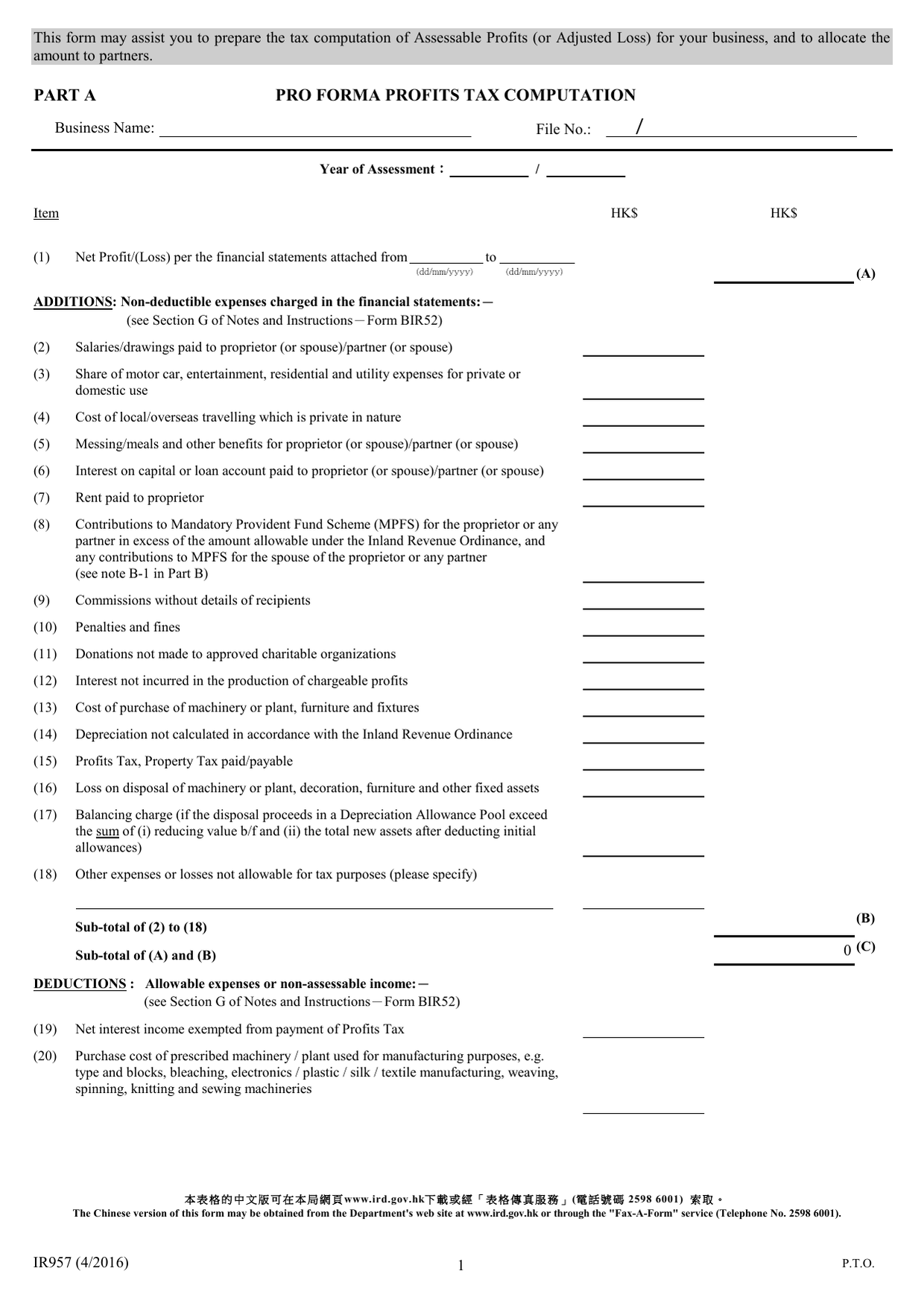
Part A Pro Forma Profits Tax Computation
Business Name / File No. / Year of Assessment Enter the business name, the Inland Revenue file number (from the IRD file reference), and the year of assessment (e.g., 2023/24).
Item (1) Net Profit/(Loss) per the financial statements Enter the net profit or loss shown in the financial statements. The dates (dd/mm/yyyy) must be the period covered by those statements.
Items (2) to (18) ADDITIONS These are non-deductible expenses already charged in the accounts. Add each amount that applies.
- (2) Salaries/drawings paid to the proprietor (or spouse) or partner (or spouse).
- (3) Private use share of motor car, entertainment, residential and utility expenses.
- (4) Private travelling costs.
- (5) Messing/meals for proprietor/partner and spouse.
- (6) Interest on capital or loan paid to proprietor/partner/spouse.
- (7) Rent paid to the proprietor.
- (8) MPF contributions for the proprietor or any partner above the allowable limit (see Part B, B-1 table: maximum $18,000 for 2015/16 onwards). Also any MPF for the proprietor’s or partner’s spouse.
- (9) Commissions without details of recipients.
- (10) Penalties and fines.
- (11) Donations not to approved charities.
- (12) Interest not incurred to produce chargeable profits.
- (13) Cost of purchase of machinery, plant, furniture and fixtures (capital, not revenue).
- (14) Depreciation not calculated per the Inland Revenue Ordinance.
- (15) Profits Tax, Property Tax paid or payable.
- (16) Loss on disposal of fixed assets.
- (17) Balancing charge - when disposal proceeds in a pool exceed the reducing value b/f plus new assets (after initial allowances).
- (18) Other non-allowable expenses - specify.
Sum items (2) to (18) as sub-total (B). Add (A) and (B) to get (C).
Items (19) to (28) DEDUCTIONS These are allowable expenses or non-assessable income not already deducted in the accounts.
- (19) Net interest income exempt from Profits Tax.
- (20) Purchase cost of prescribed manufacturing machinery/plant (e.g., textile, electronics).
- (21) Purchase cost of computer hardware and software.
- (22) Gain on disposal of fixed assets.
- (23) Dividends and other non-assessable profits - specify.
- (24) MPF contributions for proprietor/partner not charged in the accounts (within the allowable limit from B-1).
- (25) Capital expenditure on environmental protection facilities (from 2008/09 onwards).
- (26) Depreciation allowance calculation - complete the three pools (10%, 20%, 30%). Enter reducing value b/f, add new assets, deduct initial allowance (D1), deduct disposal proceeds (restricted to cost), deduct annual allowance (D2), deduct private use portion (D3). Total allowance = (D1)+(D2)-(D3).
- (27) Industrial building allowance - use example B-3.
- (28) Commercial building allowance - use example B-4.
Sum (19) to (28) as sub-total (E). Assessable Profits = (C) - (E). Adjusted Loss = (C) - (E) if negative.
Item (29) Allocation among partners Complete for each partner: name, emoluments and interest on capital, profit/loss sharing ratio (%), balance, and final share of Assessable Profits or Adjusted Loss. Follow the steps in example B-5. If any partner gets a negative amount in an overall profit case (or positive in a loss case), reallocate that amount to the other partners in proportion to their positive (or negative) shares. Total must reconcile.
Download the current form - always file the version on the issuing authority's site, not a copy.
Sources
More on the forms library.