Form IR957A Proforma Profits Tax Computation for a Sole Proprietorship
Our guide to Form IR957A helps sole proprietors in Hong Kong complete their proforma profits tax computation accurately.
IR957A at a glance
- Official title
- Proforma Profits Tax Computation for a Sole Proprietorship
- Issued by
- Inland Revenue Department
We link the issuing authority's own index rather than hosting a copy, because the form is revised there and an out-of-date copy is worse than none.
Understanding the Form IR957A Proforma Profits Tax Computation for a Sole Proprietorship
Form IR957A is a supporting schedule for self-employed individuals in Hong Kong. It shows the Inland Revenue Department how the business’s assessable profit or adjusted loss was calculated from its accounts. Sole proprietorships and other unincorporated businesses file Form BIR52 as their main profits tax return, not the corporate Form BIR51. The IR957A accompanies the BIR52.
This is not a standalone return. It is a computation sheet that helps the Inland Revenue Department verify business income and expenses have been correctly adjusted for tax purposes, separating accounting profit from taxable profit.
Sole Proprietorship Profits Tax Form HK
A sole proprietorship in Hong Kong follows a different profits tax filing process from a corporation. The business owner reports business income through their individual tax return (BIR60) and the separate BIR52 profits tax return for unincorporated businesses. The sole proprietorship profits tax form hk system requires the proprietor to compute their assessable profits using the IR957A proforma.
The form captures these key elements:
- Gross business receipts or turnover
- Cost of goods sold or direct expenses
- Gross profit or loss
- Other business income
- Operating expenses
- Adjusted profit or loss before tax adjustments
- Non-allowable expenses added back
- Capital allowances claimed
- Balancing charges or allowances
- Net assessable profits or adjusted loss
Claim only expenses wholly and exclusively incurred for the production of assessable profits. Exclude all private or domestic expenses.
Form IR957A Guide
The form IR957A guide from the Inland Revenue Department provides instructions for each line item of the proforma, clarifying which expenses are deductible and which must be added back. Common non-allowable items include:
- Private motor vehicle expenses
- Domestic entertainment costs
- Capital expenditure (depreciation)
- Fines and penalties
- Donations to charities not approved under section 26C of the Inland Revenue Ordinance (Cap. 112)
The guide explains how to compute tax depreciation allowances. This includes the initial and annual allowance for plant and machinery, and the commercial building allowance for qualifying structures.
Hong Kong Unincorporated Business Tax
The Hong Kong unincorporated business tax regime applies the same territorial principle as corporate profits tax: only profits arising in or derived from Hong Kong are chargeable. For a sole proprietorship, the assessable profits are computed on the IR957A and are then included in the proprietor's personal assessment or charged separately under profits tax.
The tax rate for unincorporated businesses is lower than the corporate rate. For the year of assessment 2024-25, the standard profits tax rate for sole proprietorships is 7.5% on the first HK$2 million of assessable profits and 15% on the remainder, subject to the two-tiered profits tax regime. The proprietor may also claim personal allowances and deductions through their individual tax return (BIR60), which can reduce the overall tax liability.
Proforma Tax Computation Sole Trader
A proforma tax computation sole trader must follow the standard format prescribed by the Inland Revenue Department. The IR957A is a vertical computation starting with net profit per accounts and ending with assessable profits. The adjustments section includes:
- Add back: depreciation, donations, private expenses, provisions, and other non-allowable items
- Deduct: capital allowances, balancing charges, and other allowable deductions
Prepare the computation for the basis period, which is usually the calendar year ending 31 December for sole proprietorships. If the business uses a different accounting date, the basis period follows the year of assessment rules under section 18B of the Inland Revenue Ordinance.
IR957A Filing Instructions
The IR957A filing instructions require the proprietor to submit the completed proforma with the BIR52 profits tax return. The filing deadline is generally within one month from the date of issue of the return, unless an extension has been granted by the Inland Revenue Department.
Key filing requirements include:
- Attach a copy of the business registration certificate
- Include the tax representative's details if an agent files the return
- Submit supporting schedules for capital allowances claimed
- Provide a breakdown of gross receipts if turnover exceeds HK$5 million
- Sign and date the declaration
The Inland Revenue Department may request additional information or supporting documents, such as bank statements, invoices, or rental agreements, to verify claimed expenses.
Interaction with Personal Tax
Assessable profits computed on the IR957A flow into the proprietor's personal tax computation. The proprietor may elect for personal assessment under section 41 of the Inland Revenue Ordinance, which aggregates all income sources (business, employment, and property) and applies progressive tax rates. Alternatively, the profits tax liability is computed separately and added to any salaries or property tax payable.
The IR957A also captures the proprietor's capital allowances, which are claimed against business profits. Unused allowances may be carried forward to subsequent years of assessment. The form must show the opening written down value, additions, disposals, and closing written down value for each asset class.
Business Tax Portal and Electronic Filing
The Inland Revenue Department encourages electronic filing through the Business Tax Portal. For the year of assessment 2025-26 onwards, mandatory electronic filing applies to in-scope multinational enterprise groups. While sole proprietorships are not yet subject to mandatory e-filing, the department has stated an intention to reach full electronic filing by 2030.
When filing electronically, the IR957A proforma can be uploaded as a supporting document in PDF or iXBRL format. The tax representative portal allows authorised agents to file on behalf of their clients. The proprietor must ensure the computation matches the figures reported on the BIR52 and BIR60.
Common Errors and Compliance Tips
Sole proprietors should avoid these common mistakes when completing the IR957A:
- Claiming depreciation instead of capital allowances
- Including private expenses such as personal motor vehicle costs
- Failing to add back non-allowable provisions
- Incorrectly computing the basis period
- Omitting the business registration certificate number
The Inland Revenue Department may impose penalties for incorrect or incomplete returns. Retain all supporting records for at least seven years after the relevant year of assessment.
Where to Obtain Form IR957A
The Inland Revenue Department forms index at https://www.ird.gov.hk/eng/paf/bus.htm provides the latest version of Form IR957A. The department revises forms periodically, so always download the current version rather than using a saved copy. The form can be completed manually or using the fillable PDF version on the department's website.
For further guidance, refer to the Inland Revenue Department's Profits Tax Guide or consult a qualified tax adviser to assist with preparing the proforma computation and ensuring compliance with the Inland Revenue Ordinance (Cap. 112).
How to fill out Form IR957A
Page one of the official form. Every field named below appears on it in the same order.
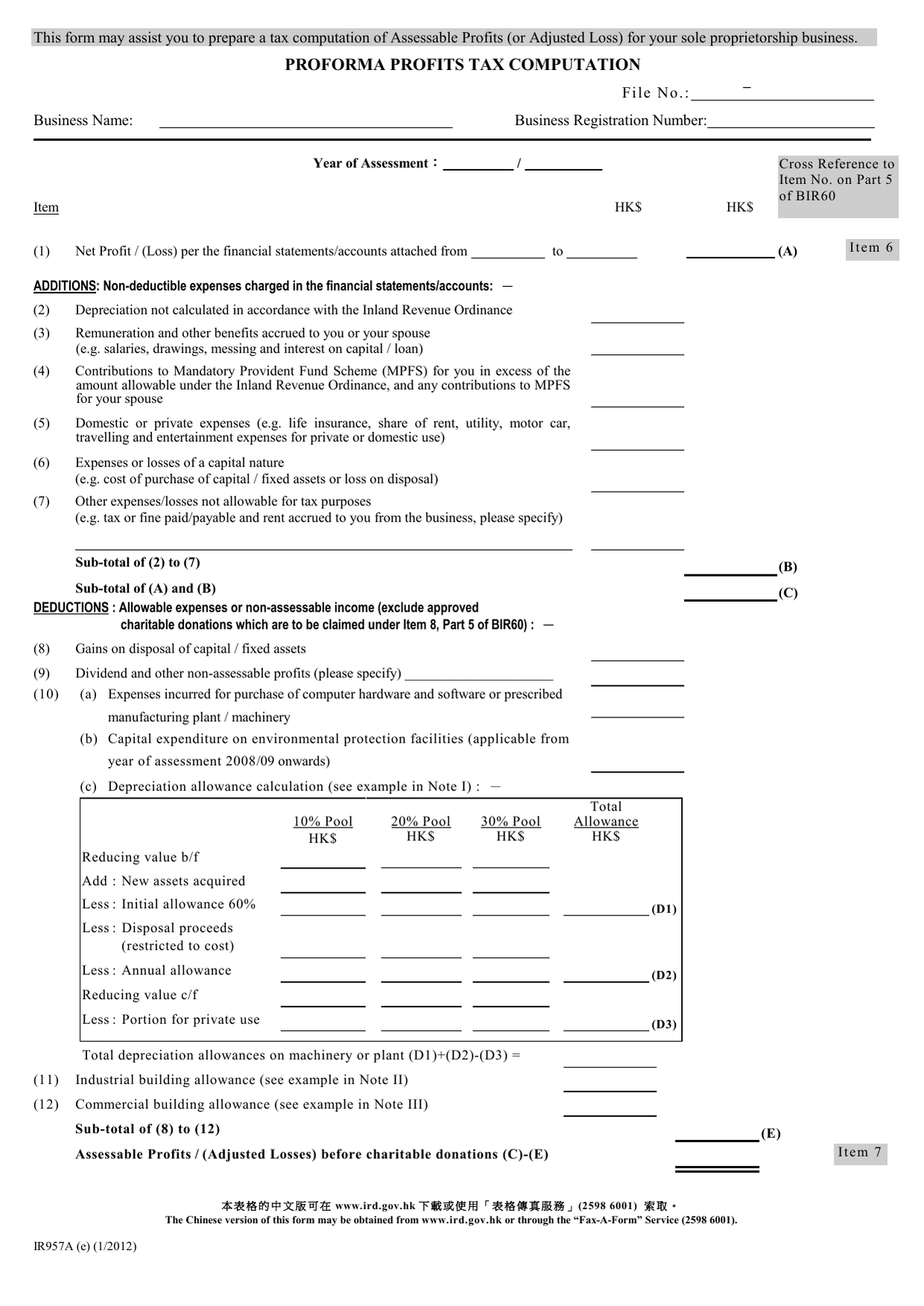
File No. and Business Details
File No.: Enter the Inland Revenue Department file number for this business. It appears on correspondence from the IRD.
Business Name: The full trading name of the sole proprietorship.
Business Registration Number: The number printed on the Business Registration Certificate.
Year of Assessment: The year of assessment the computation covers, shown as e.g. 2024/25.
Net Profit and Additions (Items 1-7)
Item 1 - Net Profit / (Loss) per the financial statements/accounts attached from [date] to [date] (A): The net profit or loss shown in the accounts for the period. The period dates must exactly match the accounting period used for the BIR60. This figure goes in the HK$ column and is cross-referenced to Item 6 of Part 5 of BIR60.
Items 2-7 - Additions (Non-deductible expenses): List each type of non-deductible expense charged in the accounts. Common errors include: - Item 3: Include all remuneration, drawings, and interest accrued to you or your spouse, not just amounts actually paid. - Item 4: Only MPF contributions for you exceeding the allowable cap, and any MPF for your spouse, go here. - Item 7: Specify any other non-allowable expenses (e.g. fines, tax, rent payable to yourself). You must provide a brief description.
Sub-total (B): Sum of Items 2 to 7.
Sub-total (C): Add (A) and (B).
Deductions (Items 8-12)
Item 8 - Gains on disposal of capital assets: Deduct any profit on sale of fixed assets already included in the accounts.
Item 9 - Dividend and other non-assessable profits: Specify the source. Do not include charitable donations (those go at Item 8 of Part 5 of BIR60).
Item 10 - Depreciation allowance calculation:
- Complete the pools table for each relevant pool (10%, 20%, 30%). The example in Note I shows the method. The most common mistake is misallocating assets to the wrong pool.
- For assets partly for private use (e.g. a motor car), subtract the private-use portion in box (D3). The example shows the calculation: (initial allowance + annual allowance) x private-use fraction.
Item 11 - Industrial building allowance: Use the example in Note II. Only applicable if the business owns an industrial building.
Item 12 - Commercial building allowance: Use the example in Note III. Note the special rule for buildings acquired before 1998/99.
Sub-total (E): Sum of Items 8 to 12.
Final Result
Assessable Profits / (Adjusted Losses) before charitable donations (C) minus (E): This figure goes to Item 7 of Part 5 of BIR60. If negative, it is an adjusted loss.
No signature block appears on this form; it is a working paper, not a return.
Download the current form - always file the version on the issuing authority's site, not a copy.
Sources
More on the forms library.