
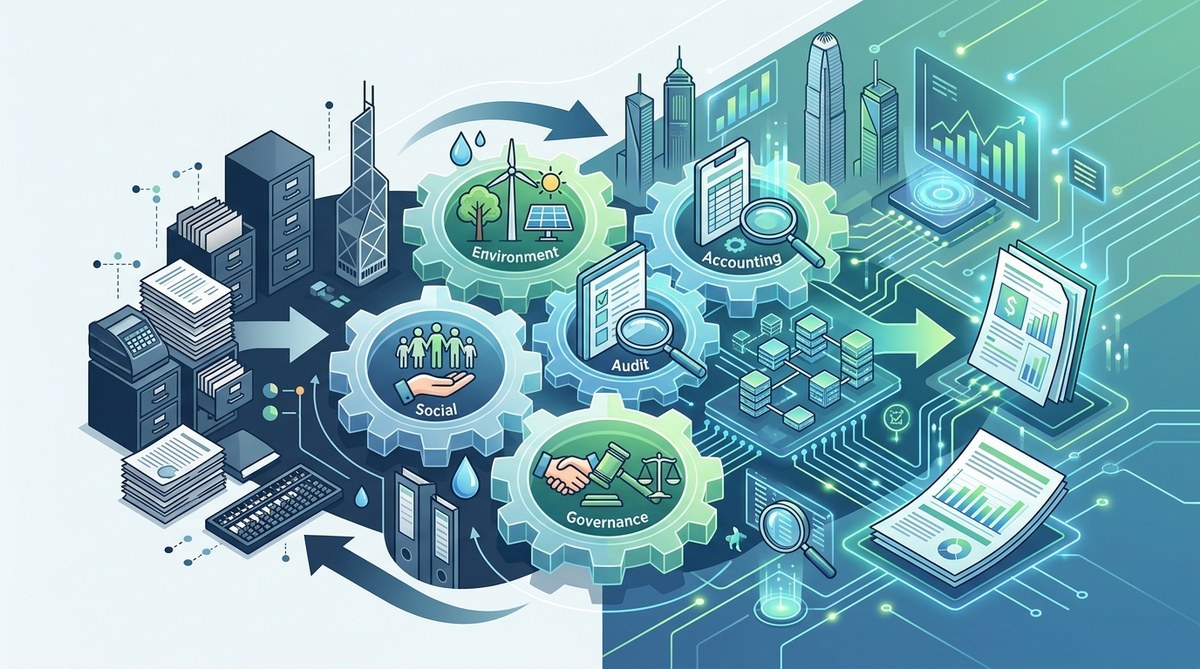
Picture this scene. You are a CFO at a mid-sized Hong Kong company, and your auditor just asked for carbon emission data alongside the usual financial statements. A few years ago, that question would have seemed strange. Today, it is the new normal. Environmental, Social, and Governance (ESG) reporting has moved from a nice-to-have initiative to a regulatory requirement that touches every part of the accounting and audit process. The Hong Kong Stock Exchange (HKEX) continues to tighten its ESG disclosure rules, and the government is aligning with global frameworks like the ISSB standards. For accounting and audit professionals in Hong Kong, this shift is not just about adding a few extra pages to the annual report. It is about rethinking how data is collected, verified, and communicated from the ground up.
ESG reporting is transforming Hong Kong accounting and audit by introducing new data sources, assurance requirements, and regulatory deadlines. Professionals must learn to verify non-financial data, adopt new frameworks like ISSB, and avoid common pitfalls such as greenwashing. This article covers the changes, the techniques, and the mistakes to watch for in 2026.
Why ESG Reporting Is No Longer Optional for Hong Kong Firms
The regulatory push is real. HKEX has mandated ESG disclosures for listed companies since 2016, but the requirements have grown more prescriptive each year. In 2025, Hong Kong adopted the IFRS Sustainability Disclosure Standards (ISSB) as a blueprint for future regulation. By 2026, many listed firms are already reporting against climate-related metrics with third-party assurance. Private companies are not immune either. Banks and investors increasingly demand ESG data before approving loans or funding rounds.
This creates a direct impact on accounting and audit teams. You cannot just copy last year’s report and change the date. ESG reporting requires reliable data from departments that never used to talk to finance, like operations, HR, and supply chain. And auditors must now form an opinion on information that is harder to measure than a typical balance sheet item.
How ESG Reporting Reshapes the Accounting Workflow
The accounting process for ESG data looks different from traditional financial accounting. Here are the main areas where the shift is most visible.
Data Collection Moves Beyond Finance
In the past, accountants pulled numbers from invoices, bank statements, and ledgers. ESG reporting introduces new data streams.
- Energy consumption data from utility bills and smart meters.
- Greenhouse gas emissions calculated using activity data and emission factors.
- Waste and water usage figures from facility management.
- Social metrics like employee turnover, training hours, and health and safety records.
- Governance data such as board diversity percentages and anti-corruption training completion.
Accountants must learn to collect, clean, and categorize these data points. Many firms are adopting specialized ESG software to automate the process, but human judgment is still needed to define boundaries and select appropriate calculation methods.
New Assurance Standards Create Audit Complexity
Auditors are being asked to provide assurance on ESG information. This is not the same as a financial audit. The standards are different.
| Technique | What It Involves | Common Mistakes |
|---|---|---|
| Limited assurance review | Checking data for consistency and plausibility without detailed testing. | Assuming limited assurance means no work at all. |
| Reasonable assurance engagement | Testing controls and verifying data sources with the same rigor as a financial audit. | Treating ESG data like financial data without understanding its limitations. |
| Site visits and interviews | Observing operations and talking to staff to confirm reported practices. | Relying only on spreadsheets without seeing actual processes. |
| Data traceability checks | Following a data point from source to report to confirm accuracy. | Accepting estimates without verifying the underlying assumptions. |
| Third-party certification review | Examining certificates for waste disposal, carbon offsets, or green building ratings. | Taking certifications at face value without checking scope and expiry dates. |
“The biggest shift we see is in mindset. Auditors used to think of verification as a binary exercise. With ESG data, everything exists on a spectrum of reliability. You have to ask better questions and accept that some numbers will never be as precise as a dollar figure.”
Senior Partner at a Top 10 Hong Kong audit firm
Practical Processes for Integrating ESG into Your Accounting Work
Here is a numbered list of steps your team can take right now to get ahead of the ESG reporting curve.
-
Map your data landscape. Identify every source of ESG data inside your organization. Talk to facilities, HR, procurement, and legal. Document where the data lives, who owns it, and how often it is updated. This step alone will reveal gaps you never knew existed.
-
Choose a reporting framework and stick with it. Hong Kong regulators are moving toward ISSB, but you may also need to align with GRI or TCFD depending on your industry and investor base. Pick one primary framework and map your disclosures to it. Hopping between frameworks each year creates confusion and extra work.
-
Build internal controls for non-financial data. This is where accounting professionals add real value. Design approval workflows, validation rules, and review checklists for ESG data just like you would for financial data. If a number looks off, flag it before it reaches the report.
-
Train your audit team on ESG topics. Your auditors cannot verify what they do not understand. Provide training on carbon accounting, social metrics, and governance indicators. Help them recognize red flags like inconsistent emission factors or gaps in board diversity data.
-
Run a dry run before the real deadline. Do not wait until the last month to produce your first ESG report. Run a practice cycle six months before the filing date. Identify bottlenecks, clarify unclear data sources, and refine your narrative. The first attempt will be messy. That is normal. Learn from it and improve.
Common Pitfalls in ESG Reporting and How to Avoid Them
Let us look at some mistakes that Hong Kong firms make when they first adopt serious ESG reporting.
- Greenwashing through vague language. Saying “we care about the environment” without supporting data is a red flag for auditors and regulators. Back every claim with a specific metric or target.
- Using outdated emission factors. Hong Kong’s grid emission factor changes regularly. Using last year’s number can misstate your carbon footprint significantly.
- Forgetting scope 3 emissions. Many companies report scope 1 and 2 emissions but ignore the supply chain. Regulators and investors are increasingly asking about scope 3.
- Treating ESG as a separate silo. If ESG data never enters your main accounting system, you will struggle to produce consistent reports year after year.
- Ignoring the materiality assessment. Not every metric matters equally to your business. A proper materiality assessment helps you focus on what is relevant and avoid reporting fatigue.
The Role of Company Secretaries in ESG Governance
Company secretaries in Hong Kong have a critical part to play. They oversee board governance, maintain statutory registers, and ensure compliance with the Companies Ordinance. As ESG reporting expands, company secretaries are often the ones coordinating the disclosure process. They work with the board to define ESG strategy, track progress against targets, and ensure the report meets HKEX requirements.
If you are a company secretary or compliance officer, understanding the intersection of ESG and corporate governance is essential. You may find it useful to review our guide on corporate governance best practices for Hong Kong company secretaries to see how ESG fits into the bigger picture.
How Digital Tools Are Making ESG Reporting Easier
Technology is helping accounting teams manage the ESG workload. Cloud-based platforms now integrate ESG data collection with financial reporting. Sensors and IoT devices feed real-time energy and water data directly into dashboards. Artificial intelligence can flag anomalies in emission calculations before they become errors.
But here is the catch. Tools are only as good as the people using them. An automated system that pulls bad data will produce bad reports faster. That is why internal controls and human oversight remain non-negotiable. For a broader look at how technology is changing the profession, read our article on how digital accounting is transforming Hong Kong businesses.
Preparing for the 2026 Reporting Cycle
The 2026 reporting cycle in Hong Kong comes with higher stakes. HKEX has signaled that climate-related disclosures will become mandatory for all listed companies, not just large caps. The government is also exploring a carbon tax, which would make accurate emissions data a financial liability issue, not just a reputation issue.
Here is what you should do before the next reporting deadline.
- Audit your current ESG data collection process for gaps and weaknesses.
- Confirm that your reporting framework aligns with ISSB standards.
- Train your finance and audit teams on carbon accounting and social metrics.
- Engage with external assurance providers early, not at the last minute.
- Review your materiality assessment to ensure it reflects current business realities.
If you are still building your company structure, the choices you make during incorporation can affect your ESG reporting obligations. Learn more about the hong kong company incorporation requirements for foreign entrepreneurs and how they relate to disclosure requirements.
A Practical Look at ESG and Audit for Smaller Firms
Small and medium-sized enterprises in Hong Kong often assume ESG reporting is only for large listed companies. That is changing fast. Banks are requesting ESG data from SME borrowers. Large corporate clients are requiring their suppliers to disclose environmental metrics. And the government is considering expanding disclosure requirements to private companies over time.
If you run a smaller firm, start small. Focus on the metrics that matter most to your stakeholders. Track your electricity usage and waste production first. Add social metrics like staff turnover and training hours later. The key is to start building the habit of collecting and reviewing ESG data now, before it becomes a legal requirement.
Looking Ahead: What 2027 Will Bring
The trajectory is clear. ESG reporting in Hong Kong will become more standardized, more mandatory, and more integrated with financial reporting. The International Sustainability Standards Board (ISSB) will continue to shape local regulations. Assurance requirements will move from limited to reasonable assurance for more metrics. And the demand for professionals who understand both accounting and sustainability will keep rising.
For accounting and audit professionals, this is an opportunity to grow your skills and your value. The firms that invest in ESG capabilities today will be the ones that lead the market tomorrow.
Your Next Steps in ESG Reporting
ESG reporting is reshaping accounting and audit in Hong Kong in ways that are both challenging and rewarding. The rules are changing, the data is harder to collect, and the assurance standards are still evolving. But the core principles remain the same: accuracy, transparency, and integrity.
Start by auditing your current processes. Train your team. Choose your framework. And do not be afraid to ask for help. If you need guidance on how to structure your company for compliance and governance, explore our complete guide on how to incorporate a company in Hong Kong in 2026.
The work you do today to embed ESG into your accounting and audit practices will build trust with stakeholders, reduce regulatory risk, and position your firm for long-term success. Take the first step this week. Review one ESG metric, check one data source, and start the conversation with your team. Small actions add up to real change.