Applying for a company resident status certificate with Form IR1313B
How partnerships in Hong Kong can apply for a Certificate of Resident Status using Form IR1313B.
IR1313B at a glance
- Official title
- Application for Certificate of Resident Status for a Company or Partnership
- Issued by
- Inland Revenue Department
We link the issuing authority's own index rather than hosting a copy, because the form is revised there and an out-of-date copy is worse than none.
Introduction
The Form IR1313B company resident status certificate is the application form used by partnerships to seek a Certificate of Resident Status (CRS) from the Inland Revenue Department (IRD) of Hong Kong. This certificate confirms that the partnership is a tax resident of Hong Kong for the purposes of claiming benefits under a double taxation agreement (DTA). The specific requirements for partnerships applying for a tax residency certification via Form IR1313B are distinct from company applications, and the IRD expects particular evidence to substantiate the claim.
Understanding the Certificate of Resident Status for Partnerships
A Certificate of Resident Status is an official document issued by the IRD to confirm an entity's tax residency in Hong Kong. For partnerships, this status is not automatic; it depends on where the business is effectively managed and controlled. The IRD uses Form IR1313B to assess whether a partnership meets the criteria for residency under a relevant DTA. Unlike a company, which is taxed as a separate legal entity, a partnership is a flow-through entity for Hong Kong tax purposes. The partners, not the partnership, are liable for profits tax, but the DTA claim is made at the level of the partnership. This distinction is critical when preparing the application.
Form IR1313B Application Guide for a Company Resident Status Certificate
A partnership must complete Part A and Part B of Form IR1313B, providing full particulars of the partnership. The form asks for the partnership name, business registration number, address of the place of business in Hong Kong, and details of all partners. The IRD uses this information to verify the partnership's existence and its Hong Kong-based operations.
Supporting documents must accompany the completed form. These include a certified true copy of the Partnership Agreement and a certified true copy of the Business Registration Certificate. The IRD may also request a certified true copy of the partnership's profits tax return (Form BIR52) for the relevant year of assessment. If the partnership has not yet filed a return, a letter explaining why is advisable.
The key distinction from a company application (Form IR1313A) is that the partnership must demonstrate that the business is carried on in Hong Kong and that the central management and control of the partnership is exercised in Hong Kong. For a company, the IRD focuses on the location of board meetings and the place of incorporation. For a partnership, the focus is on the partners' decision-making and the physical location of the partnership's place of business.
Certificate of Resident Status Partnership Hong Kong
For a partnership to obtain a Certificate of Resident Status in Hong Kong, it must satisfy the IRD that it is a resident of Hong Kong under the terms of the relevant DTA. The IRD interprets "resident" generally as the entity being liable to tax in Hong Kong by reason of its domicile, residence, place of management, or any other criterion of a similar nature.
A partnership is not itself chargeable to profits tax, so residency is determined by the location where the partnership's activities are controlled and managed. The IRD will examine where the partnership's business decisions are made, where the partners meet to conduct business, and where the partnership's books and records are kept. A partnership with a place of business in Hong Kong and partners who exercise management and control from Hong Kong has a strong case.
Tax Residency Certificate Partnership Hong Kong
The application for a tax residency certificate for a partnership uses Form IR1313B, not Form IR1313A (which is for companies) or Form IR1314A/IR1314B (which are for individuals). The process requires the partnership to demonstrate that it has a substantive presence in Hong Kong.
The IRD will scrutinise the following:
- The partnership's physical place of business in Hong Kong, such as a registered office or a leased office.
- The location of the partnership's management and control, evidenced by where partners hold meetings and make decisions.
- The nature and scale of business activities conducted in Hong Kong.
- The partnership's tax compliance history, including timely filing of profits tax returns and payment of profits tax by the partners.
The partnership must also provide a certified true copy of the partnership's tax return and any relevant correspondence with the IRD. The IRD may issue the certificate only if it is satisfied that the partnership is a Hong Kong resident for the purposes of the DTA claimed.
Evidence of Management and Control
The most critical evidence for a partnership applying under Form IR1313B is proof that the business is managed and controlled from Hong Kong. The IRD expects:
- Minutes of partners' meetings held in Hong Kong.
- Records showing where strategic decisions are made.
- Evidence that the partnership's principal place of business is in Hong Kong.
- A certified true copy of the partnership agreement, which should specify that the partnership is to be managed from Hong Kong.
- Proof that the partnership's bank accounts are operated from Hong Kong.
For partnerships with partners based outside Hong Kong, the IRD may require additional evidence to show that the partners' management decisions are still made in Hong Kong, not from the partner's location. The burden of proof sits with the partnership.
Difference From Company Applications
While the broad purpose of Form IR1313A (companies) and Form IR1313B (partnerships) is the same, to obtain a Certificate of Resident Status, the evidentiary focus differs.
For a company, the IRD looks at: - The location of the company's registered office and principal place of business. - The place of incorporation (Hong Kong incorporation is a strong indicator but not conclusive). - The location where board meetings are held. - The location where directors exercise their powers.
For a partnership, the IRD looks at: - The location of the partnership's place of business. - The location where partners exercise management and control. - The partnership agreement and how it allocates decision-making authority. - The partners' residency and their physical presence in Hong Kong for business purposes.
A partnership cannot rely solely on a Hong Kong business registration address. It must demonstrate that the partnership's business is genuinely managed from Hong Kong.
Supporting Documents Checklist
When preparing the Form IR1313B application, a partnership should assemble:
- Completed and signed Form IR1313B.
- Certified true copy of the partnership agreement.
- Certified true copy of the Business Registration Certificate.
- Certified true copy of the partnership's profits tax return (Form BIR52) for the relevant year.
- Certified true copy of the partnership's tax assessment or notice of assessment from the IRD.
- Evidence of the partnership's place of business in Hong Kong, such as a tenancy agreement or utility bill.
- Evidence of management and control in Hong Kong, such as meeting minutes or correspondence.
- A cover letter explaining the partnership's business activities and why it seeks the certificate.
The IRD may request original documents for verification and may refuse the application if the supporting documents are incomplete.
Application Submission and Processing
The partnership must submit Form IR1313B and all supporting documents to the Inland Revenue Department's Deputy Commissioner of Inland Revenue. The IRD will review the application and may request additional information. Processing times vary, but the IRD aims to respond within several weeks.
If the IRD grants the certificate, the partnership receives a Certificate of Resident Status. This certificate can then be presented to the tax authority in the other contracting state to claim the benefits of a DTA, such as reduced withholding tax rates on income sourced from that jurisdiction.
If the IRD refuses the application, the partnership may request a review. The IRD's decision is based on the facts and the terms of the specific DTA. There is no standard appeal procedure, but the partnership can submit a fresh application with additional evidence.
How to fill out Form IR1313B
Page one of the official form. Every field named below appears on it in the same order.
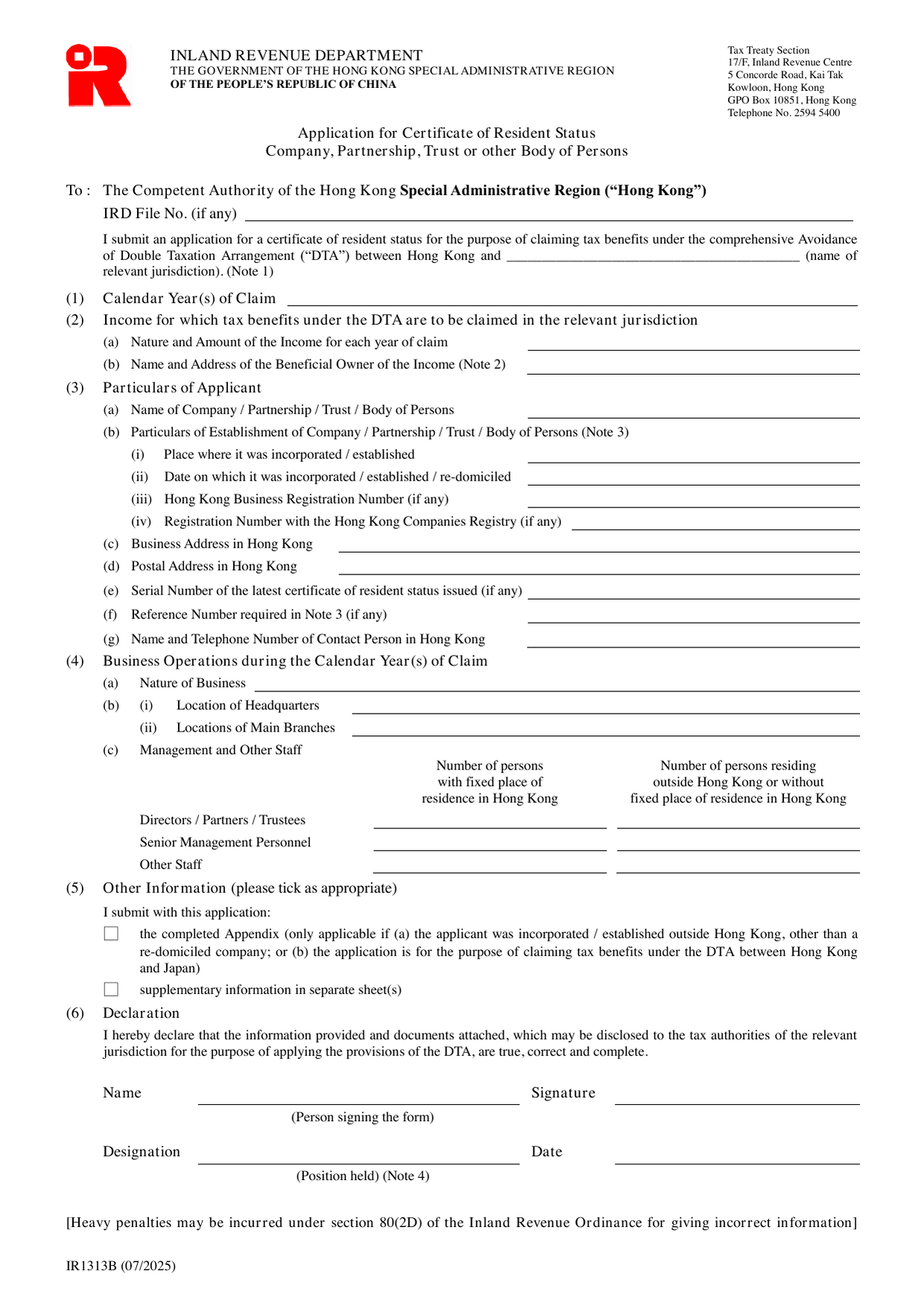
(1) Calendar Year(s) of Claim
Enter the year(s) for which you are claiming tax benefits under the DTA. This determines the period the IRD examines.
(2) Income for which tax benefits under the DTA are to be claimed in the relevant jurisdiction
- (a) Nature and Amount of the Income: Describe the income (e.g., dividends, interest, royalties) and state the amount for each year of claim.
- (b) Name and Address of the Beneficial Owner: Your company is the beneficial owner only if it has full right to use and enjoy the income. If a contractual or legal obligation forces you to pass the payment to another person, that person is the beneficial owner, and you must enter their name and address. Agents, nominees, and conduit companies do not qualify as beneficial owners.
(3) Particulars of Applicant
- (a) Name: Enter the exact legal name of the company, partnership, trust, or body of persons.
- (b) Particulars of Establishment:
(i) Place of incorporation/establishment.
(ii) Date of incorporation/establishment/re-domiciliation.
(iii) Hong Kong Business Registration Number (from your BR certificate).
(iv) Companies Registry Number (from your certificate of incorporation). - (c) Business Address: Your principal place of business in Hong Kong.
- (d) Postal Address: For correspondence.
- (e) Serial Number of latest certificate of resident status: Leave blank if none.
- (f) Reference Number: Only if you previously submitted the supporting documents listed in Note 3 and are relying on that earlier submission.
- (g) Contact Person: Name and telephone number of someone in Hong Kong who can answer queries.
(4) Business Operations
- (a) Nature of Business: Describe your core activities.
- (b) (i) Location of headquarters; (ii) Locations of main branches.
- (c) Management and Other Staff: Use the table to show numbers of directors/partners/trustees, senior management, and other staff, split by whether they reside in Hong Kong with a fixed place of residence or reside outside Hong Kong or have no fixed residence there.
(5) Other Information
Tick boxes as applicable: - Appendix - Mandatory if (a) the applicant was incorporated/established outside Hong Kong (other than a re-domiciled company), or (b) the claim is under the DTA with Japan. The Appendix (at the end of the form) must be completed and signed. - Supplementary information - Tick if attaching separate sheets.
(6) Declaration
- Name: Print full name.
- Signature: Must be signed by the person authorised under Note 4:
- Company: director, secretary, or manager.
- Partnership (other than limited partnership fund): precedent partner.
- Limited partnership fund: general partner, authorised representative, or investment manager.
- Trust: trustee.
- Body of persons: principal officer. - Designation: State the position held.
- Date: Date of signing.
Download the current form - always file the version on the issuing authority's site, not a copy.
Sources
More on the forms library.