Applying for an individual resident status certificate with Form IR1314A
Apply for an individual Certificate of Resident Status in Hong Kong with Form IR1314A for tax treaty benefits.
IR1314A at a glance
- Official title
- Application for Certificate of Resident Status for an Individual
- Issued by
- Inland Revenue Department
We link the issuing authority's own index rather than hosting a copy, because the form is revised there and an out-of-date copy is worse than none.
Form IR1314A Individual Resident Status Certificate
Form IR1314A applies for a Certificate of Resident Status (CRS) from Hong Kong's Inland Revenue Department (IRD). This certificate confirms the applicant is a Hong Kong tax resident, a status required to claim benefits under a double taxation agreement (DTA) Hong Kong has concluded with another jurisdiction. The IRD reviews the applicant's particulars and supporting documents to determine if they meet the residency definition in the relevant DTA before issuing the certificate.
Certificate of Resident Status Individual Hong Kong
A Certificate of Resident Status for an individual in Hong Kong is a formal IRD document. It certifies the individual is a Hong Kong tax resident for a specific double taxation agreement. The tax authority of the other contracting state requires this certificate to allow the individual to claim treaty benefits. These benefits include reduced withholding tax on dividends, interest, or royalties, or an exemption from tax on certain income. The IRD issues a CRS only if the applicant demonstrates they meet the residence criteria in the relevant DTA. Applications use Form IR1314A. The IRD assesses them based on the individual's physical presence, home, and family ties in Hong Kong.
IR1314A Application Process
The IR1314A application process begins with completing the form in full. Applicants must provide personal particulars: full name, Hong Kong Identity Card number, correspondence address, and contact details. They must also specify the double taxation agreement under which the certificate is sought and the tax authority in the other jurisdiction requiring it. Submit the completed form to the IRD with supporting documents. The IRD will review the application and may request more information if the residence evidence is insufficient. Once satisfied, the IRD issues the Certificate of Resident Status. There is no statutory fee for the application, but the IRD may charge a fee to issue the certificate.
Tax Residency Certificate Individual Hong Kong
A tax residency certificate for an individual in Hong Kong is the same document as the Certificate of Resident Status. IRD guidance uses "Certificate of Resident Status", but practitioners and taxpayers often call it a tax residency certificate. The certificate is issued under the Inland Revenue Ordinance (Cap. 112) and the relevant DTA. The IRD will only issue it if the individual is a Hong Kong resident for the DTA's purposes. The definition of "resident" varies between DTAs but generally requires a habitual abode, a permanent home, or a centre of vital interests in Hong Kong. The IRD examines the individual's physical presence, home location, and family residence when assessing the application.
Evidence of Residence Required
To support a CRS application, the individual must prove they are a Hong Kong tax resident. The IRD requires evidence of physical presence in Hong Kong, home location, and family residence. Supporting documents should include:
- A certified true copy of the applicant's Hong Kong Identity Card.
- Evidence of physical presence in Hong Kong, such as travel records, employment contracts, or payslips showing Hong Kong employment.
- Evidence of a home in Hong Kong, such as a tenancy agreement, utility bills, or property ownership documents.
- Evidence of the applicant's family residing in Hong Kong, such as marriage certificates, children's birth certificates, or proof of dependants living in Hong Kong.
- Any other documents demonstrating the applicant's centre of vital interests is in Hong Kong, such as bank statements, club memberships, or social ties.
The IRD assesses evidence on a case-by-case basis. Provide as much relevant documentation as possible to establish residence status.
Supporting Documents for Form IR1314A
Supporting documents for Form IR1314A must include certified true copies of the documents listed above. The IRD requires certification by a professional person, such as a lawyer, certified public accountant, or notary public. Include a covering letter explaining the application's purpose and the relevant DTA. The IRD may request original documents for verification if necessary. Keep copies of all submitted documents for your records. The IRD will return original documents after processing the application.
Application for Certificate of Resident Status
Applying for a Certificate of Resident Status with Form IR1314A is a formal request to the IRD. Complete the form accurately and provide all required information. The IRD will process the application and issue the certificate if the individual meets the residence criteria. The certificate states the period for which the individual is considered a Hong Kong resident. It is typically valid for the year of assessment in which the application is made, but the IRD may issue a certificate for a longer period if the individual's circumstances are unlikely to change. Submit the application well in advance of any deadline imposed by the other jurisdiction's tax authority.
Physical Presence in Hong Kong
Physical presence in Hong Kong is a key factor in determining tax residency. The IRD considers the number of days the individual spent in Hong Kong during the relevant period. Generally, an individual present in Hong Kong for 183 days or more in a year of assessment is a resident. However, the IRD also considers the individual's pattern of presence, such as a regular and habitual presence in Hong Kong. Provide evidence of physical presence, like travel records, employment records, or bank statements showing Hong Kong transactions.
Home in Hong Kong
The location of the individual's home is another important factor. The IRD considers whether the individual has a permanent home in Hong Kong, such as a property they own or rent. The home must be available to the individual on a continuous basis. Provide evidence of your home, such as a tenancy agreement, property ownership documents, or utility bills in your name. The IRD will also consider whether your family lives in the home.
Family in Hong Kong
The location of the individual's family is also relevant. The IRD considers whether the individual's spouse, children, or other dependants live in Hong Kong. Provide evidence of your family's residence in Hong Kong, such as marriage certificates, birth certificates, or proof of dependants living in Hong Kong. The IRD considers family ties as part of the overall assessment of the individual's centre of vital interests.
Certified True Copy Requirements
The IRD requires supporting documents submitted with Form IR1314A to be certified true copies. A certified true copy is a copy of an original document verified as a true copy by an authorised person. The certifier must sign and stamp the copy, stating it is a true copy of the original. The IRD accepts certification by a lawyer, certified public accountant, notary public, or justice of the peace. Ensure the certification is clear and legible. The IRD may reject improperly certified documents.
Double Taxation Agreement Benefits
The Certificate of Resident Status is used to claim benefits under a double taxation agreement. Hong Kong has DTAs with many jurisdictions, including Mainland China, the United Kingdom, and Singapore. Benefits under each DTA vary but typically include reduced withholding tax on dividends, interest, and royalties, and an exemption from tax on certain income. Apply for the certificate using Form IR1314A and provide it to the other jurisdiction's tax authority to claim these benefits. The IRD issues the certificate only if the individual is a Hong Kong resident for the relevant DTA's purposes.
How to fill out Form IR1314A
Page one of the official form. Every field named below appears on it in the same order.
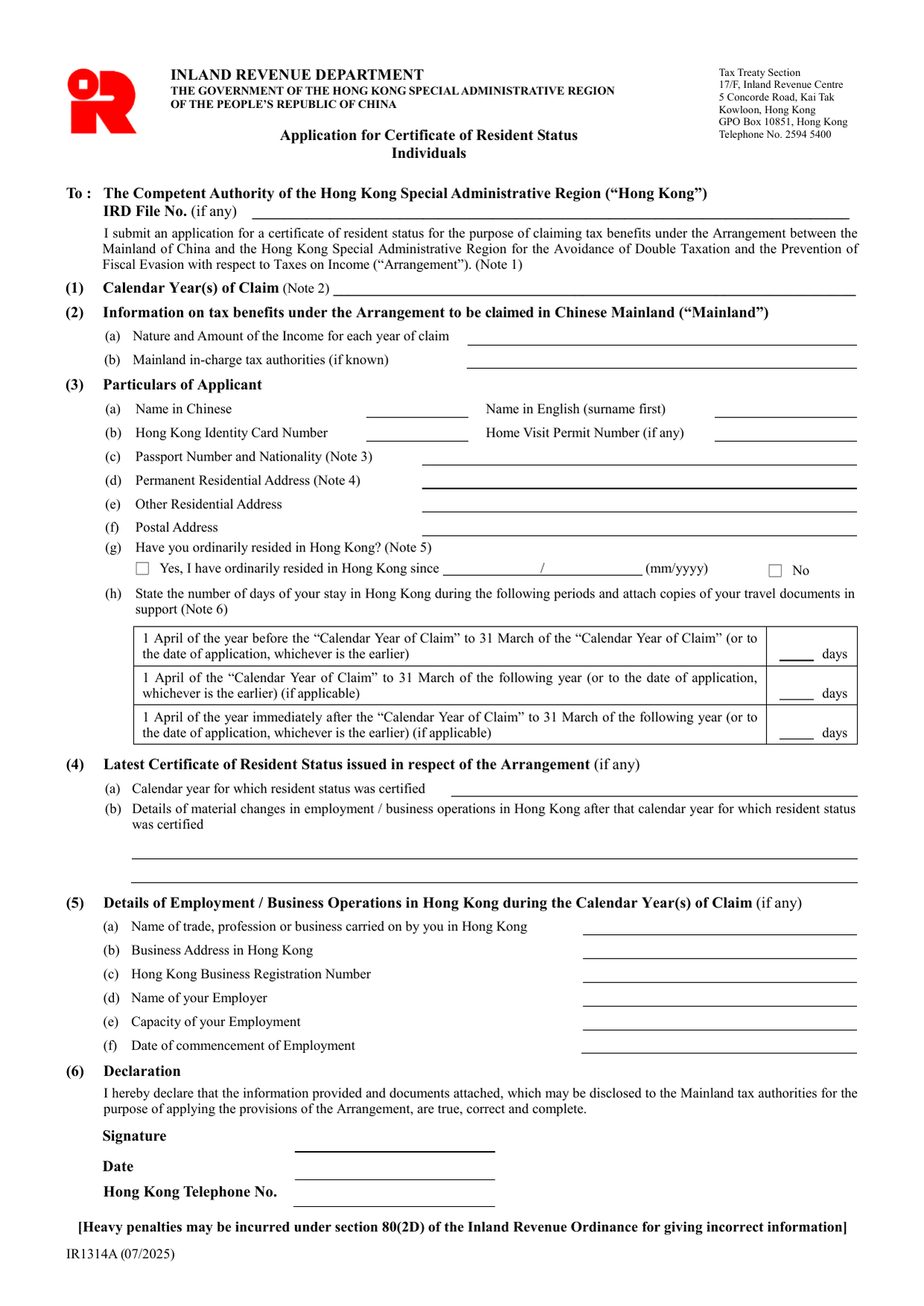
To: The Competent Authority of the Hong Kong Special Administrative Region (“Hong Kong”) / IRD File No.
Leave the IRD File No. blank. The Inland Revenue Department will fill this in if it already has a file for you.
(1) Calendar Year(s) of Claim
Enter the calendar year(s) for which you are claiming resident status. For example, 2024. Refer to Note 2: a certificate for one year generally covers that year and the two succeeding years. If you already hold a certificate for 2023, you do not need one for 2024 or 2025 unless your circumstances have changed.
(2) Information on tax benefits under the Arrangement to be claimed in Chinese Mainland
(a) Nature and Amount of the Income for each year of claim - State the type of income (e.g., dividends, interest, royalties, employment income) and the amount for each year of claim. Use a continuation sheet if you have more than one year.
(b) Mainland in-charge tax authorities (if known) - The name of the Mainland tax authority that will assess your claim (e.g., the local State Taxation Bureau). If you do not know it, leave blank.
(3) Particulars of Applicant
(a) Name in Chinese / Name in English - Your full name. For the English name, write your surname first.
(b) Hong Kong Identity Card Number / Home Visit Permit Number - Your HKID number. The Home Visit Permit number is only for non-permanent residents who hold a permit.
(c) Passport Number and Nationality - Required only if you are not a Hong Kong Identity Card holder (see Note 3). If you are a card holder, leave this blank.
(d) Permanent Residential Address - The permanent place where you and your family live (Note 4). This is your main home in Hong Kong.
(e) Other Residential Address - Any other address where you live (e.g., a temporary rental).
(f) Postal Address - Where you want IRD correspondence sent.
(g) Have you ordinarily resided in Hong Kong? - Tick Yes if you have a permanent home in Hong Kong where you or your family live (Note 5). If Yes, enter the month and year you began ordinarily residing (mm/yyyy). If No, tick No.
(h) State the number of days of your stay in Hong Kong during the following periods - Fill each row with the actual number of days you were physically present in Hong Kong. Attach copies of your travel documents (e.g., passport stamps, boarding passes, e‑Travel records). Use Note 6’s table to calculate the correct periods:
- Row 1: 1 April of the year before the Calendar Year of Claim to 31 March of the Calendar Year of Claim (or to the date of application, whichever is earlier).
- Row 2: 1 April of the Calendar Year of Claim to 31 March of the following year (or to the date of application, whichever is earlier).
- Row 3: 1 April of the year after the Calendar Year of Claim to 31 March of the following year (or to the date of application, whichever is earlier).
If the period ends on your application date, use that date, not 31 March. For a multiple‑year claim, use separate sheets for each year (Note 6).
(4) Latest Certificate of Resident Status issued (if any)
(a) Calendar year for which resident status was certified - If you have previously received a certificate under the Arrangement, state the year it covered.
(b) Details of material changes - Describe any significant changes in your employment or business operations in Hong Kong since that certified year (e.g., change of employer, ceasing trade, moving out of Hong Kong).
(5) Details of Employment / Business Operations in Hong Kong
Fill in only if you have employment or a business in Hong Kong during the claim years. Provide the business/employer name, business address, Hong Kong Business Registration Number (from your BR certificate), your job title/capacity, and the date you started the employment/business.
(6) Declaration
Signature - You, the applicant, must sign. The form does not accept a company stamp or another person’s signature.
Date - The date you sign.
Hong Kong Telephone No. - A daytime contact number.
Do not leave the declaration blank. Incorrect information can attract heavy penalties under section 80(2D) of the Inland Revenue Ordinance.
Download the current form - always file the version on the issuing authority's site, not a copy.
Sources
More on the forms library.