

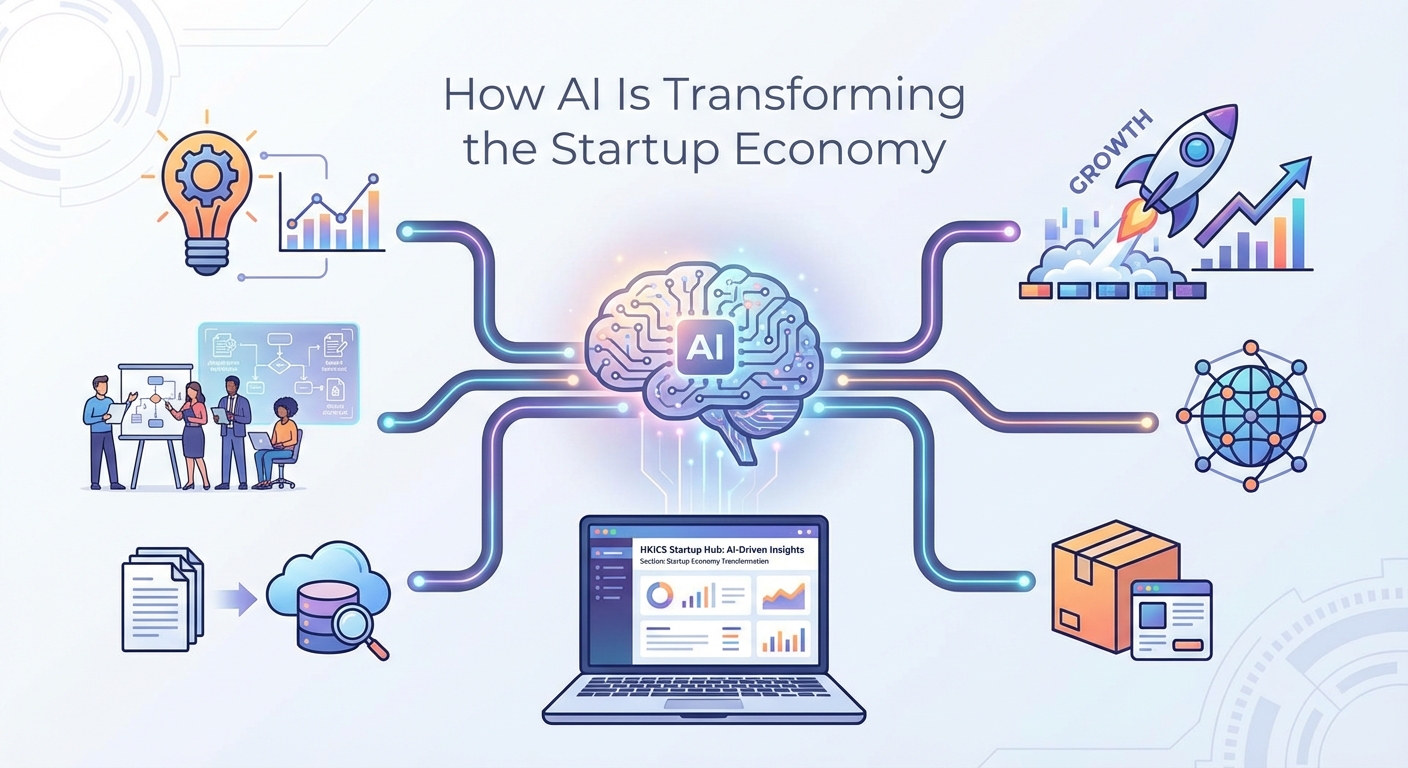
Artificial intelligence has stopped being a luxury for startups. It’s now the baseline for staying competitive. Founders who understand how to integrate AI into their operations are building faster, spending smarter, and scaling with fewer resources than ever before.
AI is fundamentally changing startup operations through automation, data analysis, and customer engagement tools. Founders who adopt AI strategically gain significant advantages in product development, resource allocation, and market positioning. Success requires understanding which AI applications deliver real value versus those that simply add complexity to your business model without measurable returns.
Why startups are turning to AI now
The cost barrier has collapsed. Tools that required six-figure budgets five years ago now cost less than a monthly software subscription. A solo founder can access machine learning models, natural language processing, and predictive analytics without hiring a data science team.
Timing matters too. Customers expect personalized experiences. Investors want proof of scalability. Competitors are already using AI to optimize everything from pricing to product recommendations. Waiting means falling behind.
The technology has also become accessible. You don’t need a PhD to implement AI solutions anymore. Platforms offer pre-built models you can customize for your specific needs. Integration takes days, not months.
Core areas where AI creates startup value
Product development and iteration
AI accelerates how you build and refine products. Machine learning analyzes user behavior patterns to identify which features actually matter. You stop guessing what customers want and start building based on data.
Testing cycles shrink dramatically. AI can run thousands of A/B test variations simultaneously, learning which combinations drive conversions. What used to take months now happens in weeks.
Code generation tools help small teams punch above their weight. Developers use AI assistants to write boilerplate code, debug faster, and explore solutions they might not have considered. This doesn’t replace human creativity but amplifies it.
Customer acquisition and retention
Finding the right customers becomes more precise. AI models analyze your best customers and identify similar prospects across marketing channels. Your ad spend goes further because you’re targeting people more likely to convert.
Chatbots handle initial customer inquiries 24/7. They answer common questions, qualify leads, and escalate complex issues to humans. Your team focuses on high-value interactions while AI manages routine communication.
Churn prediction models flag at-risk customers before they leave. You can intervene with targeted offers or support when it actually makes a difference. Retention improves because you’re proactive instead of reactive.
Operations and resource allocation
AI optimizes how you spend money and time. Inventory management systems predict demand fluctuations, preventing both stockouts and overstock situations. Cash flow improves because capital isn’t tied up in excess inventory.
Hiring gets smarter. AI screens resumes, schedules interviews, and even conducts initial assessments. Your team reviews qualified candidates instead of sorting through hundreds of applications.
Financial forecasting becomes more accurate. Models incorporate multiple variables to predict cash runway, revenue trends, and resource needs. You make strategic decisions with better information.
Practical implementation steps for founders
Getting started doesn’t require a complete business overhaul. Here’s how to integrate AI strategically:
-
Identify your biggest bottleneck. Look for repetitive tasks consuming disproportionate time or areas where decisions rely on gut feeling instead of data. These are prime AI opportunities.
-
Start with one tool. Pick a single AI application that addresses your primary bottleneck. Master it before adding more. Trying to implement everything at once creates chaos.
-
Measure specific outcomes. Define what success looks like before implementation. Track metrics like time saved, conversion rate improvements, or cost reductions. Vague goals lead to abandoned projects.
-
Train your team properly. AI tools only work when people know how to use them. Budget time for learning and experimentation. Resistance usually comes from confusion, not opposition.
-
Iterate based on results. Review performance monthly. Double down on what works and cut what doesn’t. AI implementation is an ongoing process, not a one-time project.
Common AI applications by startup stage
Different growth phases benefit from different AI tools. Here’s what typically makes sense at each stage:
| Startup Stage | High-Impact AI Applications | Why It Matters |
|---|---|---|
| Pre-seed | Market research tools, competitor analysis, content generation | Validate ideas faster with limited resources |
| Seed | Customer support chatbots, email marketing automation, basic analytics | Scale customer engagement without proportional hiring |
| Series A | Predictive analytics, personalization engines, sales forecasting | Prove unit economics and demonstrate scalability |
| Series B+ | Advanced ML models, custom AI features, process automation | Build defensible competitive advantages |
Avoiding common AI implementation mistakes
Many founders rush into AI without proper planning. Here are pitfalls to avoid:
Don’t solve problems you don’t have. AI for the sake of appearing innovative wastes resources. Only implement solutions that address actual business needs.
Avoid data quality issues. AI models are only as good as their training data. Garbage in, garbage out. Clean, organize, and validate your data before feeding it into AI systems.
Don’t ignore privacy and compliance. Different markets have different data regulations. Make sure your AI applications comply with relevant laws, especially if you handle customer information.
Resist over-automation. Some interactions need human touch. Customer complaints, complex sales, and sensitive situations often require empathy and judgment that AI can’t provide.
Don’t neglect monitoring. AI models can drift over time, becoming less accurate as conditions change. Regular audits ensure your systems still perform as expected.
The biggest mistake I see is founders treating AI as a magic solution instead of a tool. You still need strategy, execution, and understanding of your market. AI amplifies good decisions but can’t fix fundamental business problems.
Real advantages AI gives startups over established companies
Startups actually have AI advantages that larger companies struggle to match. You can move faster because you have fewer legacy systems to work around. Your tech stack is modern and designed for integration.
Cultural resistance is lower. Everyone on a small team can understand why you’re implementing AI and how it helps. Large organizations battle internal politics and change management.
You can experiment more freely. Failed AI experiments don’t risk billion-dollar revenue streams. This freedom lets you test aggressive applications that might give you breakthrough advantages.
Data is cleaner. You’re building systems from scratch instead of trying to unify decades of siloed information. This makes AI implementation simpler and more effective.
Skills founders need in an AI-driven landscape
You don’t need to become a machine learning engineer, but certain competencies help:
- Data literacy: Understanding how to interpret analytics, spot patterns, and make data-informed decisions.
- Prompt engineering: Knowing how to communicate effectively with AI tools to get useful outputs.
- Critical evaluation: Distinguishing between AI hype and genuinely useful applications for your business.
- Integration thinking: Seeing how different tools and systems can work together rather than viewing each as standalone.
These skills develop through practice. Start small and build competence over time.
Cost considerations and ROI expectations
AI doesn’t have to break your budget. Many powerful tools operate on freemium models or affordable monthly subscriptions. A typical early-stage startup might spend $200 to $500 monthly on AI tools and see immediate returns.
Calculate ROI by comparing time saved or revenue generated against tool costs. If an AI assistant saves your team 10 hours weekly at an average rate of $50 per hour, that’s $2,000 monthly in value. A $200 tool becomes an obvious investment.
Some applications pay for themselves within weeks. Others take months to show returns. Be realistic about timelines and patient with learning curves.
Building AI into your competitive strategy
Smart founders use AI to create sustainable advantages. This means going beyond obvious applications everyone uses.
Think about proprietary data you can collect. AI models trained on unique datasets create barriers competitors can’t easily replicate. A restaurant startup with years of customer preference data builds better recommendation engines than new entrants.
Consider how AI enables business models that weren’t previously viable. Personalization at scale, dynamic pricing, or predictive maintenance might open entirely new market opportunities.
Look for compounding advantages. Each AI improvement makes your product better, which attracts more users, which generates more data, which enables better AI. This flywheel effect separates winners from followers.
What’s coming next for startups and AI
The technology keeps evolving rapidly. Multimodal AI that processes text, images, and audio simultaneously will enable richer applications. Smaller, more efficient models will run on edge devices instead of requiring cloud processing.
AI agents that can complete complex tasks autonomously are emerging. Imagine systems that not only analyze your sales pipeline but actually conduct outreach and qualification without human intervention.
Regulation will shape what’s possible. Privacy laws, AI transparency requirements, and industry-specific rules will create both constraints and opportunities. Startups that build compliant systems from the start will have advantages.
Making AI work for your startup reality
The founders winning with AI aren’t necessarily the most technical. They’re the ones who clearly understand their business problems and thoughtfully apply AI where it creates real value.
Start with one area where AI can make a measurable difference. Learn how the tools work. Measure results honestly. Build from there.
Your competitors are already doing this. The question isn’t whether to use AI but how to use it better than everyone else in your market. The tools are available, affordable, and proven. What you do with them determines whether you lead your category or chase it.