

Artificial intelligence is no longer a futuristic concept reserved for tech giants. It sits in boardrooms across Hong Kong and beyond, reshaping how executives make critical business decisions. From risk assessment to strategic planning, AI tools now influence choices that once relied purely on human intuition and experience.
AI corporate decision making combines machine learning algorithms with human expertise to improve strategic choices. Leaders who implement AI systems gain faster insights, reduce bias, and make data-backed decisions. Success requires understanding both the technology’s capabilities and its limitations, along with clear governance frameworks that maintain human accountability while leveraging computational power.
What AI brings to the boardroom
Traditional decision making relies on historical data, market reports, and executive experience. These remain valuable. But AI adds computational power that processes millions of data points in seconds.
Machine learning algorithms identify patterns humans miss. They analyze customer behavior, market trends, and operational metrics simultaneously. This creates a fuller picture of business conditions.
Consider a manufacturing company facing supply chain disruptions. Human analysts might review supplier performance reports and delivery schedules. An AI system examines those same metrics plus weather patterns, geopolitical events, shipping routes, commodity prices, and thousands of other variables. It then predicts which suppliers face the highest risk of delays.
The difference is scale and speed. AI handles complexity that would take human teams weeks or months to analyze.
Core applications transforming executive decisions
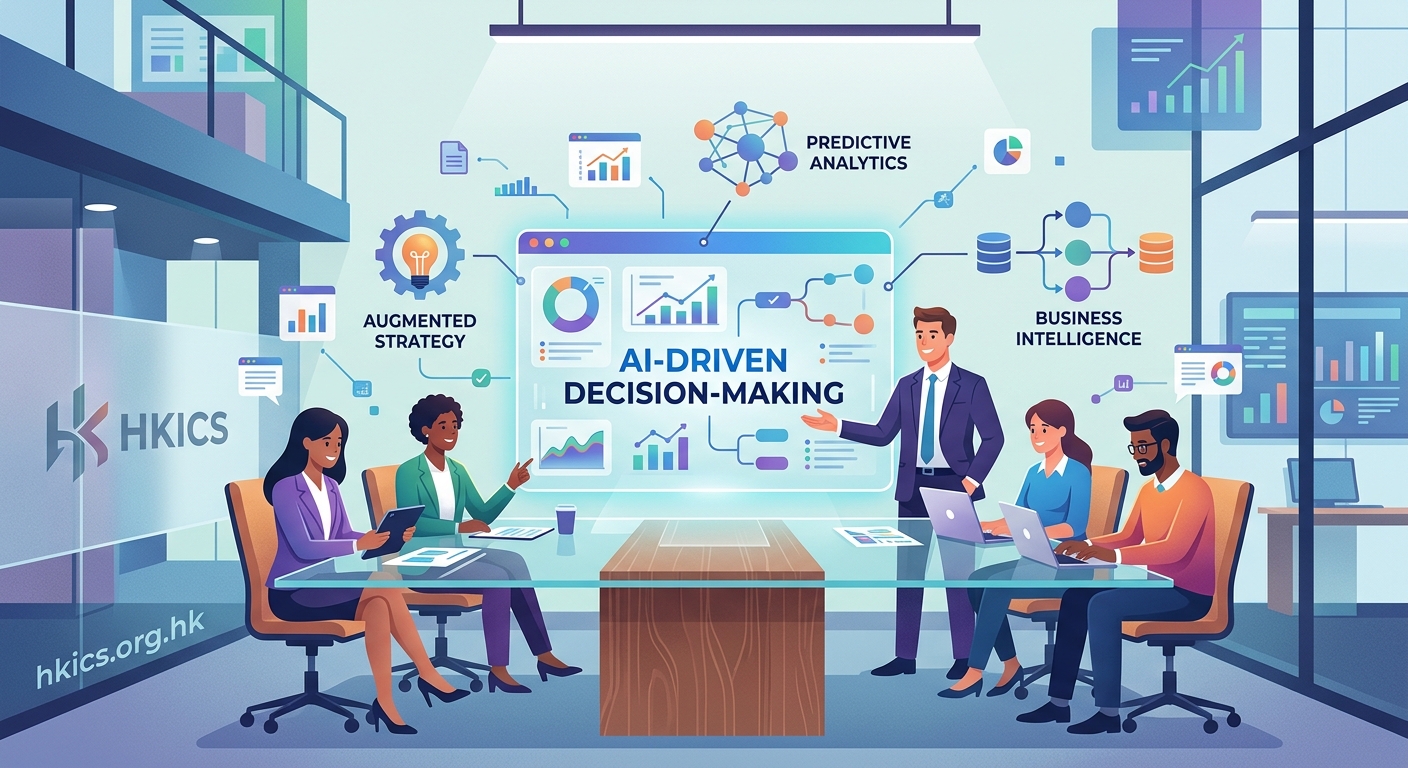
AI corporate decision making shows up in specific, measurable ways across organizations. Here are the areas where impact appears most clearly:
Financial forecasting and budget allocation
Predictive models analyze revenue patterns, seasonal fluctuations, and market conditions to project future performance. CFOs use these insights to allocate resources more precisely.
Risk management and compliance
AI systems monitor regulatory changes, transaction patterns, and operational data to flag potential compliance issues before they become problems. This proactive approach reduces legal exposure.
Talent acquisition and retention
Algorithms assess candidate profiles, predict employee turnover, and identify skill gaps. HR leaders make more informed hiring and development decisions.
Customer strategy and market positioning
Natural language processing analyzes customer feedback, social media sentiment, and competitor activities. Marketing executives adjust strategies based on real-time market signals.
Operational efficiency
AI identifies bottlenecks, predicts equipment failures, and optimizes workflows. Operations leaders reduce costs while maintaining quality.
Building an AI decision framework
Implementing AI requires structure. Random adoption of tools creates confusion and wasted investment. Follow this approach:
-
Identify high-impact decision points
Map out where executives make choices that significantly affect business outcomes. Look for decisions that repeat regularly and involve substantial data analysis. These are prime candidates for AI augmentation. -
Assess data readiness
AI needs quality data to produce reliable insights. Audit your current data collection, storage, and cleaning processes. Poor data quality produces poor AI recommendations, regardless of algorithm sophistication. -
Start with pilot programs
Choose one decision area for initial implementation. Test the AI system against human-only decisions. Measure accuracy, speed, and business impact. Learn what works before scaling. -
Establish governance protocols
Create clear rules about who reviews AI recommendations, who makes final decisions, and how to handle disagreements between AI outputs and human judgment. Document these processes. -
Train decision makers
Executives need to understand what AI can and cannot do. Provide training on interpreting AI outputs, questioning assumptions, and recognizing algorithmic limitations. -
Monitor and refine continuously
AI systems improve with feedback. Track decision outcomes, identify where AI recommendations proved accurate or missed the mark, and adjust models accordingly.
Common implementation mistakes
| Mistake | Why it happens | Better approach |
|---|---|---|
| Treating AI as a black box | Executives trust outputs without understanding methodology | Require explainable AI that shows reasoning behind recommendations |
| Ignoring data bias | Historical data contains past prejudices and errors | Audit training data for bias and implement correction mechanisms |
| Replacing human judgment entirely | Over-reliance on automation | Position AI as decision support, not decision replacement |
| Skipping change management | Focusing only on technology, not people | Invest in training and communication about new processes |
| Using inconsistent data sources | Different departments maintain separate databases | Standardize data collection and storage across organization |
| Neglecting regulatory requirements | Moving fast without legal review | Involve compliance teams early in AI implementation |
The human element remains critical
AI processes data brilliantly. It identifies correlations and predicts outcomes based on patterns. But it lacks contextual understanding that comes from lived experience.
A retail executive might receive AI recommendations to close underperforming stores in certain neighborhoods. The algorithm bases this on foot traffic, sales data, and demographic trends. But the executive knows one of those locations serves as a community anchor and generates brand loyalty that extends beyond that single store’s revenue.
Human judgment weighs factors AI cannot quantify: brand reputation, employee morale, community relationships, long-term strategic positioning.
The best decisions combine AI’s analytical power with human wisdom about context, values, and intangible factors. Technology should inform judgment, not replace it.
This balance requires intentional design. Build decision processes that explicitly require human review of AI recommendations. Create space for executives to question, challenge, and override algorithmic outputs when circumstances warrant.
Measuring AI impact on decision quality
How do you know if AI actually improves decisions? Track these metrics:
- Decision speed: Time from data collection to final choice
- Outcome accuracy: Percentage of decisions that achieve intended results
- Cost efficiency: Resources saved through better allocation
-
- Risk reduction: Fewer compliance issues, operational failures, or strategic missteps
- Stakeholder confidence: Board and investor trust in decision processes
Compare these metrics before and after AI implementation. Look for meaningful improvement, not just marginal gains. If AI adds cost and complexity without measurable benefit, reassess your approach.
Regulatory and ethical considerations
Hong Kong and international regulators increasingly scrutinize AI use in business decisions. Several principles guide responsible implementation:
Transparency: Stakeholders deserve to know when AI influences decisions that affect them. This includes employees, customers, and investors.
Accountability: Humans, not algorithms, bear responsibility for decisions. Ensure clear lines of authority and oversight.
Fairness: AI systems must not perpetuate discrimination. Regular audits help identify and correct bias in algorithms and training data.
Data protection: AI often requires extensive personal or proprietary data. Comply with privacy regulations and implement strong security measures.
Explainability: Decision makers should be able to articulate why they chose a particular course of action, including how AI recommendations influenced that choice.
Corporate secretaries play a vital role here. They ensure AI governance aligns with broader corporate governance frameworks and regulatory requirements.
Practical steps for getting started
You do not need massive budgets or technical expertise to begin. Start small and build capability over time.
For financial decisions: Implement predictive analytics for cash flow forecasting. Compare AI projections against traditional methods for three months before making significant budget changes based on AI recommendations.
For operational decisions: Use AI to analyze process efficiency in one department. Measure before and after metrics on cost, time, and quality.
For strategic decisions: Apply sentiment analysis to customer feedback and competitor communications. Use these insights to inform, not dictate, positioning choices.
For risk decisions: Deploy AI monitoring for regulatory compliance in one jurisdiction. Expand to additional regions as you gain confidence in the system.
Each small success builds organizational comfort with AI. Each failure teaches valuable lessons about limitations and proper use cases.
Building internal capability
External consultants can accelerate AI adoption. But sustainable success requires internal expertise. Develop this through:
- Hiring data scientists who understand business context, not just algorithms
- Training existing executives on AI fundamentals and interpretation
- Creating cross-functional teams that combine technical and domain knowledge
- Establishing centers of excellence that share learnings across departments
- Partnering with universities and research institutions for cutting-edge insights
The goal is not turning every executive into a data scientist. It is creating enough literacy that leaders ask informed questions and make sound judgments about AI recommendations.
When AI gets it wrong
No system achieves perfect accuracy. AI makes mistakes. Sometimes these errors stem from flawed data. Other times, unprecedented situations fall outside the model’s training.
Prepare for failures by:
- Maintaining manual override capabilities in all AI systems
- Conducting regular stress tests with unusual scenarios
- Creating rapid response protocols when AI recommendations prove incorrect
- Documenting failures to improve future model training
- Avoiding over-reliance on any single AI system for critical decisions
The companies that succeed with AI treat it as a powerful tool with known limitations, not an infallible oracle.
The competitive advantage question
Does AI create lasting competitive advantage? The answer depends on implementation approach.
Simply purchasing the same AI platforms as competitors provides little differentiation. Everyone accesses similar technology.
Advantage comes from:
- Proprietary data that feeds better predictions
- Organizational culture that effectively combines AI and human insight
- Faster learning cycles that improve models more rapidly
- Integration depth that embeds AI throughout decision processes
Companies that view AI as a transformational capability, not just a software purchase, gain sustainable benefits.
Making AI work for your organization
AI corporate decision making represents a fundamental shift in how leaders operate. The technology continues advancing rapidly. New capabilities emerge constantly.
But the core principle remains constant: AI should augment human decision making, not replace it. The most effective executives use computational power to process complexity while applying judgment, ethics, and strategic vision that only humans provide.
Start with clear objectives. Understand what decisions matter most to your organization. Identify where AI can genuinely improve outcomes. Build governance frameworks that maintain accountability. Train your team to work effectively with AI tools.
The goal is not perfect decisions. It is better decisions, made faster, with greater confidence. AI makes that possible when implemented thoughtfully and managed responsibly. Your competitors are already experimenting with these tools. The question is not whether to adopt AI for decision making, but how to do it well.