

The average cost of a data breach now exceeds $4.45 million globally. For many organizations, that figure represents not just financial loss but irreparable damage to customer trust, regulatory standing, and competitive position. As companies expand their digital footprints and remote work becomes standard, the attack surface grows exponentially.
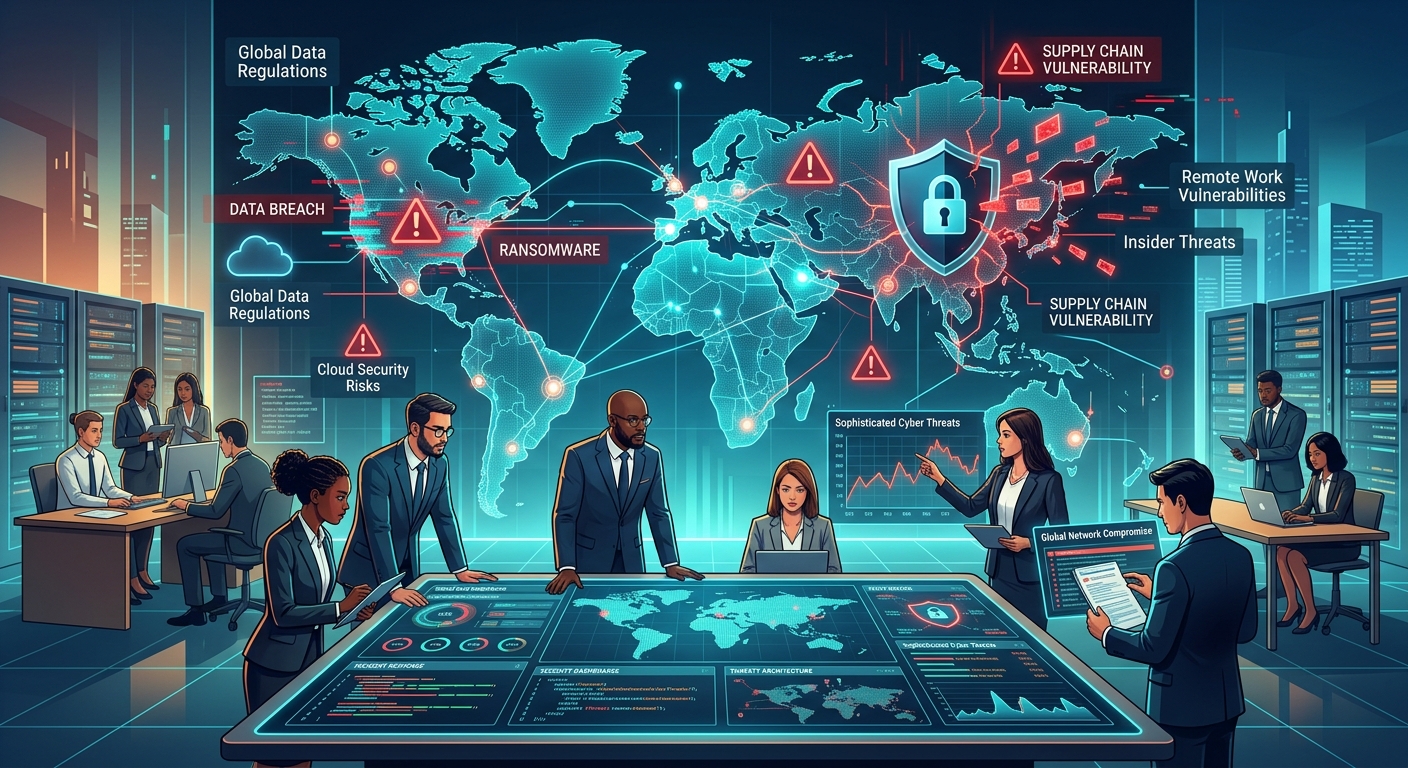
Cybersecurity challenges for businesses have intensified as threat actors become more sophisticated and attack vectors multiply. Organizations face ransomware attacks, supply chain vulnerabilities, insider threats, and compliance pressures simultaneously. Successful defense requires layered security controls, employee training, incident response planning, and continuous monitoring. Companies that treat cybersecurity as a business priority rather than an IT problem position themselves to withstand modern threats while maintaining customer confidence and operational continuity.
The evolving threat landscape facing modern organizations
Cybercriminals no longer operate as lone hackers in basements. They run sophisticated operations with business models, customer service departments, and affiliate programs. Ransomware-as-a-service platforms allow even inexperienced attackers to launch devastating campaigns against businesses of any size.
The shift to cloud infrastructure and remote work created new vulnerabilities. Employees access corporate systems from home networks, coffee shops, and airports. Each connection point represents a potential entry for attackers. Traditional perimeter security models that assumed a trusted internal network no longer apply.
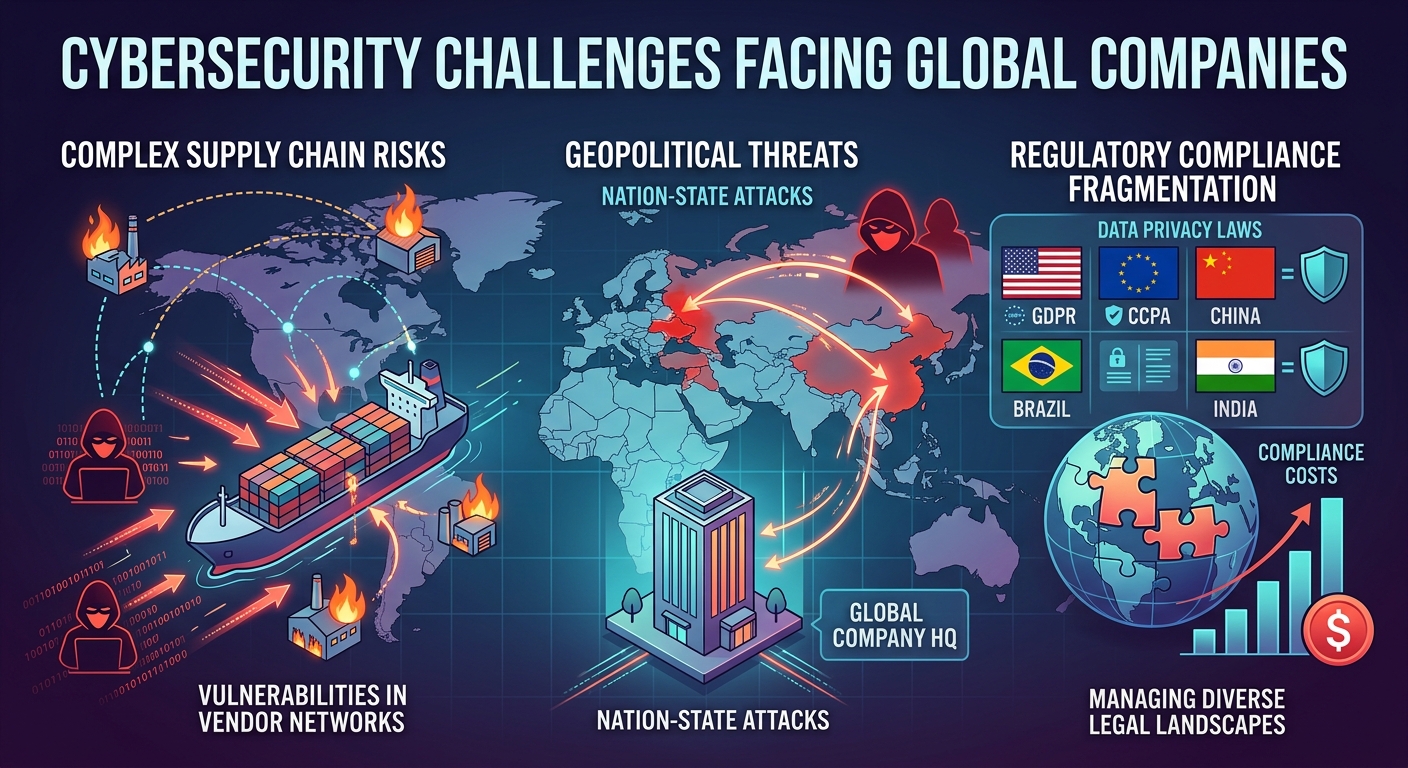
State-sponsored actors add another layer of complexity. These groups possess advanced capabilities and often target intellectual property, trade secrets, and strategic business information. Unlike financially motivated criminals, state actors may maintain persistent access for months or years before detection.
Third-party vendors and supply chain partners introduce risks beyond your direct control. The compromise of a single software provider can affect thousands of downstream customers. Recent high-profile attacks demonstrated how attackers exploit trusted relationships to breach otherwise secure organizations.
Common attack vectors threatening business operations
Phishing remains the most successful initial access method. Attackers craft convincing emails that appear to come from colleagues, vendors, or business partners. These messages trick employees into revealing credentials or downloading malware. Training helps, but human error remains inevitable.
Ransomware attacks have evolved beyond simple file encryption. Modern variants exfiltrate sensitive data before encrypting systems, creating dual extortion scenarios. Attackers threaten to publish stolen information even if victims pay the ransom. Some groups now target backup systems specifically to eliminate recovery options.
Credential theft through various methods gives attackers legitimate access to systems. Stolen passwords purchased on dark web marketplaces, credentials harvested through malware, and accounts compromised through password reuse all provide entry points. Multi-factor authentication significantly reduces this risk but adoption remains inconsistent.
Distributed denial of service attacks can cripple online operations. While less sophisticated than other threats, these attacks cause immediate business disruption. Attackers often use DDoS as a smokescreen while launching more serious intrusions elsewhere.
Insider threats come from current or former employees with legitimate access. Some act maliciously, stealing data for personal gain or revenge. Others cause damage through negligence or lack of security awareness. Both categories create substantial risk.
Critical vulnerabilities in business infrastructure
Unpatched software represents one of the most preventable yet persistent vulnerabilities. Organizations struggle to maintain current patch levels across diverse systems. Legacy applications that no longer receive security updates create permanent weak points in infrastructure.
Misconfigured cloud services expose sensitive data to the public internet. Default settings often prioritize convenience over security. Storage buckets, databases, and APIs accidentally left open have leaked billions of customer records. Cloud security requires specialized knowledge that many teams lack.
Shadow IT creates blind spots in security monitoring. Employees adopt unauthorized cloud services and applications to improve productivity. These systems operate outside IT oversight, often with inadequate security controls and no backup or recovery capabilities.
Inadequate network segmentation allows attackers to move laterally after initial compromise. If every system can communicate with every other system, a single compromised endpoint provides access to the entire environment. Proper segmentation limits blast radius and contains breaches.
Weak identity and access management practices grant excessive permissions. Users often retain access to systems they no longer need. Service accounts run with administrative privileges unnecessarily. The principle of least privilege remains more theoretical than practical in many organizations.
| Vulnerability Type | Business Impact | Remediation Difficulty |
|---|---|---|
| Unpatched systems | High | Medium |
| Cloud misconfigurations | Critical | Low |
| Shadow IT | Medium | High |
| Poor segmentation | High | High |
| Excessive permissions | Medium | Medium |
Regulatory and compliance pressures intensifying
Data protection regulations now exist in most major markets. GDPR in Europe, CCPA in California, and similar laws elsewhere impose strict requirements for handling personal information. Non-compliance results in substantial fines and legal liability.
Industry-specific regulations add additional layers of requirements. Healthcare organizations must comply with HIPAA. Financial institutions face PCI-DSS requirements for payment data. Each regulation demands specific controls, documentation, and reporting.
Breach notification laws require timely disclosure of security incidents. Organizations must notify affected individuals, regulators, and sometimes the public within tight timeframes. These requirements add urgency to incident response and increase reputational damage from breaches.
Cross-border data transfer restrictions complicate global operations. Moving personal data between jurisdictions requires specific legal mechanisms and safeguards. Cloud architectures must account for data residency requirements.
Regulatory expectations continue evolving faster than many organizations can adapt. New requirements emerge regularly, and enforcement agencies increasingly scrutinize cybersecurity practices. Boards and executives face personal liability for inadequate security governance.
The human element in security failures
Employee awareness varies dramatically across organizations. Some staff understand basic security hygiene while others struggle with fundamental concepts. Consistent training programs help but require ongoing investment and reinforcement.
Security fatigue reduces vigilance over time. Employees bombarded with warnings, alerts, and security requirements become desensitized. They develop workarounds to bypass controls perceived as obstacles to productivity.
Lack of security culture creates environments where risky behavior goes unchallenged. If leadership treats security as an IT problem rather than a business priority, employees follow that example. Culture change requires visible executive commitment.
Insufficient staffing leaves security teams overwhelmed. The cybersecurity talent shortage affects organizations of all sizes. Overworked analysts miss critical alerts, and important projects get delayed or abandoned.
Your security posture is only as strong as your least aware employee. Technical controls matter, but human judgment remains the ultimate defense against social engineering and targeted attacks. Invest in people as much as technology.
Building resilient security programs
Effective security requires layered defenses that assume individual controls will fail. No single technology or practice provides complete protection. Multiple overlapping controls create resilience even when attackers bypass specific safeguards.
A structured approach to security program development includes these essential steps:
- Conduct comprehensive risk assessments to identify critical assets and likely threats specific to your industry and business model.
- Implement baseline security controls across all systems including endpoint protection, network monitoring, and access management.
- Establish incident response procedures with clear roles, communication protocols, and recovery priorities before breaches occur.
- Deploy continuous monitoring to detect anomalous behavior and potential compromises in real time rather than discovering breaches months later.
- Test security controls regularly through penetration testing, tabletop exercises, and simulated phishing campaigns.
- Review and update security measures quarterly to address new threats and incorporate lessons from incidents.
Security architecture should separate critical systems and data from general corporate networks. High-value assets deserve additional protection layers. Not everything requires the same security level, and risk-based approaches allocate resources efficiently.
Automation reduces the burden on security teams while improving consistency. Automated patch management, security configuration enforcement, and threat detection tools handle routine tasks that humans perform inconsistently or too slowly.
Practical steps for immediate improvement
Most organizations can significantly improve security posture through straightforward measures that don’t require massive budgets or specialized expertise:
- Enable multi-factor authentication on all systems that support it, prioritizing email, VPN, and administrative access
- Implement regular automated backups stored offline or in immutable storage that ransomware cannot encrypt
- Establish clear policies for software installation, cloud service usage, and data handling that employees actually understand
- Deploy endpoint detection and response tools that provide visibility into suspicious activity across all devices
- Create an incident response plan with contact information, decision trees, and communication templates ready to use
- Conduct regular security awareness training using realistic scenarios relevant to your business rather than generic content
- Review user access quarterly and remove unnecessary permissions following job changes or departures
- Segment networks to isolate critical systems from general corporate environments and guest networks
These measures address the most common attack vectors and vulnerabilities. Perfect security remains impossible, but basic hygiene prevents the majority of successful attacks targeting businesses today.
Vendor security assessments deserve careful attention. Before granting third parties access to your systems or data, evaluate their security practices. Request evidence of controls, review audit reports, and include security requirements in contracts.
Resource allocation and budget considerations
Security spending should align with business risk rather than arbitrary percentages of IT budgets. Organizations with valuable intellectual property or extensive customer data require different investment levels than those with lower risk profiles.
Cost-benefit analysis for security investments differs from other business decisions. You’re purchasing risk reduction rather than direct revenue generation. Quantifying potential breach costs helps justify security spending to financial stakeholders.
Managed security services provide capabilities that smaller organizations cannot maintain in-house. Outsourcing threat monitoring, incident response, or security operations can deliver better outcomes than understaffed internal teams.
Cyber insurance transfers some financial risk but doesn’t eliminate the need for strong security controls. Insurers increasingly scrutinize security practices before providing coverage. Premiums reflect your security posture, creating financial incentives for improvement.
Preparing for inevitable incidents
Assuming breach rather than hoping to prevent all attacks creates realistic expectations. Despite best efforts, determined attackers eventually succeed. Preparation determines whether incidents become minor disruptions or existential crises.
Incident response plans should address these critical elements:
- Detection procedures that identify compromises through monitoring alerts, user reports, or anomalous behavior
- Containment strategies that isolate affected systems without destroying forensic evidence
- Investigation protocols that determine attack scope, entry points, and data exposure
- Communication templates for notifying executives, customers, regulators, and law enforcement as required
- Recovery procedures that restore operations from clean backups while ensuring attackers cannot regain access
- Post-incident reviews that identify security gaps and process improvements
Regular testing reveals gaps in plans that look comprehensive on paper. Tabletop exercises walk teams through scenarios without actual systems impact. Full simulations test technical and organizational response under realistic conditions.
Legal counsel should review response plans before incidents occur. Attorney-client privilege protections and regulatory notification requirements vary by jurisdiction. Involving lawyers during active incidents often proves too late for optimal decisions.
Securing the future of your business
Cybersecurity challenges for businesses will intensify as technology adoption accelerates and threat actors become more capable. Organizations that treat security as a continuous process rather than a project position themselves to adapt as threats change.
The most successful security programs balance technical controls with organizational culture. Technology provides essential capabilities, but people make the decisions that determine whether businesses withstand attacks or become statistics in breach reports.
Start with the basics if your current security posture feels overwhelming. Enable multi-factor authentication today. Implement automated backups tomorrow. Build incrementally toward comprehensive programs rather than waiting for perfect solutions that never materialize.
Your customers, partners, and stakeholders increasingly expect robust security practices. Demonstrating commitment to protecting their data and maintaining operational resilience becomes a competitive advantage. The question isn’t whether to invest in cybersecurity, but how quickly you can implement effective protections before the next attack targets your organization.